The Math Behind the Merger: Why the States’ Case Against PSKY + WBD Is Winnable ($PSKY, $WBD)
The states aren’t arguing politics. They’re arguing about math.

Accrued Interest TLDR: Plenty of writers will cover the politics of the states’ lawsuit against the Paramount Skydance–Warner Bros. Discovery merger. Accrued Interest is the only newsletter that will break down the math behind the case — because math is exactly what the twelve state AGs built it on. Their complaint, filed July 13, is a pure Clayton Act case arguing the $110 billion deal is presumptively illegal in three separate markets: wide-release films, tentpole blockbusters, and basic cable. In each one, the HHI concentration score jumps well past the threshold where the law presumes a merger is anticompetitive — and the states only need one of the three to hold. Add a newly assigned judge with deep labor-and-antitrust roots and a complaint that pre-dismembers the “we promise to release 30 films” defense, and this deal is in far more danger than most realize.
One quick reminder: Accrued Interest goes paid 1 week from today, Wednesday, July 22. Pledge your subscription now, the first 100 pledges lock in $199/year ($16.58/month), forever, before the price goes up on July 23rd.

Introduction: Everyone Is Reading the Wrong Case
If you have been following my coverage here on Accrued Interest, you know I have been skeptical of this merger since before it was even official. Back in December, on Day 2 of Pitch-Mas (Why Paramount Skydance Won’t Win Warner Bros.), I pitched PSKY as an Underperform and warned that a horizontal combination of two of Hollywood’s five major studios would “invite horizontal antitrust scrutiny concerning theatrical market concentration.” In March, in Dead on Arrival: 8 Reasons the Paramount-WBD Merger Will Fail, reason #8 I gave was that the deal was a “regulatory and political time bomb”.
On July 13, a coalition of twelve states — California, Arizona, Colorado, Connecticut, Massachusetts, Minnesota, Nevada, New Jersey, New Mexico, New York, Oregon, and Washington — led by California Attorney General Rob Bonta, filed suit in the Northern District of California to permanently enjoin the $110 billion merger (State of California et al. v. Paramount Skydance Corp. and Warner Bros. Discovery, Inc., Case No. 4:26-cv-7116).
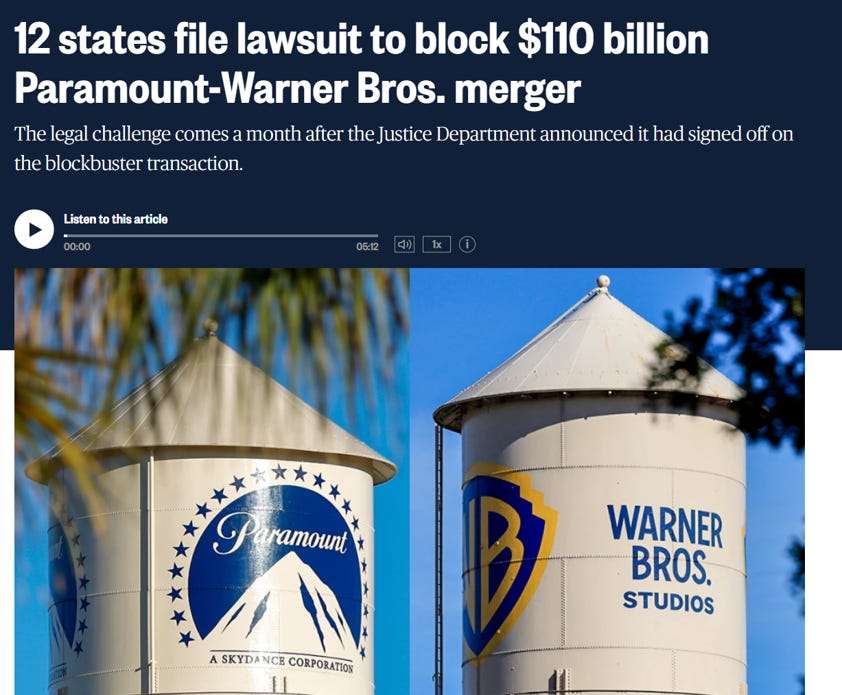
Let me say upfront - the first surprise to me is that the case mostly stays clear of the most political arguments. The states built their case without leaning on any of the politically charged angles everyone expected, such as the foreign investors, news consolidation, or editorial independence.
Instead, the states built a boring, but disciplined, case around Section 7 of the Clayton Act, which relies on market concentration math.
This is a deliberate strategic choice, and I think it is the correct one. The plaintiffs are stripping away every distraction Paramount’s lawyers would love to litigate and forcing them onto the one battlefield where the government historically wins: the structural presumption.
There have been many summaries of the case in the last 48 hours you can read. But at Accrued Interest, I always aim to be original, so this will be one of the few recaps you find on the internet that actually explains the MATH behind the case.
Remember when you were in ninth grade and thought to yourself, “When will I ever have to use the quadratic formula in real life”? Well today is your lucky day!
(Note - lock-in your subscription price today because mathematical deep-dives such as this are going behind a paywall come July 22nd)
The 30-Second Antitrust Math Lesson (Read This Part)
The Herfindahl-Hirschman Index (HHI) measures market concentration. You take every competitor’s market share, square it, and then add up the squares. For example, a pure monopoly scores 10,000 (100²). A market with five equal players at 20% each scores 2,000 (5 × 20²). Perfect competition approaches zero. Squaring the respective market shares makes big players count a lot more than small ones, which is exactly the point.
I want to cover two legal facts upfront. (I will put the page numbers from where I quote from the case so you can follow along. Let me know if you disagree.)
First, the Supreme Court presumption. As the complaint puts it:
“The Supreme Court has held that mergers that significantly increase concentration in a concentrated market are presumptively anticompetitive and therefore presumptively unlawful. United States v. Phila. Nat’l Bank, 374 U.S. 321, 363 (1963).” (Complaint, p. 19–20)
Once the plaintiffs establish the presumption, the burden shifts to the merging parties to rebut it. The government does not have to prove harm will happen because the structure is inherently harmful.
Second, we have the modern thresholds. Under the 2023 FTC/DOJ Merger Guidelines — which the complaint notes courts have repeatedly endorsed, citing Kroger, IQVIA, Tapestry, and, notably, this April’s Nexstar-Tegna decision out of the Eastern District of California:
“Mergers that increase the HHI by more than 100 and result in an HHI above 1,800 in any relevant market are presumed to be anticompetitive.” (Complaint, p. 20)
Section 7 of the Clayton Act prohibits any merger whose effect “may be substantially to lessen competition” in “any line of commerce” (15 U.S.C. § 18).
“A merger need only harm competition in one market to be condemned as unlawful and enjoined.” (p. 20)
Below I made a table of the HHI numbers cited in the filing to make it easier to follow. The case is focusing on three markets.

Now let me walk you through the arguments for each of the three.
Argument 1: Wide-Release Theatrical Films — 3.6x Over the Legal Limit
The complaint’s first market is the distribution of wide-release theatrical films in the United States. These are movies intended for broad initial theatrical exhibition, as opposed to limited releases or straight-to-streaming titles. The industry convention (used by Nielsen, IMDb, and the box office trackers) is a film released in at least 600 theatres during its first run. The states even disclose their methodology in the footnotes on pg. 20: shares are calculated on box office revenue for films released in 600+ theatres within the first four weekends, over calendar years 2022–2025.
And before you say this market definition is “arbitrary”, note that wide-release films accounted for 98 percent of all box office revenue over the past four years. In other words, they are the entirety of the theatrical business.
Plaintiffs claim the merger increases the HHI of the wide-release market by 359 points, to 2,074.
“In the market for the distribution of wide-release theatrical films in the United States, the proposed merger would increase the HHI by 359 and result in an HHI of 2,074. This increase in concentration is more than three times that required to create a presumption of illegality. After the merger, the combined company will possess a share of this market exceeding 27 percent.” (Complaint, p. 20)
Now, let me show you how using ninth grade algebra, you can take the case numbers and back into the market shares for the companies.
When two firms with shares a and b merge, the HHI increases by exactly 2×a×b (that’s what happens when (a+b)² replaces a² + b²).
So we know two things: a + b ≈ 27, and 2ab = 359.
Solve the quadratic and you back into implied standalone shares of roughly 15% and 12% for the two companies. (Sanity check: 2 × 15 × 12 = 360 ≈ 359.)
Post-merger, PSKY + WBD would take home more than 27 cents of every wide-release box office dollar in America. Using real numbers for context, the 2025 domestic box office was over $8 billion, so that’s roughly $2.2 billion flowing through a single distributor.
And it gets worse. Going forward, only three distributors would control 75% of wide-release films, and only four (PSKY+WBD, Disney, Universal, and Sony) would control 86% (Complaint, p. 13).
Concentration among distributors matters immensely because movie theatres are not NORMAL customers in the way you or I purchase another discretionary good. They are counterparties in a continuous, multi-dimensional negotiation.
Studios and theatres bargain over EVERYTHING. From box office revenue splits, minimum ticket prices, limits on discounts, screen allocation, exclusivity windows and more.
A theatre’s only leverage in that negotiation is the ability to give their screens over to a competitor’s film.
The complaint makes this very clear:
“The merger will end this competition. As a result, theatres will likely face worse revenue splits, higher minimum ticket prices, less flexibility to discount and offer complimentary tickets, and less freedom to allocate screens to the most in-demand films.” (Complaint, p. 22)
And squeezed theatres do not eat those costs, they will pass them along to consumers:
“With film distributors siphoning a greater portion of box office revenue, theatres will likely be forced to raise the price for a trip to the theatre and slash investments in the viewer experience (e.g., less investment in larger screens, luxury seating, concessions).” (Complaint, p. 4)
There is a genuine irony here that the complaint is smart to surface: the theatrical industry is finally experiencing several years of healthy growth. Domestic box office topped $8 billion last year, and 2026 is projected to reach $10 billion, making this the best year since 2019. The states are saying that PSKY + WBD is not about saving a dying industry. They are arguing that the industry is about to have its recovery taxed by a more concentrated oligopoly.
The lawsuit argues that a decrease in film output is not just likely, but inevitable.
Beyond pricing leverage, the complaint argues the merged company will make fewer movies, because a studio that owns both slates has no reason to release films against itself.
“The combined company will then avoid competitive pressure to release films into windows already occupied by its own titles, as doing so would ‘cannibalize’ its own sales.” (Complaint, p. 22)
Going from five major distributors to four makes tacit coordination dramatically easier, because release-date scheduling is publicly announced months or years in advance.
“A film distributor that unexpectedly moves an anticipated top-grossing theatrical film into a competitor’s release window is immediately visible to all market participants.” (p. 23)
Fewer players plus perfect transparency is the textbook recipe for market coordination.
Argument 2: The Tentpole Stranglehold — 88% of the Money, Two Companies, 60% Control

Within wide-release films, the states allege a second, narrower market: “anticipated top-grossing theatrical films”, these are what we commonly call blockbusters, event films, tentpoles.
What makes a tentpole is what happens before release: tentpoles have bigger budgets, major franchise IP or A-list talent, global marketing campaigns, and mandatory premium-format (IMAX, 4DX, ScreenX) placement (Complaint, p. 15). Warner Bros. literally sets an annual “tentpole” target separate from the rest of its slate. The $100 million figure comes in as validation of the screen-count proxy the states use to compute shares:
“Over the past four years, every film that has earned at least $100 million in box office revenue has been initially released in at least 3,000 theatres. These films accounted for 88 percent of box office revenue for films released over the past four years.” (Complaint, p. 16)
So the quantitative parameters are: 3,000+ screens at initial release, which captures every $100M+ grosser of the last four years.
I’m sure the defense will argue this is an arbitrary distinction, but I think it makes a lot of sense.
The Ninth Circuit blessed a market for “anticipated top-grossing motion pictures” in Syufy Enterprises v. American Multicinema back in 1986 (Complaint, p. 15), and a federal court used the same logic in 2022 to block Penguin Random House’s acquisition of Simon & Schuster with a market for “anticipated top-selling books.”
I think the concentration numbers look really bad for the defense when you do the HHI math for the tentpole market:
“In the market for distribution of anticipated top-grossing theatrical films in the United States, the proposed merger would increase the HHI by 445 and result in an HHI of 2,427.” (Complaint, p. 20)
That is a 445-point jump, nearly 4.5 times the 100-point threshold, getting to 2,427, which is already deep into “highly concentrated” territory.
The combined company’s share exceeds 30%, which (running the same algebra as before: a + b ≈ 30, 2ab = 445) implies standalone tentpole shares of roughly 17% and 13%. The top of the market becomes a de facto duopoly:
“Over the last four years, those five distributors [Defendants, Disney, Universal, and Sony] accounted for approximately 95 percent of all anticipated top-grossing theatrical films, as measured by box office revenue… This merger would reduce that number to four. Two distributors alone (Defendants and Disney) would control approximately 60 percent of this market.” (Complaint, p. 4)
Two companies = 60 percent of all blockbusters.
Four companies = 93 percent (p. 16).
The economic logic behind why tentpoles carry the entire movie industry:
Between 2022 and 2025, films released on 3,000+ screens were just 15% of releases by title count but generated 88% of total domestic box office revenue (Complaint, p. 16). Do the math, the average tentpole generates roughly 40 times the box office of the average non-tentpole release (88/15 versus 12/85, per title). A theatre chain can survive a few bad indie dramas. It cannot survive losing access to the films that produce nearly nine of every ten dollars it collects.
That is why the complaint focuses on tentpoles as essential, and why the negotiating dynamics are so lopsided. Tentpoles already command higher revenue splits, mandatory premium-screen placement, and longer guaranteed booking periods than ordinary releases (p. 15). Giving 60% of that leverage to two companies will lead to higher prices for consumers.
(E.g., Watch that $9 popcorn bucket head to $11!)
Remember, Section 7 only requires you prove one market is too concentrated. I think we just made the case for two. Now let me explain the third.
Argument 3: Basic Cable and the 50-Channel Blackout Nuke

The third market is the licensing of basic cable channels to distributors in the United States. These are the scheduled, linear channels (CNN, TNT, TBS, Nickelodeon, MTV, HGTV, Comedy Central, Cartoon Network) that cable, satellite, and internet-TV distributors (think Comcast, Charter, DirecTV, YouTube TV) license from programmers via monthly per-subscriber affiliate fees, and bundle into the packages they sell to households.
The complaint is careful to wall this market off from the most likely rebuttals from the defense: premium channels (HBO, Starz) are add-ons, not substitutes; broadcast networks operate under an entirely different retransmission-consent regime; regional sports networks are geographically limited; and streaming services don’t sell linear feeds to distributors at all (p. 17–18).
A distributor assembling a channel lineup cannot substitute any of the above for basic cable.
Now, the math coming up next is based on total 2025 affiliate fees as reported by S&P Global.
“In the market for the licensing of basic cable channels in the United States, the proposed merger would increase the HHI by 321 and result in an HHI of 2,007.” (Complaint, p. 21)
A 321-point increase, 3.2x the threshold, to 2,007. The combined company’s share exceeds 27% of affiliate fees. Measured by viewership, the share is even higher, at 34%. The states gave the court two independent measurement approaches that both clear the bar.
The same 2ab algebra implies standalone shares of very roughly 18% and 9%, consistent with the complaint’s description of Warner Bros. and Paramount as the nation’s second- and third-largest owners of basic cable channels (p. 24).
“It combines two of the five major owners of basic cable channels, leaving only two (the combined company and Disney) to control 59 percent of all basic cable in the United States.” (Complaint, p. 2)
The lawsuit alleges PSKY + WBD could use channel blackout as a nuclear option in negotiations.
Carriage negotiations between programmers and distributors are a recurring game of chicken, and the programmer’s ultimate weapon is the blackout: pull your channels off the platform until the distributor caves. What keeps programmers humble is that distributors can replace said channels with other networks.
“If a distributor refuses to cave to onerous demands from Paramount, for example, Paramount can withhold its basic cable channels from distribution… The existence of alternative sources of basic cable, like Warner Bros., enables the distributor to stand up to the threat of this blackout.” (Complaint, p. 3)
Post-merger, this alternative is gone. The combined company would control more than 50 basic cable channels spanning every genre — news (CNN), kids (Nickelodeon, Cartoon Network), lifestyle (HGTV, Food Network), general entertainment (TBS, MTV, Comedy Central), plus rights to March Madness and MLB games.
No other programmer would have anything close to that breadth:
“The combined company’s essential basic cable content would confer enormous bargaining power. Few distributors could withstand the threat of a blackout of Defendants’ more than 50 basic cable channels, leaving them little choice but to accept onerous terms.” (Complaint, p. 5)
And the states smartly preempt the “blackouts are just theoretical brinkmanship” rebuttal with recent history: Disney actually went dark on Charter in 2023, and pulled everything — ESPN, ABC, FX, the works — off YouTube TV for two weeks in 2025 (p. 24). Blackouts happen. The only question is who has the leverage when they do, and 50+ channels of leverage concentrated in one negotiation is a fundamentally different weapon than two separate 25-channel negotiations. The endgame is spelled out on page 25: distributors “would likely be forced to accept higher fees… Those higher fees will likely be passed on to their subscribers in the form of higher monthly bills.”
Regular readers know I have argued that in the streaming era (See Dead on Arrival) I wrote that tech-driven distributors like YouTube TV increasingly hold the leverage and that “the threat of a blackout is no longer the weapon it once was”. I still believe that is directionally true over a five-to-ten-year horizon; linear cable remains a melting ice cube, and no merger changes that.
But two things can be true at once. Cable can be secularly dying and someone with a 50-channel portfolio can extract materially worse terms from distributors as the industry shrinks.
The complaint anticipates exactly this - saying the combined company will hike fees while simultaneously cutting content investment (p. 25), because the bundling leverage protects its carriage even as quality degrades.
That is the melting-ice-cube playbook in a nutshell; in order to harvest a declining market, companies must squeeze distributors harder every renewal.
Antitrust law does not ask whether a market is growing; it asks whether the merger substantially lessens competition within it. A dying market can still be an illegal monopoly. The judge does not have to choose one story.
Argument 4: The Courtroom Reality — Judge Pitts and the “Voluntary Remedies” Trap

The first three arguments are about the case on paper. This one is about where the paper landed.
Judge P. Casey Pitts is a favorable draw for the plaintiffs — with one important caveat.
The case has been assigned to the Hon. P. Casey Pitts, a Biden appointee confirmed in 2023. Three facts from his record stand out:
First, he spent his pre-bench career on the labor side of the table. Pitts spent fourteen years at Altshuler Berzon LLP in San Francisco, the premier union-side and public-interest firm, and personally defended the Writers Guild of America against antitrust claims brought by the Hollywood talent agencies. Now go re-read the complaint, which argues the merger threatens “the livelihoods of tens of thousands of workers across the production ecosystem — the writers, actors, directors, crews, and craftspeople who make this content” (p. 28). The states’ labor-harm theory should get a careful hearing from a judge who spent years litigating Hollywood labor economics himself.
Second, he has shown a willingness to let state AG coalitions fight mega-mergers. In the HPE-Juniper matter, after the DOJ cut an eleventh-hour settlement on the eve of trial, Judge Pitts granted twelve state attorneys general leave to intervene and challenge the settlement in November 2025. Based on that history, I doubt he waves the states out of court prematurely.
Third — and this cuts the other way, so let’s be honest about it — he is no rubber stamp for antitrust plaintiffs. In Sullivan v. Google (March 2024), Pitts dismissed an antitrust conspiracy claim against Apple and Google with prejudice because the plaintiffs failed to adequately plead antitrust injury. He demands economic rigor. The good news for the states is that this complaint is essentially 38 pages of disclosed, reproducible HHI methodology built on a Supreme Court presumption. The honest news is that how he ultimately weighs that economics is his call, not mine.
No judicial assignment decides a case. But if you are handicapping this deal, the draw did not help the defense.
In plain English: the plaintiffs are arguing that the defendants’ voluntary promises to behave cannot be trusted — and they brought receipts.
Everyone knows how this defense usually goes: the merging parties promise to behave. And right on schedule, on March 22, 2026, PSKY/WBD executives publicly committed to release “at least 30 films annually” to calm regulators.
The states didn’t wait for that promise to be raised as a defense — they dedicated an entire section of the complaint (“Unenforceable Promises from Executives Cannot Be Credited”) to executing it in advance, with six separate reasons. The two that matter most:
“Defendants’ commitment, made under threat of antitrust investigation, does nothing to prevent the likely harms to competition… the commitment is not legally enforceable.” (Complaint, p. 29)
And then the receipts:
“Third, the commitment is not credible, given Defendants’ failure to keep prior commitments. In April 2023, Warner Bros.’ CEO publicly committed to create 16 theatrical films in 2023 and ‘more than 20’ in 2024. In the end, Warner Bros. released only 11 in 2023 and 9 in 2024.” (Complaint, p. 29)
Do the math on that one. Warner Bros. promised at least 36 films across two years and delivered 20 — a 44 percent shortfall on a public commitment made with no antitrust gun to its head, purely in the ordinary course of running the business. And now we are supposed to underwrite a promise of 30 films a year made specifically to escape an antitrust investigation, from a company that will have every economic incentive (and, per its fiduciary duties, arguably an obligation) to cut output the moment the ink dries? The complaint even notes the commitment does nothing for the cable market and would still permit them to degrade quality and raise prices on whatever 30 films they do make. You cannot fix a structural problem with a behavioral pinky-promise, and the states have made sure the court hears that before the defense even files its answer.
The Disney-Fox merger is the best real-world evidence of what a deal like this does to film output — a comparison longtime readers know I first made back in September in Same Script, Different Cast.
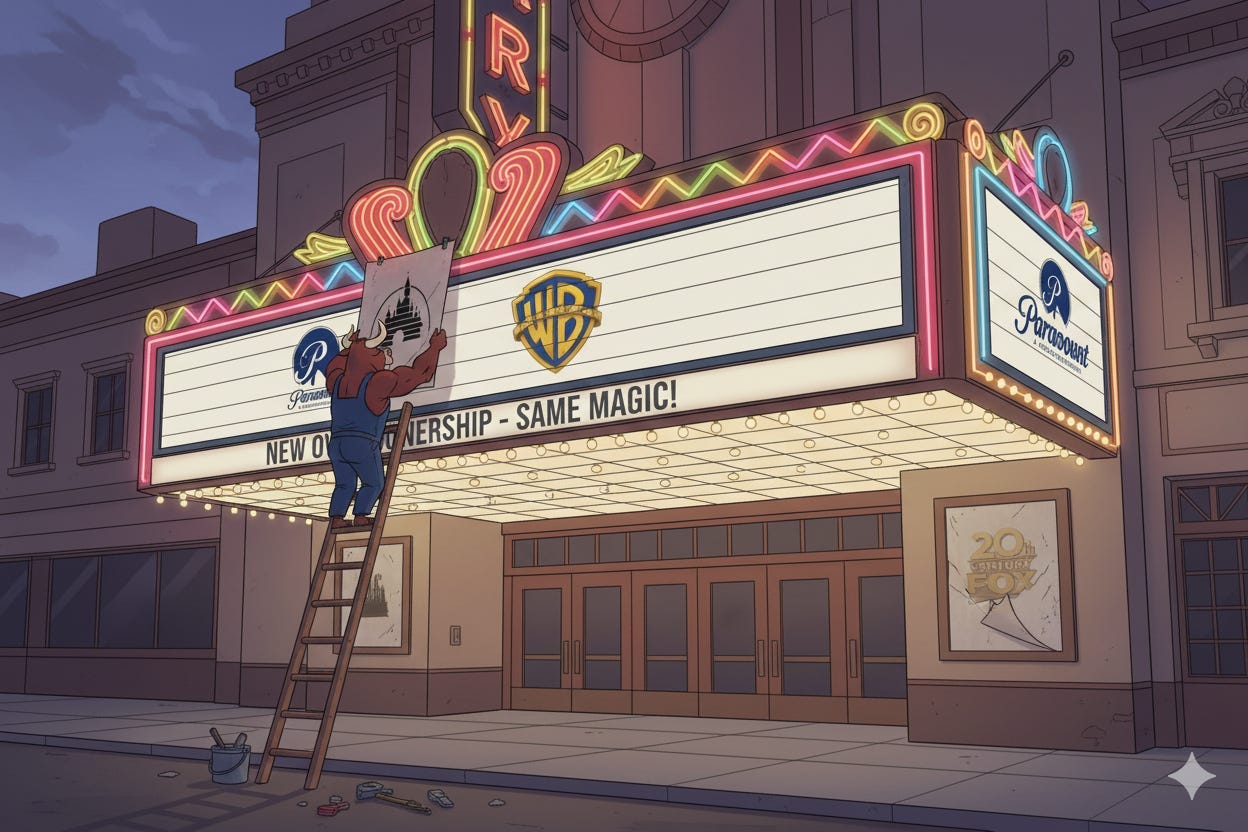
The states’ single most devastating piece of evidence is not a projection or a model. It is history. The complaint introduces the Disney-Fox precedent with a line I genuinely wish I had written: “Audiences have seen this movie before.” (p. 22)
In 2019, Disney acquired 20th Century Fox — then one of six major distributors, taking the industry to five, exactly the five-to-four move being proposed now. Fox had been releasing 12 to 17 films per year. On his first earnings call after closing, Disney’s then-CEO announced the Fox slate would be slashed by more than half, to “5 or 6 films a year,” and Disney’s CFO confirmed “a reduction in output.” Then they did it:
“True to its word, Disney cut the combined theatrical output of the merged company by more than half after the acquisition. From 2015 to 2018, the four-year period before Disney acquired Fox, the companies together distributed 112 wide-release theatrical films. From 2022 to 2025, the combined company distributed only 54 wide-release theatrical films.” (Complaint, p. 23)
112 films down to 54. And before anyone says “COVID”: the complaint pre-empts that too, noting the analysis excludes 2020–21 entirely, and that Disney/Fox output fell 52 percent while the other majors’ output fell only 13 percent over the same window. The industry-wide shock explains 13 points of decline. The merger explains the other 39. Oh, and Disney terminated more than 4,000 Fox employees after closing — a fact that will not be lost on the former WGA counsel reading this complaint.
As I wrote back in September, PSKY/WBD (2025) is essentially the sequel to Disney/Fox (2019) — same scale-and-IP rationale, same “compete with Netflix” pitch, same consolidation logic — and the Fox deal is now widely regarded as a disappointment, if not a failure, that Disney itself has strategically moved on from. The states have now taken that same-script comparison and turned it into Exhibit A, with subpoena power behind it. When your merger’s best historical comp is the deal that proved the plaintiffs’ theory of harm, you have a serious evidentiary problem.
Conclusion: The Plaintiffs’ Case Is Winnable — and That’s Not Priced In
Let me pull the threads together.
Three narrowly defined markets, each with a disclosed, reproducible methodology. Three HHI calculations that clear the presumptive-illegality thresholds by 3.2x, 3.6x, and 4.5x — when they only need one to hold. A market definition for tentpoles that the Ninth Circuit itself blessed forty years ago, filed in a Ninth Circuit courtroom. A pre-built demolition of the inevitable “we promise to release 30 films” defense, backed by the defendants’ own 44 percent shortfall on their last public output promise. A historical control case — Disney/Fox, 112 films to 54 — that maps onto this transaction almost one-to-one. And a judge whose résumé reads like it was reverse-engineered from the complaint’s table of contents: labor-side Hollywood antitrust experience, demonstrated willingness to let state coalitions fight mega-mergers, and a documented insistence on exactly the kind of economic rigor this filing delivers.
None of this guarantees the states win. Merger litigation is never a lock; the defense will attack the market definitions, argue streaming discipline, and parade efficiency experts. The presumption can be rebutted in theory. But “in theory” is doing heavy lifting there — the structural presumption exists precisely so that defendants face an uphill battle once the math is against them, and here the math is emphatically against them, three times over.
My stance has been consistent since December, and I will restate it plainly: this deal is at materially greater risk than the market is pricing, because the case the government actually brought is stronger than the case investors think was brought.
The states have the math, the precedent, and quite possibly the judge to stop the cameras from rolling for Paramount.
Relevant tickers: CMCSA 0.00%↑, PSKY 0.00%↑, WBD 0.00%↑, FOX 0.00%↑, NFLX 0.00%↑, ROKU 0.00%↑
— Accrued Interest
Disclaimer: The information presented in this Substack is for educational purposes and should not be construed as investment advice. Investors should make their own decisions regarding the prospects of any company discussed here, as I am not a registered investment advisor.
You can always reach me at simeon@accruedint.com.