
Dead on Arrival: 8 Reasons the Paramount-WBD Merger Will Fail
From a crushing $79 billion debt anchor to a massive culture clash, here is why Hollywood’s newest mega-merger is doomed.

Accrued Interest TLDR: David Ellison won Paramount, but inheriting WBD is a Pyrrhic victory. Saddled with a crushing $79 billion debt anchor, this new Frankenstein media conglomerate is paralyzed, unable to match Big Tech’s spending power. This isn’t strategy; it’s financial engineering applied to a melting linear TV ice cube. From unpayable sports rights to an inevitable, explosive culture clash, the strategic headwinds are insurmountable. It’s not a question of if this merger fails, but when it must be restructured. Here are eight brutal reasons why this deal is destined for disaster.
Introduction
The merger of Paramount Skydance and Warner Bros. Discovery represents what is truly a Pyrrhic victory. Paramount Skydance is going to struggle to create value with their newfound prize.
Towards the end of my interview with Andrew Walker last week on the Yet Another Value Podcast, in the closing moments, he asked me what I thought were the odds that a combined Paramount and Warner Bros. Discovery, WBD 0.00%↑, would be a success. I said emphatically, without hesitation, a negative 10. By that, I mean it is a question of “when”, not “if”, the company is going to have to be restructured and the assets likely separated yet again.
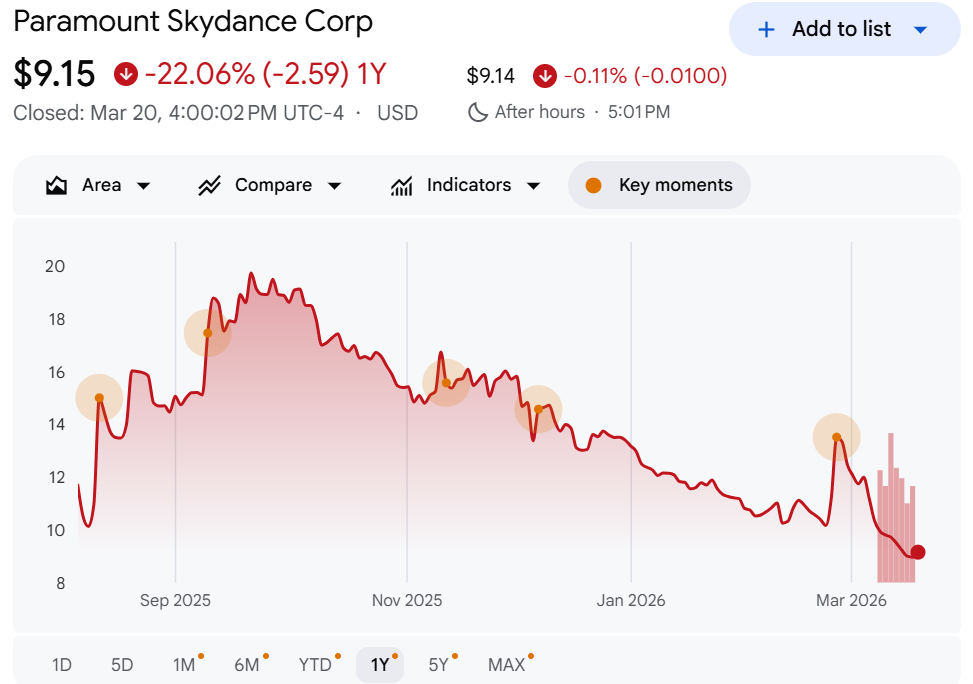
As I warned in my 12 Days of Pitch-Mas series (specifically Day 2, when I pitched PSKY 0.00%↑ as an Underperform), financial engineering is not a strategy. Ultimately, viewers dictate who wins. To put it bluntly: big picture, Paramount and Warner Brothers are starting off with a lot working against them. Last November, I wrote in my Paramount Skydance Q3-25 Review “David Ellison is a CEO who is 10 years too young, with a strategy that is 10 years too late to save Paramount shareholders from subpar returns, unless they can win WBD.” Now that the dust has settled on the merger, I can say confidently that winning WBD absolutely STILL lead to returns less than the S&P 500 over time.
Here are the 8 reasons the PSKY + WBD combination is destined to fail.
1. The $79 Billion Debt Anchor
Ellison is inheriting a crushing debt load he is completely unprepared for.
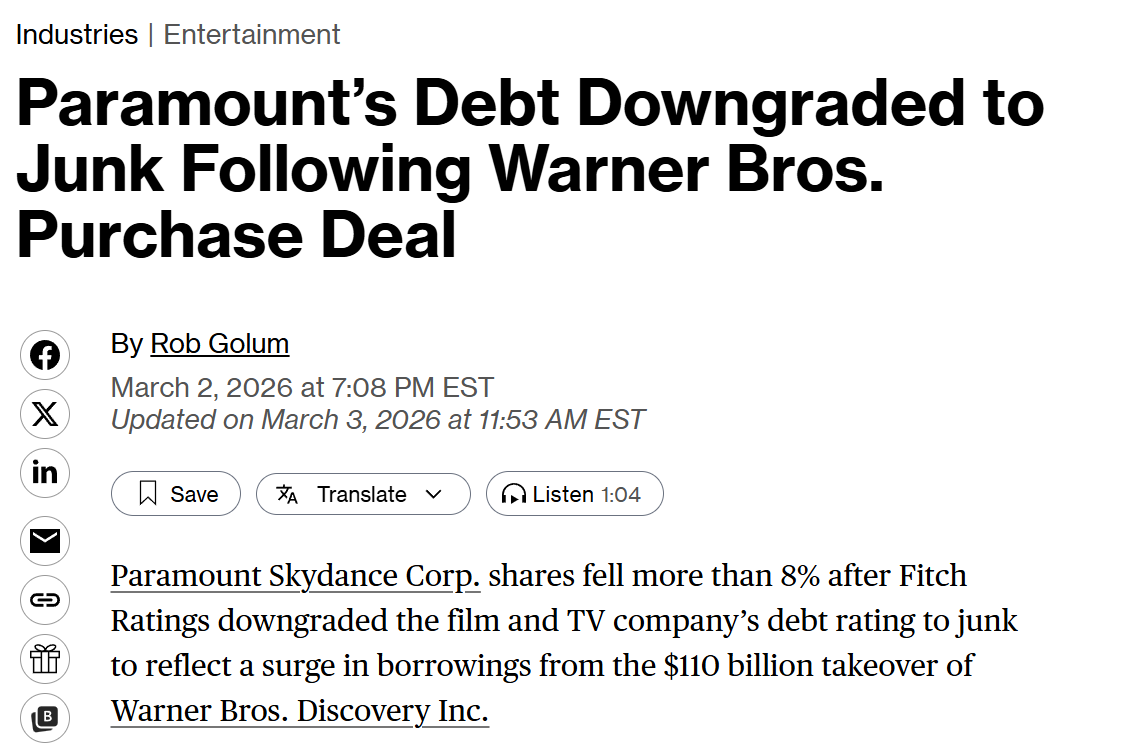
The $79 Billion Reality: Between WBD’s roughly $29 billion in debt, Paramount’s $12 billion, and $38 billion in new transaction debt, this new Frankenstein media conglomerate is staring down a $79 billion balance sheet nightmare.
The Innovation Penalty: In an era where Big Tech is investing tens of billions in AI and streaming platform infrastructure, this debt load entirely prevents PSKY + WBD from aggressively investing in the future.
Managing Liabilities Over Growth: Their free cash flow will be overwhelmingly diverted toward servicing interest payments rather than product development. Instead of funding the next major streaming innovation or user interface overhaul, cash will be funneled directly to bondholders.
Strategic Paralysis: When your balance sheet is this constrained, every creative swing becomes a “bet the company” moment. They simply do not have the financial elasticity to weather a string of box office or streaming failures.
2. Combining Two Melting Ice Cubes
Smashing two dying cable portfolios together does not reverse secular decline.

The False Security of Cable: I spent extensive time analyzing this dynamic in my recent deep dives on Versant, VSNT 0.00%↑ , pointing out the dangers of relying on the false security of legacy cable cash flows. Paramount and WBD are both heavily weighted toward linear cable networks. Combining MTV, Comedy Central, TNT, and Discovery just increases their collective exposure to a decaying ecosystem.
The Cable DNA Constraint: As I detailed in The Pokémon Theory of Media Investing, companies and their business models are inherently constrained by their original “type.” You cannot easily evolve an aquatic creature to survive in the desert.
Digital Incompatibility: Because their underlying DNA is built for a distribution model that is actively dying, a combined entity is still functionally a legacy television company. They are fundamentally unprepared to take on digital-native competitors.
3. Outgunned in the Sports Rights Bloodbath
PSKY + WBD cannot afford the blank checks Silicon Valley is writing for live sports.
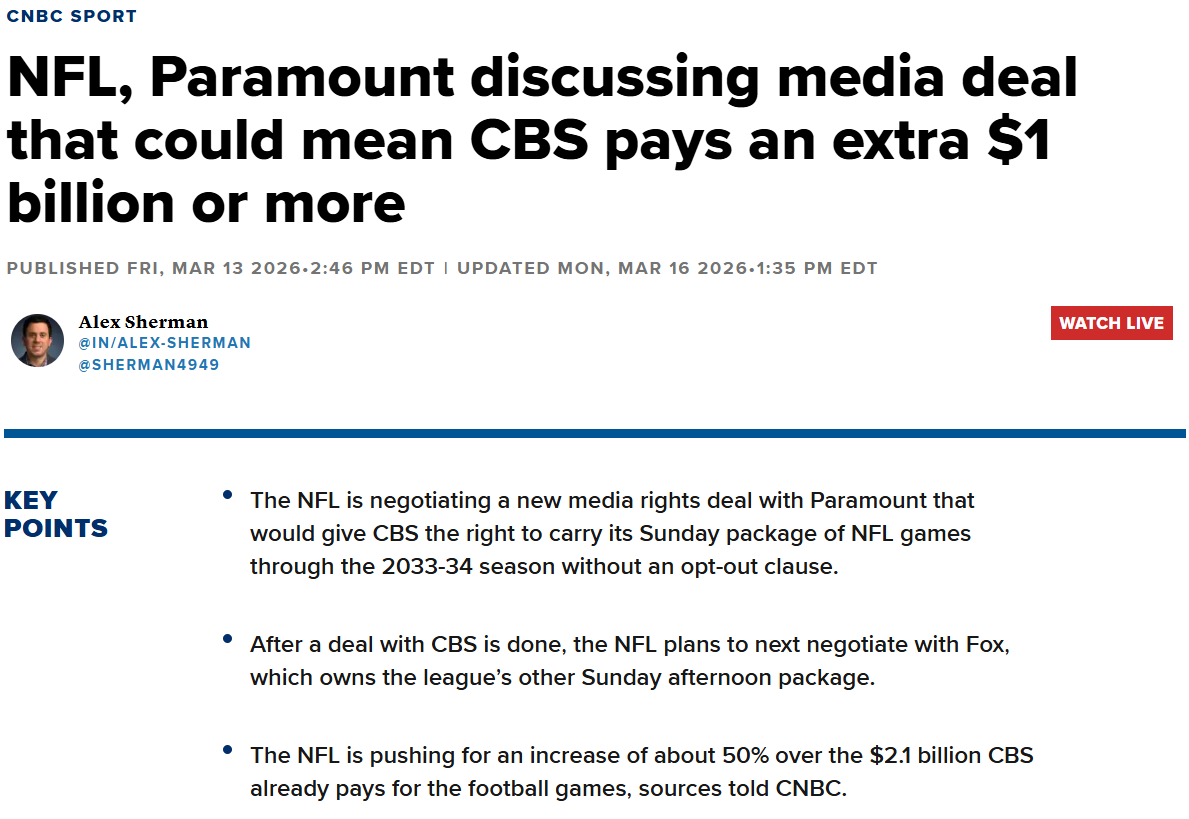
The Tech Giant Premium: Tier 1 sports rights (like the NFL and NBA) have become a playground for tech giants like Amazon and Google. Tech companies view sports rights as loss leaders for larger ecosystem lock-in. They can afford to overpay and treat sports as an acquisition cost.
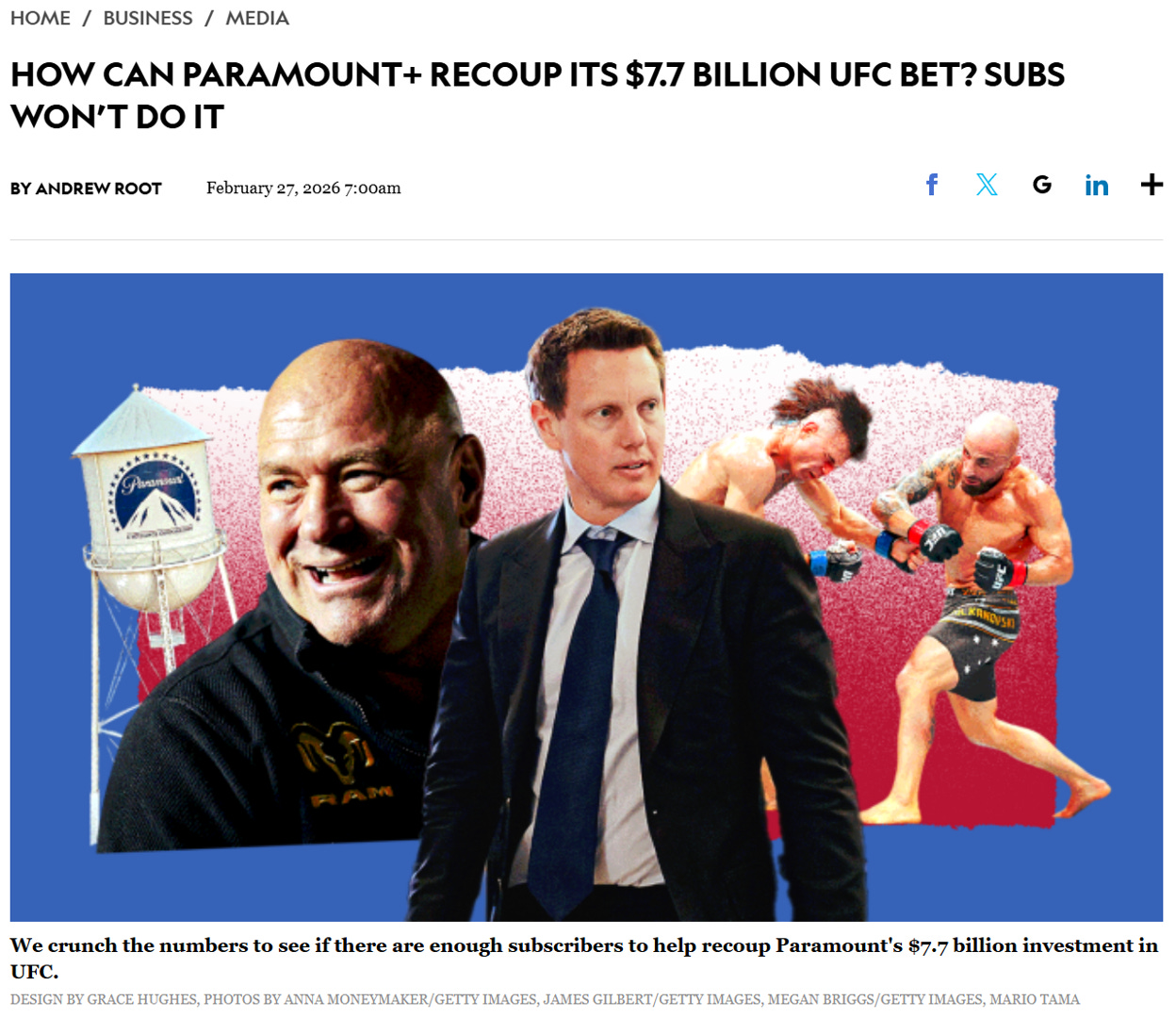
The Debt Ceiling: With a $79 billion debt load, PSKY + WBD simply cannot compete. A glaring example of this desperation is Paramount’s recent 7-year, $7.7 billion agreement for exclusive UFC media rights. At $1.1 billion annually, they are paying double what ESPN previously paid, while simultaneously abandoning the lucrative Pay-Per-View model entirely. They are grossly overpaying for sports rights just to maintain engagement on Paramount+.
The Domino Effect: Without premium live sports, their linear networks lose their “must-carry” status with major distributors. This accelerates carriage fee declines, which in turn accelerates cash flow deterioration.
4. The Content “Scale” Fallacy
Hoarding legacy content is meaningless without the technological scale to distribute it.
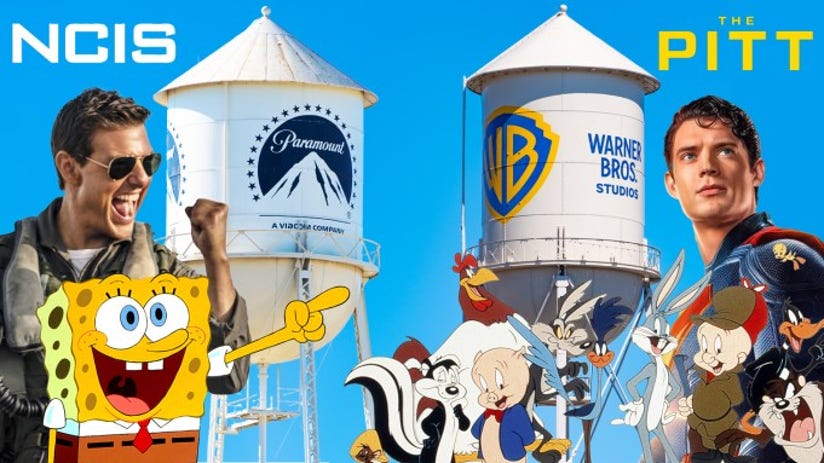
Tech Scale vs. Content Scale: True scale today is distribution and technological scale. Netflix and YouTube have global tech scale. PSKY + WBD merely has a bloated content vault.
The Interface Bottleneck: As I noted in The Pokémon Theory of Media Investing, the “gotta catch ‘em all” approach to hoarding content doesn’t work if your delivery mechanism and user interface are sub-par. If users cannot easily discover the content due to clunky algorithms, the sheer volume of the library is irrelevant.
Diminishing Returns on IP: Stacking more average shows onto a single platform does not exponentially increase pricing power. It just increases server and royalty costs without driving proportional subscriber growth.
5. The DTC Sub-Scale Trap
Combining two sub-scale streamers just creates a slightly larger service with massive subscriber overlap.
The High Churn Reality: Combining Max and Paramount+ does not magically create a dominant platform to rival Netflix or YouTube. It just creates a service with incredibly high churn rates as consumers rotate in and out for specific shows.
The Overlap Illusion: WBD finished Q4 2025 with 131.6 million Max subscribers, while Paramount+ reported 78.9 million paid subs. Management aggressively touts a combined footprint of over 210 million subscriptions.
Preaching to the Same Choir: However, third-party analytics from Forrester reveal a massive 30% overlap between the two platforms. Both skew toward a very similar demographic profile, meaning this merger does not unlock entirely new audience segments. They are simply double-counting the same households.
6. The Loss of Distribution Leverage
Tech-driven distributors like YouTube TV now hold the power, and they don’t need bloatware cable networks.
The Shifting Media Landscape: As I discussed extensively in my Interview: Yet Another Value Podcast and the Shifting Media Landscape, the balance of power has fundamentally shifted away from programmers to digital distributors.
MVPDs Don’t Care About Video: Paramount is bulking up on channels at exactly the time that traditional MVPDs and cable companies are giving up on the video product entirely. Cable providers are pivoting to become pure broadband pipes. They no longer care about video consumers; their priority is selling high-margin internet subscriptions.
The Rise of vMVPDs: Distributors like YouTube TV now hold the leverage over traditional networks. When a distribution platform generates massive ad revenue and structurally doesn’t need your tier-2 cable channels, the negotiation math flips entirely.
The Unbundling Threat: PSKY + WBD will quickly find that Virtual MVPDs will simply refuse to pay for their bloated portfolio of secondary, low-rated cable networks. The threat of a blackout is no longer the weapon it once was.
7. A Spectacular Culture Clash
You cannot merge a culture of ruthless austerity with one of Hollywood expansion without explosive friction.
The Inevitable Friction: The integration process will be bogged down by warring executive factions and fundamentally misaligned operational philosophies.
The Morale Cost of Synergy: Draconian layoffs are HORRIBLE for morale. When management promises Wall Street massive cost synergies, that inherently means dramatic headcount reductions.
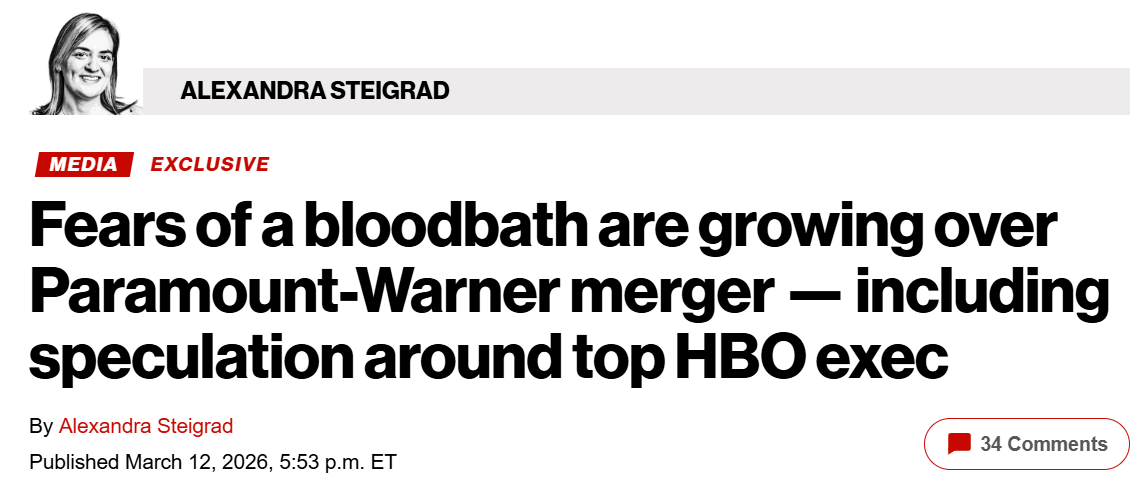
A Year of Paranoia: Over the next year, employees from all parts of both organizations are going to be fearing for their jobs. You cannot foster creative risk-taking or build a cohesive streaming strategy when your workforce is paralyzed by the threat of impending layoffs.
The Ellison Vision: As I highlighted in my Paramount Skydance Q3-25 Review, David Ellison’s rhetoric is heavily reliant on tech-forward ambitions and Hollywood-legacy Skydance dreams. He envisions a company that spends to innovate, which stands in stark contrast to the financial realities of their bloated balance sheet.
8. The Regulatory and Political Time Bomb
Foreign funding and news ownership create a massive vulnerability to future political shifts.
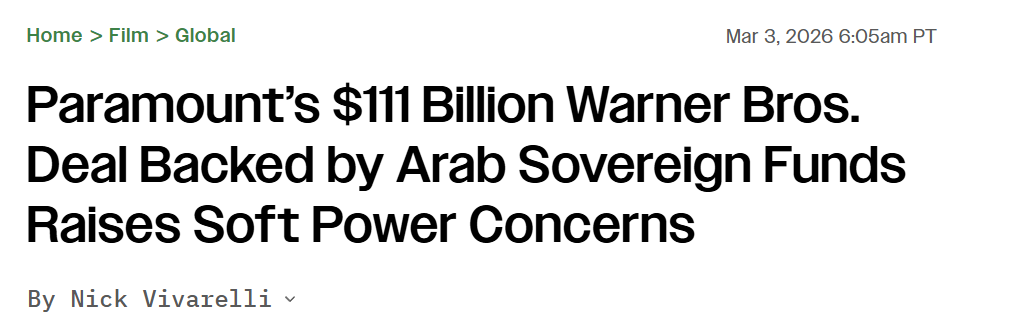
Foreign Funding Scrutiny: A significant amount of the funding for this transaction is coming from foreign sources, including sovereign wealth from Gulf countries.
News Ownership Concerns: Regulators and politicians across the spectrum are not going to be comfortable with foreign entities holding massive ownership stakes in vital American cultural and news institutions like CBS News and CNN.
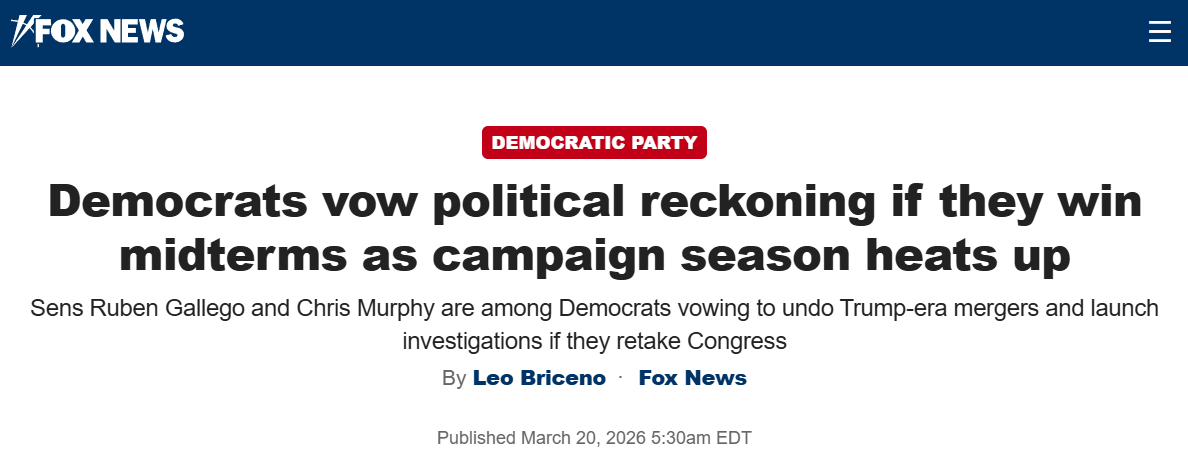
The Unpredictable 2028 Window: Politics isn’t final, and no party wins forever. Companies that play fast and loose with the regulatory approval process today might find their deals scrutinized—or partially undone—by a future administration in 2028 or 2029 if the political winds shift.
CONCLUSION
You will notice that I have not used many numbers in this piece; I just wanted to focus on the strategic aspects of this colossal merger. I will still be covering the upcoming Paramount earnings and will do more rigorous financial analysis to flesh out the math behind this thesis.
But strategically, looking at the big picture: Paramount and Warner Brothers are starting off with a massive amount of secular, structural, and financial headwinds working against them. Based on the fundamental history of media M&A, I am not optimistic about their future.
-Accrued Interest
Disclaimer: The information presented in this Substack is for educational purposes and should not be construed as investment advice. Investors should make their own decisions regarding the prospects of any company discussed here, as I am not a registered investment advisor.
You can always reach me at simeon@accruedint.com.
https://substack.com/@thedreydossier/note/c-247204685
Great piece. 3 quick ones:
1) do you think there is deal risk here? The arb spread is pretty wide for a fully funded deal with no outs, a ticking fee, and a supposedly friendly DOJ/FTC/FCC. I’m almost tempted…
2) do you think anyone but the Ellisons actually puts $ into this thing? Stock is 40%+ below their backstop price. They are taking a $20B hickey on day one, why would anyone follow?
3) on a related note, they backstopped this at $16 when the stock was at $12 - do they not know how math works? Any theories as to why they decided to issue B(!) shares to themselves at a premium?