Accrued Interest Weekly Cypher: Apr-26-26
Vol. 3 — 2026

Welcome to Volume 3 of the Accrued Interest Weekly Cypher! Consider this your “in-case-you-missed-it” digest for catching up over the weekend, featuring all the analysis and commentary I shared throughout the past week.
Let’s cue the record drop and get into this week’s cypher for the week ending April 26, 2026.
Before I dive in, a quick reminder: much of Accrued Interest’s investment content will soon be moving behind a paywall. Please subscribe today to ensure you don’t miss out on my ongoing TMT stock analysis, media industry commentary, and deep-dive financial breakdowns.
Comcast’s Accelerating Cord-Cutting is a Blinking Red Light for Legacy Media
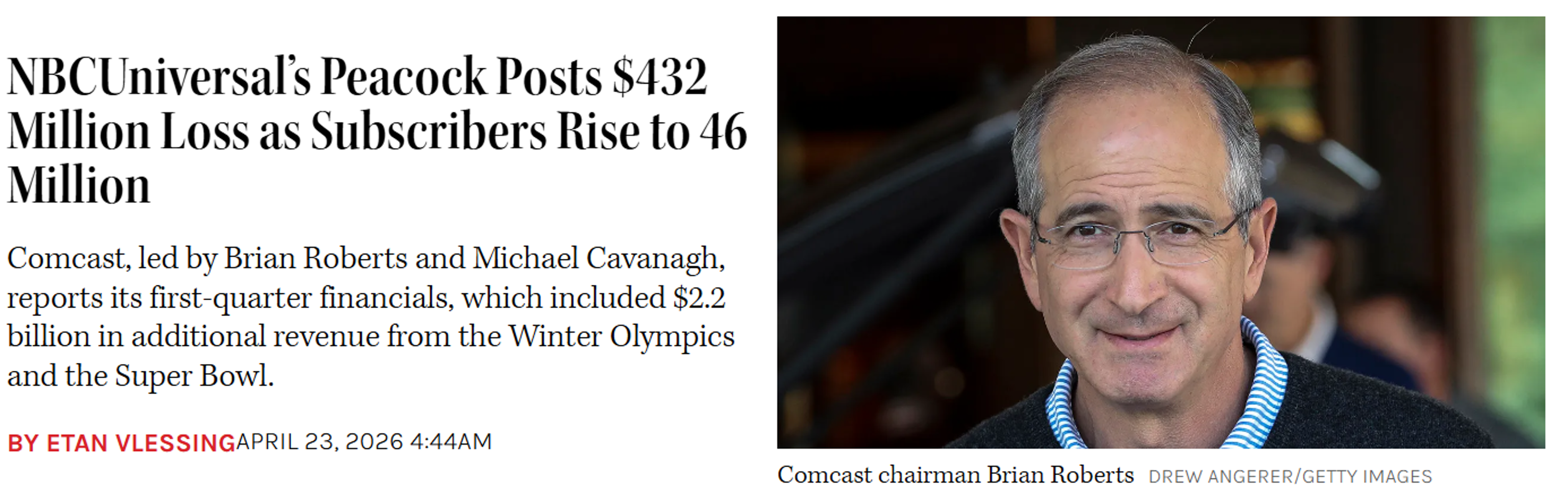
The Q1 2026 earnings report from Comcast confirmed that the ongoing loss of video subscribers has evolved from a lingering concern into a rapid, unyielding decline. Cord-cutting is accelerating far beyond investor expectations, with severe losses mounting on both an absolute and year-over-year basis.
CMCSA 0.00%↑ , DIS 0.00%↑, PSKY 0.00%↑, VSNT 0.00%↑, NXST 0.00%↑
YouTube is Cleaning House While SiriusXM Sells Its Lowest-Tier Inventory

Digiday reported that YouTube is partnering with SiriusXM to monetize the massive volume of background audio listening currently left on the table. SiriusXM is set to act as the sales arm, aggregating audio inventory across YouTube’s podcast ecosystem. The initiative aims to capture value from users who treat the platform as an audio-first service, enabling advertisers to target high-intent listeners during background consumption—a behavior YouTube previously struggled to monetize on its own.
GOOGL 0.00%↑, GOOG 0.00%↑, SIRI 0.00%↑
Adobe’s $25 Billion Buyback is Strategy Subbing in for Substance
Adobe’s board authorized a $25 billion share buyback program through 2030, a move that follows the massive $15 billion authorization from early 2024. This signals a desperate pivot toward “return of capital” weeks after longtime CEO Shantanu Narayen’s exit. It represents roughly 23% of Adobe’s current market cap (~$110B)—a clear attempt to stem the bleeding of a stock that is down 27% YTD.
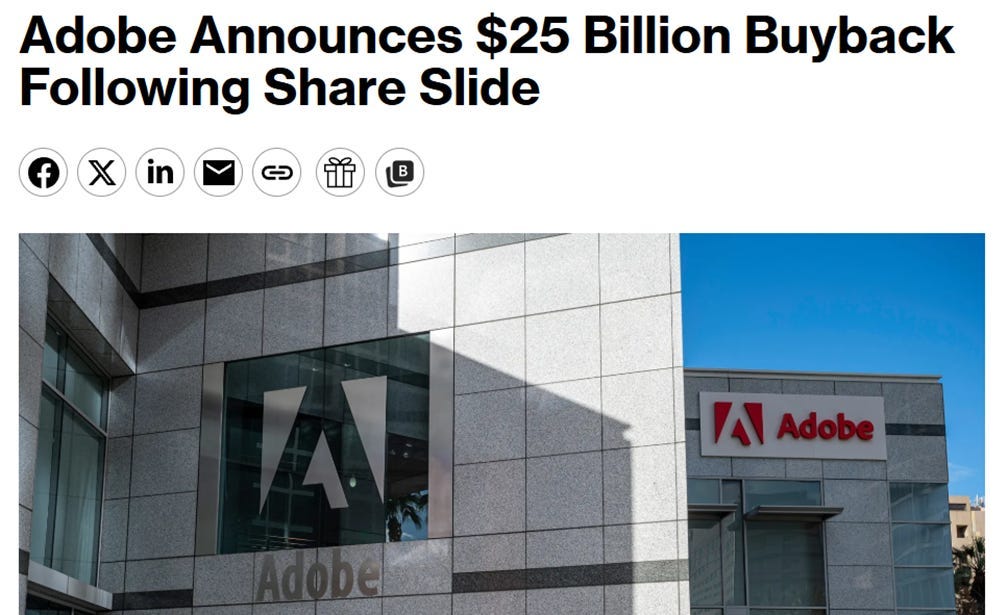
I am not as impressed by the buyback as some other value investors because I fundamentally believe that financial engineering is not a strategy. I do not have faith that Adobe can both spark organic growth (note that consensus revenue estimates are forecasting less than 10% YoY top-line growth between 2026 and the foreseeable future) and avoid being further disrupted by AI products.
For now, I am keeping Adobe in the “Too Hard” bucket. Avoid.
Zaslav’s Exit and the Warner Bros-Paramount Fiction
We need to talk about Variety’s latest deep dive: “Inside David Zaslav’s $500 Million Warner Bros Exit After Paramount Sale.“ The piece relies heavily on quotes from corporate insiders to paint a picture of a company that was magically on the mend before the Paramount-Skydance (PSKY) acquisition.

WBD had real, systemic problems—a crushing debt load, a melting cable business, and the fumble of the NBA rights. A change in ownership doesn’t magically fix a broken balance sheet. Now that the bidding war is over and Paramount actually owns this asset, they have to run it. Given the premium paid and the underlying rot at WBD, I am highly pessimistic that PSKY can create any actual shareholder value here. Do not be fooled by the attempts at revisionist history. Paramount-Warner Bros. is still poised to underperform the S&P 500 over the medium and long-term.
PSKY 0.00%↑ , WBD 0.00%↑ , DIS 0.00%↑ , NFLX 0.00%↑ , CMCSA 0.00%↑
AI Tracking Employee Keystrokes Validates Meta Bull Case

Reuters reporting reveals Meta is actively installing tracking software to capture U.S. employees’ keystrokes, mouse movements, and screen snapshots. While the mainstream press is framing this as a corporate surveillance or privacy story, they are missing the massive financial signal. This internal data collection is training Meta’s AI agents to automate white-collar workflows. It is the definitive proof that Meta intends to execute headcount reductions far deeper than the rumored 20% cut. Management is aggressively swapping human payroll for AI infrastructure, ensuring their massive CapEx spend translates directly into margin expansion. Let me explain why this is very bullish news for Meta.
A Melting Ice Cube on Trial: Breaking Down the Nexstar-TEGNA Injunction
If you have been following my coverage of the broadcast television sector, you know my ongoing bearish stance on Nexstar (NXST) and the broader broadcast M&A playbook. I have consistently warned that rolling up declining linear television assets with massive leverage is a flawed long-term strategy. Now, that strategy has hit a massive roadblock.

On Friday, April 17, 2026, the U.S. District Court for the Eastern District of California slammed the brakes on the $6.2 billion Nexstar-TEGNA megadeal by granting a preliminary injunction. In granting this injunction, the judge’s reasoning systematically exposes the structural flaws in the broadcast roll-up strategy. This ruling isn’t just a legal setback; it is a validation of the bear thesis that this industry is running out of runway.
Here are 5 key reasons why the antitrust risk in Nexstar is understated based on my read of the 52-page preliminary injunction…
The Mispriced Victor: Why I’m Reaffirming My $120 Netflix Target
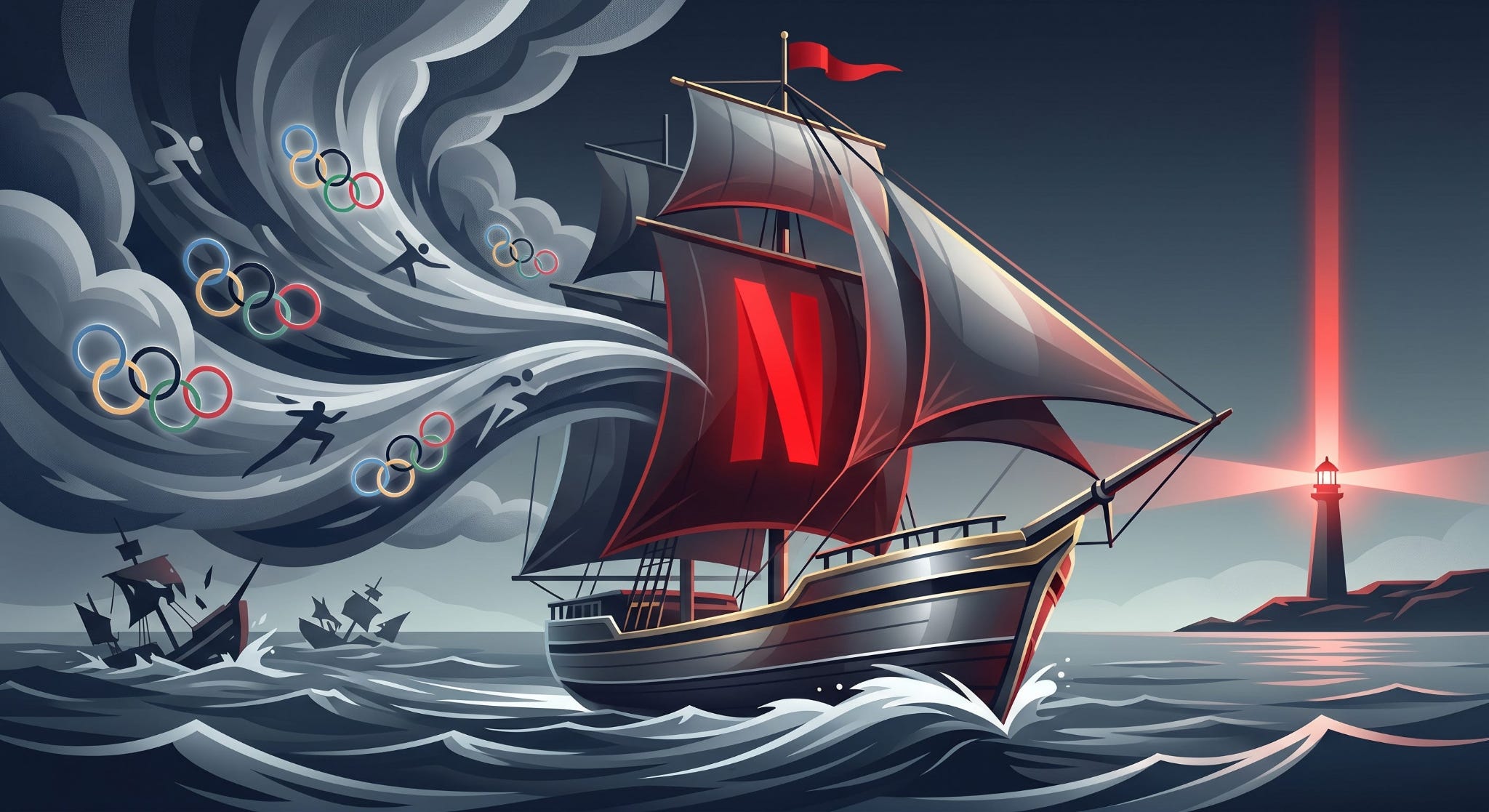
Netflix’s post-earnings -10% dip was a shortsighted mistake. While the Street panicked over “light” guidance, the fundamentals revealed strong pricing power: +16.2% YoY revenue growth achieved without a single tentpole release and despite wall-to-wall Winter Olympic competition. With 60% of sign-ups hitting the ad tier and an industry-low $0.48 cost-per-hour viewed, Netflix is effectively scaling the “unscalable.” From daytime share grabs via podcasts to programmatic ad growth, the undisputed victor of the streaming wars is just getting started. Subscribe to read my full Q1 2026 earnings breakdown.
Enjoy your Sunday. I look forward to more content this week!
-Accrued Interest
Disclaimer: The information presented in this Substack is for educational purposes and should not be construed as investment advice. Investors should make their own decisions regarding the prospects of any company discussed here, as I am not a registered investment advisor.