
Adobe’s Smoke Screen and the Warner Bros. Reality Check (Accrued Interest Update 4-22-26)
On the hollow promise of financial engineering and rewarding the $500 million failure of legacy media’s old guard.

Accrued Interest TLDR: Adobe is trying to mask a broken growth engine with a massive $25 billion buyback, but the math points straight to a value trap. Financial engineering won’t stop the AI threat. Meanwhile, Variety’s attempt to paint David Zaslav’s WBD tenure as a turnaround success is preposterous. He was bailed out by a bidding war, and the new owners are holding a very expensive bag.
Please subscribe to read the rest of the Accrued Interest Daily Update for April 22, 2026.
A) Adobe’s $25 Billion Buyback is Strategy Subbing in for Substance
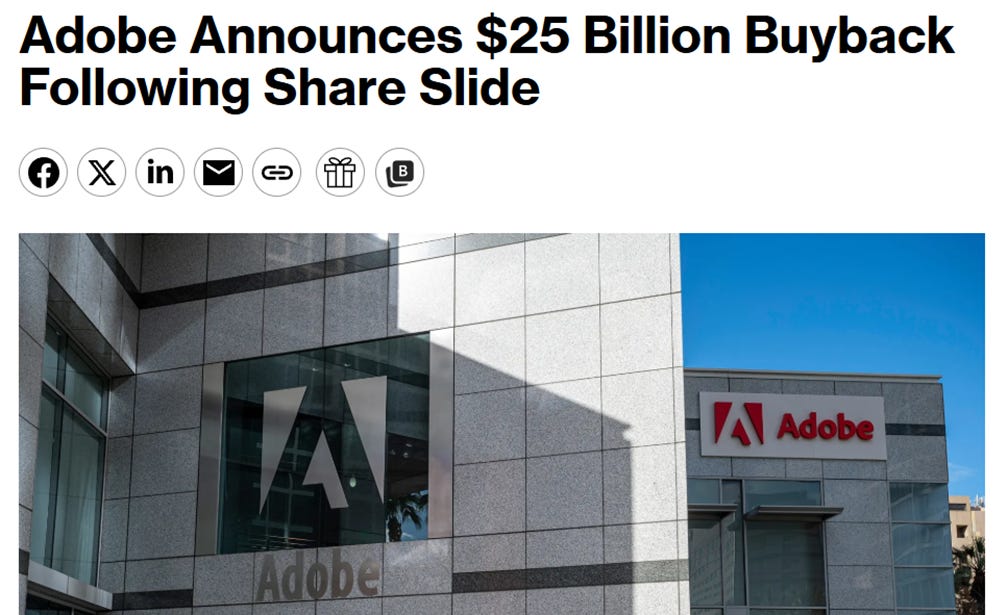
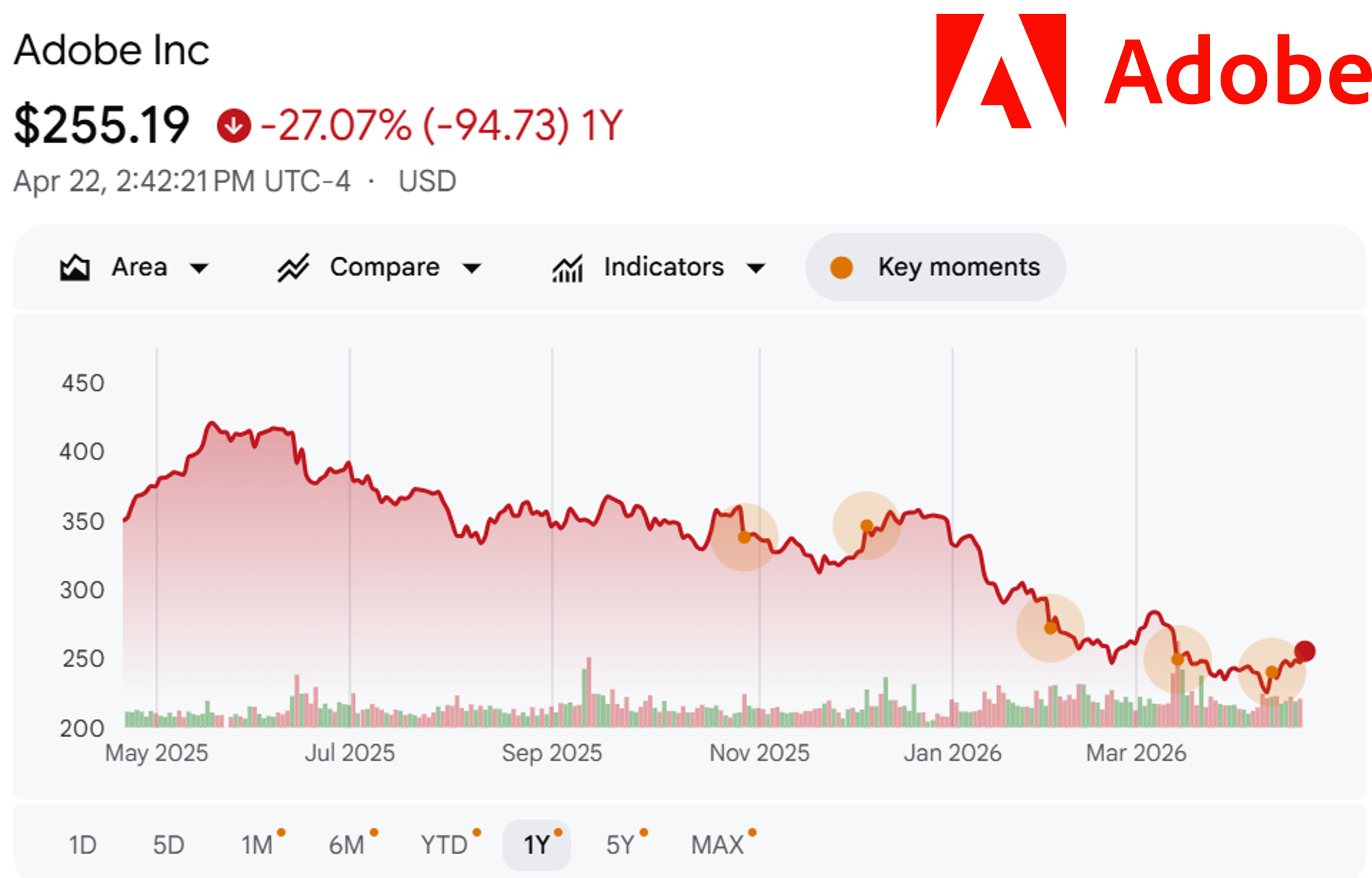
Adobe’s board just authorized a $25 billion share buyback program through 2030, a move that follows the massive $15 billion authorization from early 2024. This signals a desperate pivot toward “return of capital” just weeks after longtime CEO Shantanu Narayen’s exit. It represents roughly 23% of Adobe’s current market cap (~$110B)—a clear attempt to stem the bleeding of a stock that is down 27% YTD.
The “Agentic AI” Sales Pitch is a Distraction
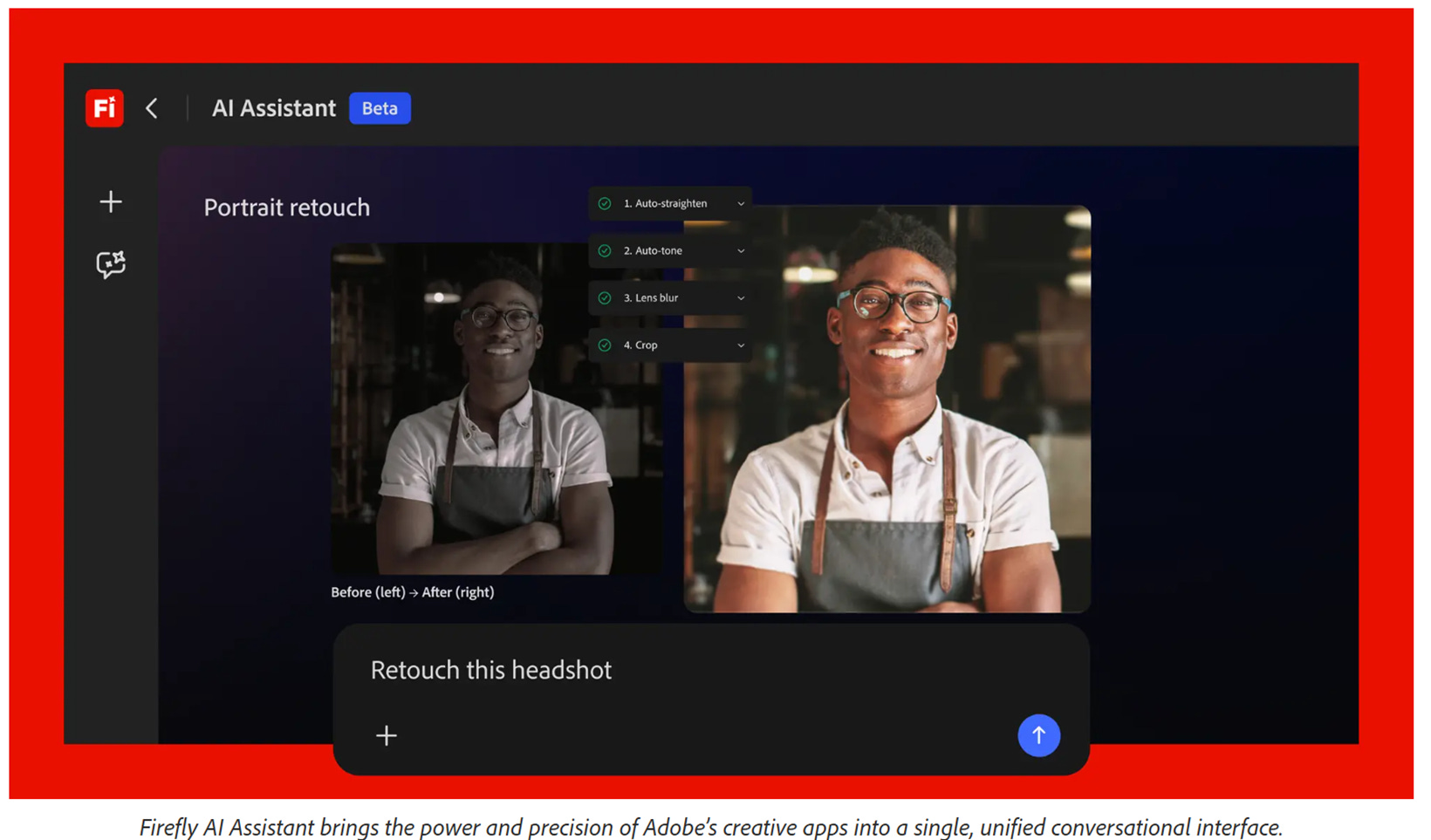
To be fair, Adobe is touting a massive product evolution alongside the buyback. They are pitching “Agentic AI”—specifically the new Firefly AI Assistant—as a game-changer. They claim this conversational agent will execute multi-step workflows across the entire Creative Cloud (Photoshop, Premiere, Illustrator) from a single prompt. Furthermore, they are opening their ecosystem to third-party models (like Kling 3.0 and Nano Banana 2), arguing that Adobe will remain the essential “orchestrator” for professional creatives, regardless of which underlying model wins.
Valuation Does Not Equal Value
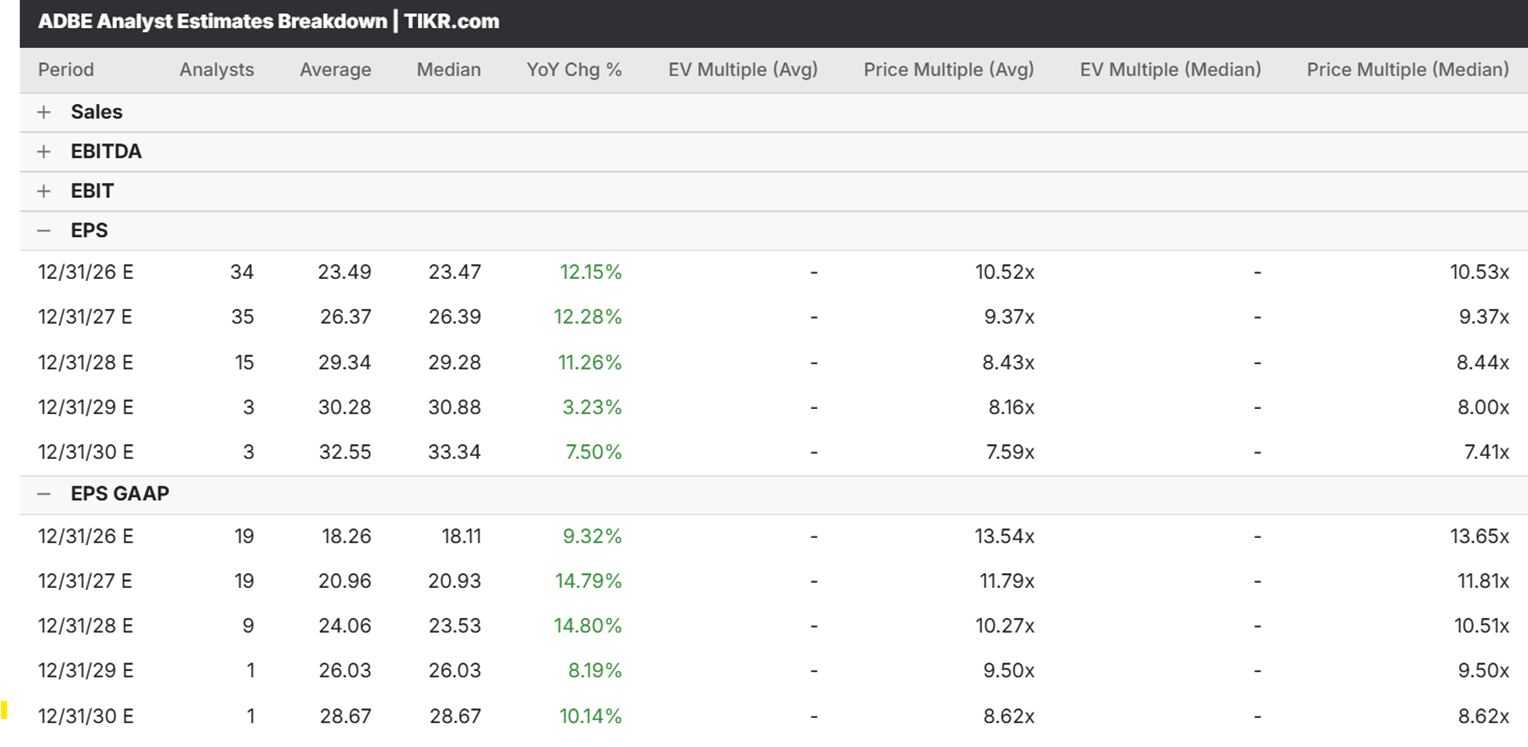
Adobe is arguably the cheapest large-cap TMT stock that has been on my radar, but I still cannot bring myself to rule it out as a value trap. At the current price of $255, it trades at 14x 2026 GAAP EPS of $18 and 12x 2027 GAAP EPS of $21.
I am not as impressed by the buyback as some other value investors because I fundamentally believe that financial engineering is not a strategy. I do not have faith that Adobe can both spark organic growth (note that consensus revenue estimates are forecasting less than 10% YoY top-line growth between 2026 and the foreseeable future) and avoid being further disrupted by AI products.
Adobe’s Orchestrator Moat is Evaporating
Bulls would counter and say that professionals still need to use Adobe products and that they can’t get by using competitors’ free versions. While I get their point that Adobe will ultimately use AI models made by others such as Gemini, I am worried that AI models are advancing so quickly that every year the threat will get bigger as these models become even more sophisticated.
From my experience, the only way to prove to the market that your stock is not a value trap is by demonstrating accelerating revenue growth. I have to pass on this stock—but good luck to any of the enterprising souls who want to try to catch a falling knife. In my opinion, life is too short to spend too much time on companies with middling growth rates.
For now, I am keeping Adobe in the “Too Hard” bucket. Avoid.
ADBE 0.00%↑ , GOOG 0.00%↑, GOOGL 0.00%↑, FIG 0.00%↑
B) Zaslav’s Exit and the Warner Bros-Paramount Fiction
We need to talk about Variety’s latest deep dive: “Inside David Zaslav’s $500 Million Warner Bros Exit After Paramount Sale.“ The piece relies heavily on quotes from corporate insiders to paint a picture of a company that was magically on the mend prior to the Paramount-Skydance (PSKY) acquisition.
Corporate Insiders are Never Neutral Narrators
Variety actually floats the claim that due to “recent internal momentum” and synergy realizations, WBD “did not need a savior” to step in. The article goes so far as to quote an unnamed executive stating that the linear TV decline had “bottomed out” and that Max’s international rollout was “weeks away from achieving dominant market share in LATAM.”
Let’s call Variety’s premise exactly what it is: preposterous. While articles like this written from corporate insiders’ perspectives go viral because of the palace intrigue nature, these employees are not neutral narrators, and they are flat-out wrong that WBD’s financial performance was on the verge of a turnaround.
An Objective Failure Rewarded by a Bidding War
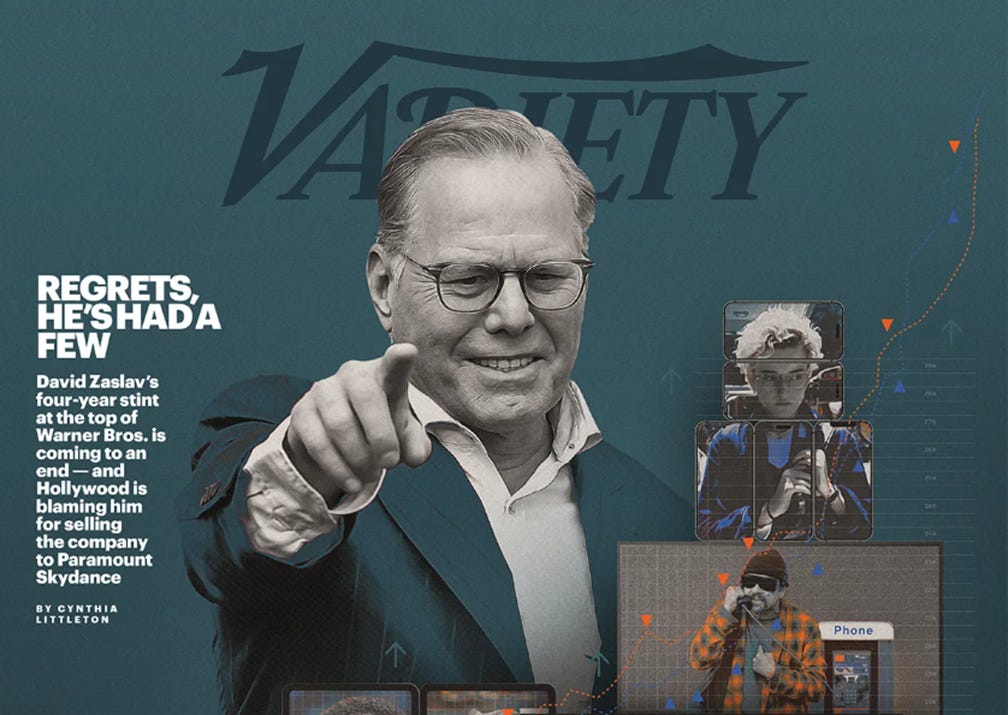
The article frames Zaslav’s staggering $500 million exit package not as a bailout, but as a hard-earned reward for weathering the storm.
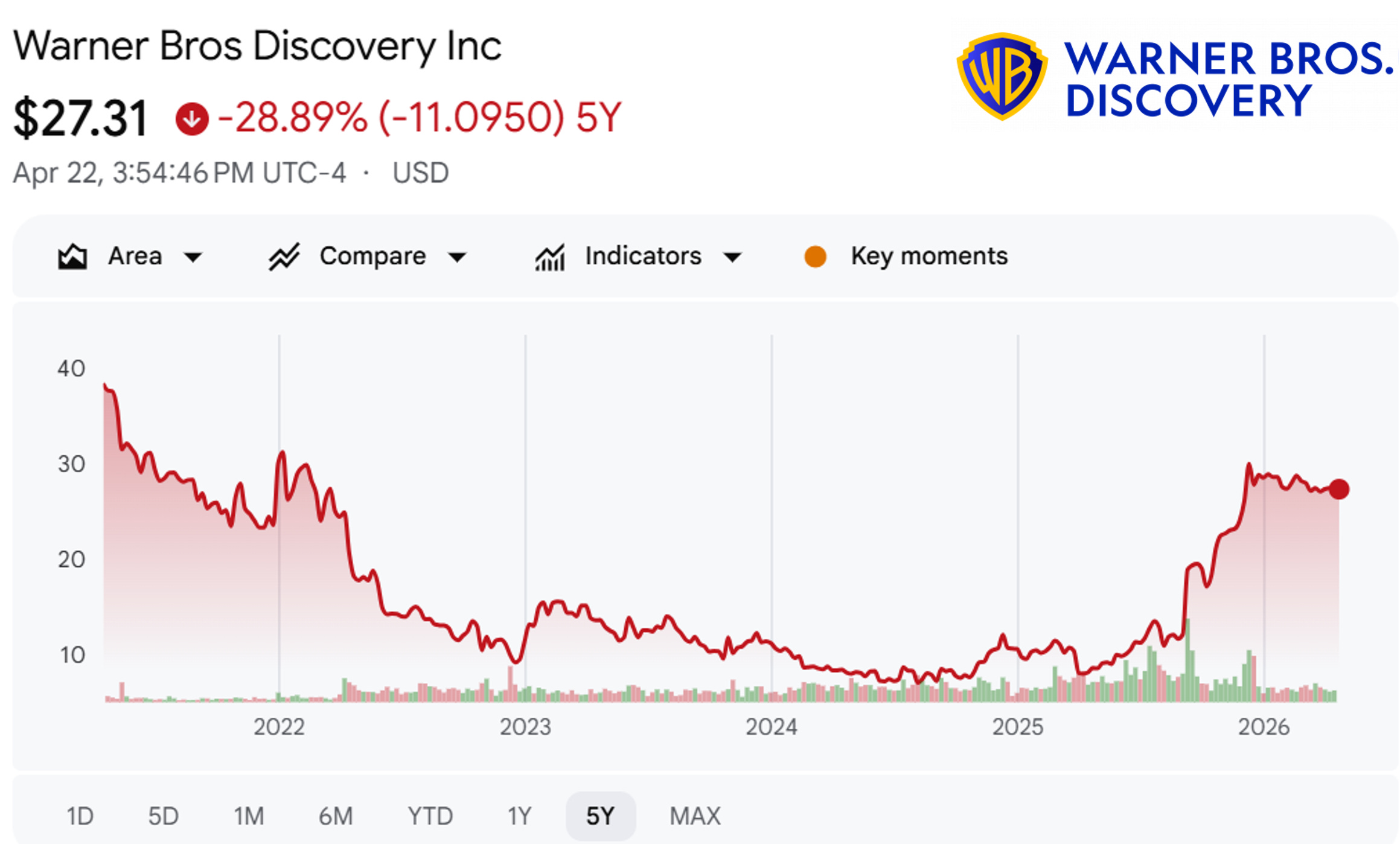
Let’s look at the actual tape. David Zaslav’s tenure at WBD was an objective failure by any real operational metric. The only saving grace of his run was that the stock jumped from $8 to $31 (deal price) after getting caught in the middle of a bidding war. One party, Paramount Skydance, was more than willing to overpay because they were buying the WBD asset as a political power move, not necessarily to make money.
A Pessimistic Outlook for the New Regime
WBD had real, systemic problems—a crushing debt load, a melting cable business, and the fumble of the NBA rights. A change in ownership doesn’t magically fix a broken balance sheet. Now that the bidding war is over and Paramount actually owns this asset, they have to run it. Given the premium paid and the underlying rot at WBD, I am highly pessimistic that PSKY can create any actual shareholder value here. Do not be fooled by the attempts at revisionist history. Paramount-Warner Bros. is still poised to underperform the S&P 500 over the medium and long-term.
PSKY 0.00%↑ WBD 0.00%↑ DIS 0.00%↑ NFLX 0.00%↑ CMCSA 0.00%↑
-Accrued Interest
Disclaimer: The information presented in this Substack is for educational purposes and should not be construed as investment advice. Investors should make their own decisions regarding the prospects of any company discussed here, as I am not a registered investment advisor.
You can always reach me at simeon@accruedint.com.
Thanks for having informed strong opinions!
Regarding Adobe as a value trap, they don't need to have accelerating revenue growth, but they need to maintain some organic revenue growth (probably MSD). If the long-term moat for the company disappears or revenue growth turns negative, then look out below.
Great piece, really enjoyed reading your thoughts on Adobe. Curious to get your take on something else in regards to $WBD: before we even get to the question of whether PSKY can create value with this asset, how confident are you that the deal actually closes? Just in the last couple of weeks we got the Live Nation/Ticketmaster monopoly verdict and a federal judge freezing the Nexstar/Tegna merger even AFTER the FCC and DOJ had waved it through. Feels like the next domino in the antitrust scrutiny line is almost certainly ParaBros given the scale. combining two of the five major Hollywood studios, HBO + Paramount+, CNN, the whole thing.
Once the Hollywood unions, state AGs, and cable distributors (who got DirecTV to move on Nexstar) start making real noise, do you think the stock takes a serious hit as the arb community starts pricing in break risk? The $4 spread already implies some of this, but it feels like it could widen a lot if things get loud. Would love your thoughts.