
3 Ways Google's Q2-26 YouTube Results Show Netflix Is Stronger Than You Think
Alphabet's Q2-26 earnings put YouTube ad revenue at $11.1B growing 12.9%. Netflix grew 13.4%. A side-by-side look at growth, monetization, and scale.

Accrued Interest TLDR: Everybody spent last week arguing about whether Google is cooked. Almost nobody checked what Alphabet’s Q2-26 filing actually said about the most interesting entertainment company in the world. YouTube ad revenue came in at $11.06B, up 12.9% Yoy… and Netflix, the service that “nobody watches” grew 13.4% in the same quarter. On a trailing-twelve-month basis Netflix has now out-grown YouTube’s ad business for seven straight quarters. YouTube’s LTM growth has been pinned at 11.7% for three quarters running while Netflix compounds at 16%. The size gap is widening: $48.4B of Netflix revenue against $42.6B of YouTube ads, a spread that was 6% in early 2024 and is 14% today. Google’s financials show YouTube grows with the global ad market, but Netflix sets its own price.

Over the weekend I was digging into Google’s latest Q2-2026 earnings to update my notes on YouTube. Yes, I have seen the headlines. We all know Google’s CapEx spend is massive right now, but honestly, I don’t care. It’s clearly worth it, and Warren Buffett thinks it’s clearly worth it. I am not going to touch on that today, it is too early to argue.

Over the 20 years I’ve followed Google, I have come to realize that investors have a much easier time appreciating YouTube’s growth trajectory than Netflix’s, without the periodic freakouts we see among the Netflix shareholder base.
When it comes to Netflix, investors default to what I call the “Brother-in-Law Test.” Instead of judging the financials, they try to remember whether the last friend they spoke with had found a new show they liked. By this heuristic, if Netflix can’t get the group chat buzzing, the business must be failing!
So in this subscriber-only post, rather than debate “Is Google Cooked?” for the 100th time, I am going to give you an Accrued Interest breakdown of what Google’s quarter actually taught us about the most interesting entertainment company in the world, YouTube, and what it says about Netflix. (And in case you missed my Netflix Q2 deep dive (no paywall), please read my July 17th article, “The Netflix Engagement Panic Is Wrong: Q2-26 Earnings Review”.)
1. Believe It or Not, Netflix Is Still Growing Faster Than YouTube
Let’s get right into it with a surprising truth. For anyone who bothered to read both the Google and Netflix earnings releases, the punchline is that for all its woes, Netflix is still growing its revenue faster than YouTube.
(Before you argue with me, the big caveat I have to call out is that YouTube’s reported ad number excludes their subscription revenue, YouTube Music, Premium, TV, and the rest. Alphabet told us YouTube crossed $60 billion across ads and subscriptions in 2025, and subscriptions have been growing faster than ads, which is a real tailwind for them. But on the figures Google actually discloses each quarter, my broader point stands.)
Here are YouTube’s and Netflix’s year-over-year revenue growth rates over the last six quarters:
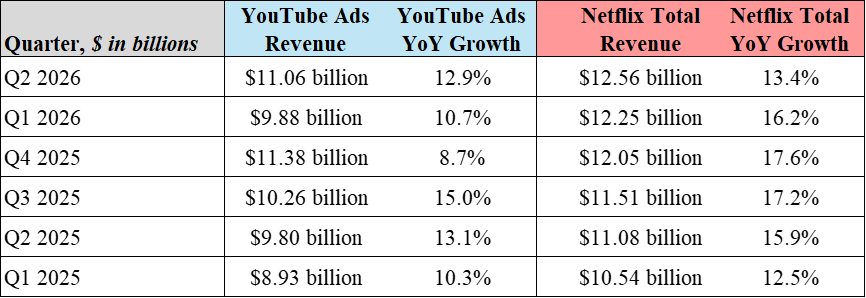
First, I thought it was a funny coincidence that, for all the negativity around Netflix’s most recent quarter, their 13.4% year-over-year revenue growth was almost identical to the 12.9% growth in YouTube’s ads business.
I believe YouTube is viewed more positively in terms of recent performance because YouTube has been consistently number one in total US TV watch time in Nielsen’s monthly Gauge report. As long as total watch time is rising, investors tend to give the benefit of the doubt to whoever is gaining viewing share. I’m going to argue that when you are dealing with companies as large and as global as Netflix and YouTube, there is no longer a clean, simple correlation between engagement and revenue.
I acknowledge there is more nuance I’m leaving out, but I was pleasantly surprised to find that Netflix grew faster than YouTube’s ad business in all six of the last six quarters, and in two of them, it wasn’t close.
Next, to separate the noise from the narrative, it helps to annualize these figures.
Below is the same comparison on a Trailing Twelve Month (LTM) basis, going back six quarters. Fair warning that this one took some work to assemble: Alphabet does not report YouTube’s Q3-2025 ad revenue on its own, so I had to back it out of the full-year total buried in the 10-K to make the series whole. I have not seen this comparison published anywhere else.
