Accrued Interest

Accrued Interest

Will Netflix Buy NBCUniversal? The Numbers Say Yes, But Not Until 2029

Comcast’s Q2-26 numbers say NBCUniversal is a theme park company with a studio attached

Accrued Interest (Simeon M.)'s avatar
Accrued Interest (Simeon M.)
Jul 29, 2026
∙ Paid

Accrued Interest TLDR: In this article I introduce my long-term prediction that NBCUniversal and Netflix will ultimately end up together. By the numbers, NBCUniversal is a theme park company with a very good studio and a media business that has never stood on its own. Even adding in the British company Sky, the parks are still more than half the earnings. After losing out on Warner Bros., the next best asset on the board is Universal. But the parks cannot be separated from the studio. Netflix does not want NBC or Peacock, nor does it need them. But all-in-all, I bet the Roberts family would trade NBC Universal for Netflix stock tomorrow if the tax code let them. Let’s discuss.

INTRODUCTION

They say, “If you stay ready, you don’t have to get ready.” Well, today I want to prepare you for what I believe is inevitable post-2029: a combination of NBCUniversal and Netflix. With Warner Bros. off the table, Universal Studios stands as the premier “global IP” asset. As I noted in my Q2-26 Netflix earnings review, Netflix’s superpower is its unmatched ability to extract revenue from content, a skill that continues to improve as evidenced by Q2’s 13% YoY revenue growth against 2% growth in view hours.

The less obvious takeaway? I think Universal Studios must be sold as a package deal with its theme parks. While it may surprise some, the parks segment (not the studio, NBC, or Peacock) consistently pays the bills at NBCUniversal once separated from Comcast. Analysts often overlook the source of a company’s actual profit when handicapping M&A, yet understanding how these business units feed each other is critical.

Before the official pro forma financials arrive, I’ve used public documents to build a preliminary picture.

Fair warning: Comcast recast its segments this year to exclude the January Versant spin-off, while the FY2025 10-K numbers still include those cable channels. While I’ve made several assumptions, my goal is to be directionally accurate, even without perfect data…


1. On the disclosed segments, parks is essentially all of the profit

Here is Content & Experiences, the Media, Studios and Theme Parks segments, on a trailing twelve-month (TTM) basis through Q2 2026, pro forma for the Versant separation ($VSNT).

(You are allowed to disagree with me, but please show your work in the comments!)
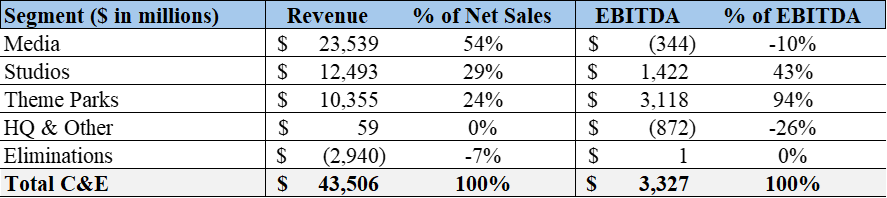
Source: Comcast Q1-26 and Q2-26 trending schedules and Q2-26 Form 10-Q. Media revenue is derived as the residual, since Comcast publishes the pro forma total but not the pro forma Media line. LTM = Q3 2025 through Q2 2026. The EBITDA column foots to $3,325 rather than $3,327 because of rounding in Comcast’s own trending schedules.

For the TTM, NBCU theme parks generated a little over $3 billion in EBITDA. Everything else generated roughly $200 million.

Now to be fair…2026 is the first year of the new 11-year NBA rights deal. The Media division is eating a full year of straight-lined rights expenses before revenue catches up.

Let’s remove the NBA factor entirely, and look at earnings two years prior. By my math, the pro forma media segment Adj EBITDA, excluding Versant, was a negative $123 million in 2024, and only barely positive at $164 million in 2025. The NBA was not a cost in either of those years.

I know I have been very negative on the Versant business (VSNT), but excluding VSNT, NBCUniversal’s media operations have not generated meaningful profit for quite some time.

I would argue that is because NBC was OVER-earning on its many, many cable channels that were protected by the old cable bundle. That is why once you strip out USA, Syfy, E! and the rest, what is left runs at roughly breakeven today.

Now before we get to the parks, I want to add the latest soon-to-be addition to the NBCU family, which is Sky’s $2 billion takeover of ITV’s television network operations over in the UK.


2. Sky, ITV, and what the full company actually looks like

First, Sky is not being merged into NBCUniversal. Comcast has owned Sky since 2018. Sky and NBCUniversal are being spun out of Comcast together, as one company, targeted for mid-2027. Sky’s UK and Italy broadband, mobile and video go with the media company.

Second, the actual deal announced on July 6 is Sky acquiring ITV’s Media & Entertainment business (the ITV channels and ITVX) for £1.4 to £1.6 billion: £1.2 billion cash, Love Productions valued at £200 million, and up to £200 million more contingent on 2027 ad revenue. ITV Studios will be spun off separately with a five-year, £2.1 billion content supply agreement back to the combined broadcaster. Sky is targeting £200 million of run-rate synergies by year three, with completion in H2 2027, which is after the NBCU spin closes.

I mentioned Sky in my last Comcast write-up (Comcast Says the Quiet Part Out Loud), but I’ll give you the cliffnotes version. Sky gives NBCUniversal a genuine European media footprint at the exact moment it stops being a cable subsidiary. Sky + ITV combined had an approx. 18.3% share of UK TV and streaming viewing in May, per BARB (that stands for Broadcasters’ Audience Research Board, aka their version of Nielsen across the pond), putting the service within striking distance of YouTube at 18.6% share.

Now, here is the problem with sizing the full company: Comcast does not disclose Sky separately anymore, not since 2020. The June spin deck is entirely qualitative. So while we get ready for the pro forma financials, I decided to make some rough estimates.

Per my notes, Sky Deutschland (Germany), sold to RTL Group and completed on May 31, did $2.24 billion of revenue and $52 million of EBITDA in 2025. Sky’s last standalone disclosure, FY2020, was roughly $18.8 billion of revenue and $2.5 billion of EBITDA including Germany. Now strip out Germany, and then strip out the roughly $5 billion of Sky Sports networks revenue that now sits inside the Media segment, and that $18.8 billion comes down to somewhere in the neighborhood of $12 billion. Call it $12–15 billion of revenue and $2–2.5 billion of EBITDA. (When in doubt, I used the midpoint.)

One trap to avoid for those of you following along at home: the Sky Sports networks revenue, which is roughly $5 billion a year, is already sitting inside the NBC Universal’s Media segment in the “international networks” line, so be careful not to double count it. Bringing it all together, here is the Accrued Interest rough estimate of the pro-forma NBCUniversal P&L post-spinoff. (I added Sky as a separate line)

Note what adding Sky does: Parks drops from the 94% you saw in the first table to a bare majority, because that first table only covers the segments Comcast actually discloses. Across my whole Sky range, I get the Parks business at 53% to 59% of total EBITDA. Even if you normalize Media for the NBA rights deal, I still get Parks’ share in the mid-to-high 40s. (Here is my work below - argue with me in the comments!)

Sky figures are my estimate, not company disclosure. Everything else is LTM through Q2 2026 per Comcast filings.


3. The parks are the physical manifestation of Universal IP

Now allow me to give you a quick overview of the NBCU Parks business. You can be forgiven if you have never thought about this segment much before today. Think of the parks as Universal IP you can physically walk into. Jurassic World, Fast & Furious, Minions and more.

NBCUniversal operates parks in Orlando, Hollywood, Osaka and Beijing, plus a new kids resort opened in Frisco, TX in July. Epic Universe opened in Orlando in 2025, the first new major theme park in the Florida market in a generation. Super Nintendo World, the Nintendo partnership, anchors the Epic park. Horror Unleashed opens in Chicago in 2027, and a full UK resort is targeted for 2031.

Understandably, the parks’ profit margins compressed after years of expansion. EBITDA margins went from 37.4% in 2023, 34.2% in 2024, 31.3% in 2025, roughly 25% in the first half of 2026. In total, from 2023 to 2025, revenue is up 10% while EBITDA is down 8%. Q2-26 parks EBITDA fell 5.1%, and it was the only NBCU segment that declined in the most recent quarter.

However, in any future sale for NBCU, I cannot come up with a logical argument a buyer would make for separating the parks. This is why I think in the inevitable Netflix tie-up, NFLX will be forced to take the asset because they are inseparable from what I argue are NBCU’s crown jewels: Universal Studios and its film and TV catalog.


4. The most underrated thing about Universal Parks: they are the NOT-Disney option

Here’s something that is not said explicitly, but after 20 years in the media industry I know to be true. Universal parks benefit enormously from being the NOT-Disney option wherever they are located. The business runs on physical space, and space is a logistical barrier to entry that no amount of capital gets around quickly. I would argue Orlando is a permanent oligopoly.

Look at what is actually in the parks and the point makes itself. The Wizarding World of Harry Potter is Warner Bros. IP. Universal monetizes it without owning the films, the same way it monetizes Nintendo’s characters without owning Nintendo. Every media brand that wants a theme park expression of its IP and cannot work with Disney ends up at Universal.

That is a real competitive advantage, and it proves something useful: synergies here get created through partnership, not only M&A. Netflix does not NEED to own a park to put its IP inside the gates. For example, KPop Demon Hunters got a themed zone at Everland in Korea through a license, and Universal Orlando already sells the merchandise, all without M&A.


5. NBC, Sky TV and Peacock are intrinsically linked and Netflix wants none of it

I see NBC, Sky TV and Peacock as intrinsically linked to each other and ultimately separable from the movie studio and parks. In any future deal I could envision an acquirer such as Netflix at least attempting to spin them off.

Here is a point about NBC that has not been fully addressed anywhere I have read. As the numbers earlier in this article show, NBC’s media business has no track record of long-term profitability without the portfolio of cable channels they just spun off.

The real superpower of the NBC media family was never NBC on its own, but its bargaining leverage vs. cable providers. NBC broadcast used its market position to extract surplus economic value from a sprawling family of cable channels.

Now, for those who do not speak like a management consultant…NBC made billions forcing cable bundles to carry channels nobody asked for, at prices well above what they were worth, under the implicit threat of pulling NFL football, Olympics and NBC’s vaunted prime-time block of “Must See TV” .

I detailed my bearish view on Versant in a multi-part series on Accrued Interest that I won’t beat to death here. My issue with VSNT investors is I do not think they accounted for the strategic risk those channels face. I expect their affiliate fees get reset meaningfully lower once they separate their sales relationship from the NBC ad sales team in 2028.

That separation of cash flows is exactly why, when you look back at the top of this article, the media profits from NBC and Peacock are so much smaller than most people assume.

So in a perfect world, Netflix does not want NBC network and its portfolio of local stations. Linear is in secular decline, and broadcast licenses come with direct FCC regulation that Netflix has spent its existence avoiding.

Now, here is why I do not think Netflix has any desire to own Peacock either.


6. Much has been made of Peacock’s improved profitability. I say “profits” depend on your point of view.

Peacock posted $189 million of EBITDA in Q2, compared to a $101 million loss a year ago. A real milestone. But that number is not standalone-comparable to anything, because Peacock is inextricably linked to NBC. Look at what happened in Q1: Studios EBITDA doubled, largely on a renewed licensing agreement for content going exclusively to Peacock. That is NBCU licensing NBCU content to NBCU’s own streamer. There is no counterparty, which means the price is a management input, and where they set it decides whether the profit shows up in Studios or in Peacock. Consolidated does not move either way. (Remember kids, always read the footnotes!)

Moreover, the reported Peacock line includes distribution and advertising revenue from NBC Sports Network, the cable channel, because the two share programming. A linear network is sitting inside the streaming metric. Management runs Media as a single P&L and has said outright that Peacock’s standalone profitability is not the objective.

The true test comes in 2027, when Peacock faces a calendar devoid of the Olympics, World Cup, or Super Bowl, with the NBA expense sitting at exactly the same level.

7. The YouTube deal is NBCUniversal telling you what Peacock actually is

User's avatar

Continue reading this post for free, courtesy of Accrued Interest (Simeon M.).

Or purchase a paid subscription.
© 2026 Simeon McMillan · Privacy ∙ Terms ∙ Collection notice
Start your SubstackGet the app
Substack is the home for great culture