Why Fox and Telemundo Don't Mind That the USA and Mexico Are Out
What pricing Spanish-language soccer ads taught me about the World Cup's real business.

Accrued Interest TLDR: Both host teams are out of the World Cup, and the broadcasters will be just fine. I used to price Spanish-language soccer ads for a living, and this piece explains why: the money was locked in before kickoff, the eliminations were the priced-in base case, and record ratings mostly can’t be billed for anyway. The one true windfall — hydration-break ads — belongs to Fox alone, and Telemundo’s refusal to touch it tells you everything about a shrinking Spanish-language TV business protecting its crown jewel. In this article I also cover: why the most-watched soccer league on American television is Mexican, what MLS’s Apple deal revealed about the home league, and a data-backed defense of the U.S. Men’s National Soccer team. (This is a free preview of a future subscriber-only post, lock in your rate.) Pledge before July 22 to lock in the $199/year founding rate for life before the price goes up.
0. Introduction
On Monday night in Seattle, Belgium put four goals past the United States and ended the USMNT’s World Cup. The night before, in Mexico City, England ended Mexico’s tournament 3–2. Let me be precise about the mood that followed, because it matters for what comes next: nobody was predicting ruin for anybody. The mood was disappointment mixed with an unusual amount of confusion.
The disappointment was about the manner of the exit. An encouraging group stage had fans dreaming of a first quarterfinal since 2002, and then the U.S. went out flat, at home, in front of everyone. The reaction was rough even from friendly quarters — The Hollywood Reporter’s roundup of the fallout ran under Dave Portnoy’s verdict that U.S. soccer is “not ready for primetime,” and captured the genuinely surreal spectacle of Fox’s own announcers pleading with viewers, live on air, to PLEASE keep watching the tournament anyway. Within a day I saw multiple articles circling the same question: with the host countries eliminated before the quarterfinals, can this WC keep its momentum? What happens to the record audiences now?
To be clear - these were fair questions. So I made a video answering them, and something unusual happened: it went mini-viral, with over 1,000 views in under two hours. That’s my small version of “breaking the internet” on my little YouTube channel.
I think it traveled because the answer genuinely surprises people: Fox and Telemundo do not mind that the U.S. and Mexico are out. The business was never riding on them. And the part that surprises people even more: those record-shattering ratings didn’t necessarily make the networks more money either (with one exception we’ll get to, and it’s a good one).
The reaction to the video convinced me this deserved a full deep dive. Because underneath the World Cup story is the thing I actually want to write about, which is why I trust markets more than commentary.
1. Where I’m coming from
For a stretch of my career I sat on the Sports Ad Sales Pricing Team at Univision, pricing Spanish-language soccer inventory. I was on that team for less than a year, but it was the most instructive year possible: I joined in early 2020, right as the pandemic — whose human toll needs no recounting from me — shut down every sporting event on Earth.
From a pricing seat, we had sold a book of business against a schedule of games, and suddenly there was no schedule! When sports came back, it was a Herculean effort: cancelled matches, shifted dates, shortened seasons, ad dollars shuttled between properties to make advertisers whole, and ratings estimates rebuilt from scratch because every assumption had changed. I worked with the research team, learning why their estimates came in where they did. The answer, I learned quickly, was deliberate, structural conservatism — because the one thing a network does not want to do is owe an advertiser a make-good.
I’m telling you this because here is what I learned: what people pay for is the truest record of what they value. It’s the reason I love the stock market, and business generally. Words are cheap, prices are actions, and actions don’t lie. A rate card, properly read, is a lie detector — for an audience, for a sport, and as we’ll see, for a culture.
2. Why the broadcasters shrugged
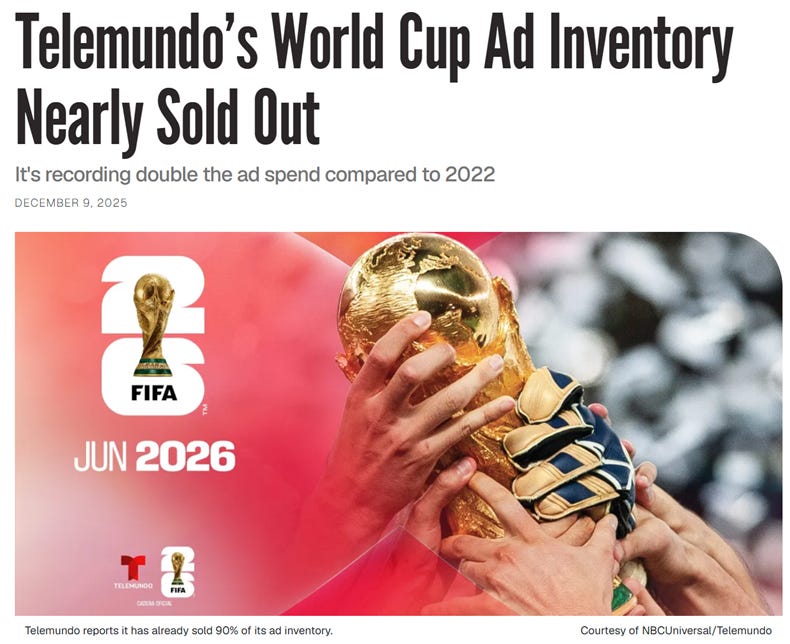
Let’s start with the fact that the money was booked before the tournament ever began. Telemundo announced in early Dec 2025 — more than six months before kickoff — that it was 90% sold out of its entire World Cup inventory, across roughly sixty brand partners, with the largest advertising deals in Spanish-language television history and total spend DOUBLE the 2022 cycle. In fact, inventory was effectively sold out across both networks. Fox’s most premium sponsorship packages ran anywhere from $15 million to $50 million, per media buyers who spoke to Adweek, and access to marquee matches was bundled: you don’t get near the final without committing to a tournament-wide package first.
This is how all elite sports properties work. The World Cup wasn’t sold match-by-match, the way casual fans imagine; but packaged and pre-sold at the upfronts, with FIFA’s official partners getting first refusal on the prime placements.
Now, the pricing itself…and here’s where my old job becomes relevant. The rate card for each match already incorporates the participating teams’ history. Thirty-second spots ran from roughly $300,000 in the group stage to an estimated $1–2 million for the late rounds, per Front Office Sports. And critically, Fox sold USMNT telecasts separately, at a premium — close to $1 million for some spots in Team USA’s first two group matches. Which means team-specific value was isolated and captured up front, and late-round pricing was tied to the round, not to which teams survived.
Here’s the thing about pricing on history: both the United States and Mexico have long histories of exiting in the Round of 16. It is, statistically, their base case. Belgium eliminating the USMNT in the Round of 16 isn’t even novel — Belgium did precisely that in 2014, in the iconic Tim Howard game. So when both host teams went out this week, the market didn’t reprice. The eliminations were the expected outcome embedded in the rate card. Nobody was underwriting a semifinal run.
Then there’s the asymmetry that most coverage misses entirely, and which Digiday flagged in its media buying briefing this month: networks guarantee advertisers a ratings level, and the consequences only run one direction. Fall short, and you owe make-goods — free compensatory inventory, real economic cost. Overdeliver, and you get...well, nothing. You cannot go back to a brand and bill them extra because the audience doubled. Overperformance is a freebie to the buyer. This is exactly why TV research departments build conservatism into every estimate. The guarantee is designed to be beaten.
This WC, Fox averaged 5.05 million viewers per group-stage telecast, up 92% from 2022 and the best English-language group stage ever. Telemundo averaged 4.6 million per match, up 122% — a figure its own sports chief admitted exceeded internal expectations. Combined, 9.65 million viewers per group-stage match, more than double 2022. USA–Bosnia in the Round of 32 drew roughly 36 million combined across languages, the most-watched English-language soccer telecast in American history. Fox’s Mike Mulvihill said they were seeing numbers “we don’t see for anything but the NFL.” (FYI…One honesty footnote before you extrapolate: this is the first WC measured under Nielsen’s expanded out-of-home sample and its new Big Data methodology, both of which inflate raw comparisons to prior years, and a home-time-zone tournament will always beat 2022 Qatar’s morning windows. The growth is real but the exact multiples deserve an asterisk.)
What the overdelivery did accomplish was two things: it vaporized any make-good liability, and it turned the held-back reserve — the inventory networks keep in their pocket precisely in case ratings fall short — into a profit center. As the LA Times noted, Fox can now take that reserve back into the marketplace and sell late-round spots for more than anyone paid before the tournament. The insurance policy effectively became another scatter market.
So in the business of soccer, the scoreboard and the rate card are different instruments, and they were never measuring the same thing.
3. The one real windfall — and the network that refused it
I said there was an exception, and it’s the most interesting business story of the tournament.
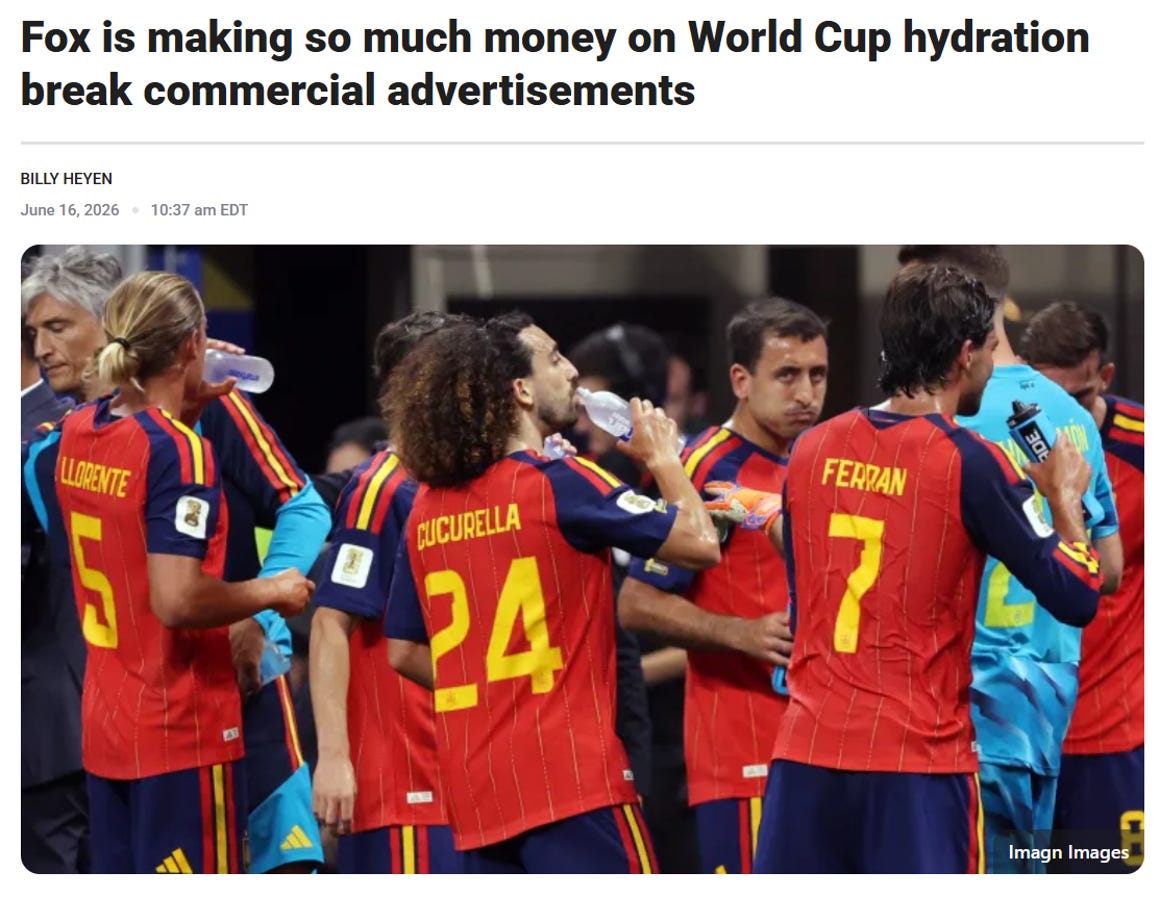
For the first time in World Cup history, FIFA introduced mandatory hydration breaks — roughly three minutes per half, framed as player welfare in the summer heat — and allowed broadcasters to sell advertising inside them. Up to four 30-second spots per break, two breaks per match. Run the math the way Awful Announcing did: 8 in-game units per match, times 104 matches, equals 832 sellable commercial spots that did not exist in any prior World Cup. Estimates of what this is worth to Fox start around $250 million and run as high as $500–600 million at the ceiling.
For context on why that number is so consequential: Fox paid $485 million for the entire tournament’s English-language rights — a VERY below-market figure, roughly a third of what analysts think the rights are worth, thanks to a deal negotiated back in 2014 under circumstances I covered in my May 27 Update (“Accrued Int: Fox’s Grand Theft FIFA” ). I won’t relitigate that here. The point for today is narrower: the hydration breaks alone may cover most or all of Fox’s rights fee, on inventory that was never contemplated when the original packages were sold. Fox has run full-screen commercials in every single break — with enough enthusiasm that it came back late from one in the opening match and English-language viewers missed a live restart, in violation of FIFA’s own buffer rules. (FIFA declined to punish them.)
And Telemundo? Telemundo left the breaks unsold. All of them. During hydration breaks, Telemundo stays with the live feed — the huddles, the coach conversations, replays and analysis, with sponsor thank-yous woven in non-intrusively. Trevor Noah publicly praised them for it.
I was not remotely surprised. Telemundo’s audience are soccer natives — people who grew up inside the rhythm of an uninterrupted 45-minute half, for whom a full-screen commercial during live play doesn’t read as a break, it reads as a violation. Fox’s audience skews toward viewers raised on the quarter-based cadence of American sports, where a mid-half commercial pod feels natural. The same inventory carries different costs to different audiences. Telemundo declining hundreds of millions of dollars is not sentimentality. It’s a pricing decision — a judgment that the long-term value of an audience relationship exceeds the short-term value of 832 spots. Which raises the obvious question: why is that relationship worth so much to them?
4. The shrinking network and its crown jewel

Because — and this cuts against conventional wisdom — Spanish-language television has been in secular decline for decades, and everyone inside the business knows it.
The conventional wisdom says the massive, well-documented growth of the U.S. Hispanic population should be a rising tide for Spanish-language media. What I learned quickly working in the industry is that the tide runs the other way. Viewer assimilation is fast and undeniable: after one generation, the typical SL household’s media tastes are essentially indistinguishable from any other American household’s. Younger viewers were not showing up for telenovelas. And the audience got hit with a triple whammy on distribution — not just cord-cutting and cord-shaving, but a higher propensity toward cord-nevers: households that never bought a cable subscription in the first place. The paradox is real and worth naming plainly: Hispanic culture in America is more prevalent and vibrant than it has ever been, while the Spanish-language entertainment business has been shrinking the entire time.
This makes sports not just the best inventory on the SL networks, but basically the load-bearing wall of their entire advertising book. I don’t need to tell you that live sports is the last form of content that still commands massive LIVE audiences. For Spanish-language networks, that dynamic was doubly true, because the rest of the schedule was bleeding out underneath it.
Now, on a Spanish-language pricing and planning team - you don’t see one league; you see a portfolio. For Liga MX (the primary domestic league in Mexico), every club sells its U.S. rights individually — so you’re not pricing “Mexican soccer,” you’re pricing Club América’s fanbase against Puebla’s, week by week — with a split-season format that produces 2 championships and 2 playoff runs every calendar year. The Mexican national team was the anchor tenant, the single biggest draw on American soccer television, with the USMNT a clear second. Gold Cup summers. The CONCACAF club competitions. The Leagues Cup. Sold-out El Tri friendlies in NFL stadiums. Pricing across all of it teaches you relative value in a way no Big Four sport can. No U.S. network airs a foreign basketball or baseball league, so pricing the NBA is pricing a monopoly. Pricing SL soccer is comparative valuation, like running a portfolio.
Now there are two structural facts about that portfolio I want to dive deeper into. First, Liga MX is the only imported league whose schedule lives in American prime time — Friday night matches, a three-match block every Saturday night, and Sunday games — because Mexico shares our time zones. The English Premier League airs on Saturday mornings Eastern, but Liga MX goes head-to-head with American sports in the evening. Second, the revealed-preference verdict: for most of the last twenty years, the most-watched soccer league on American television has been Mexican. In 2019, the Liga MX final between América and Monterrey drew 3.3 million U.S. viewers — more than that year’s Champions League final. As recently as last summer, Spanish-language networks captured over 60% of all U.S. soccer viewership, in any language.
Read this summer’s World Cup numbers through that lens and things look different. Telemundo captured 48% of the total U.S. World Cup audience while U.S. Hispanics are 20% of the population — and per Nielsen, a fifth of Telemundo’s World Cup viewers speak English as their primary language. Soccer is the one category where assimilation runs in reverse. So these 2026 records are not a rising tide for Spanish-language TV. They are the concentration of a shrinking medium’s remaining value into its one irreplaceable property. Now Telemundo’s hydration-break restraint reads correctly: when one property is holding up the house, you do not cheapen it to make a quick buck.
Let me give one more piece of history because it points at the future. When I joined Univision, the historicals told a painful story: they used to have the World Cup, but Telemundo outbid them and stole it away. Candidly, given Univision’s balance sheet at the time, I think passing was the correct call. But let’s be clear-eyed about how Telemundo pulled off this heist: it is NBC’s sister network, and it bid with Comcast money. Capital structure decides who gets to broadcast a culture. I’m watching the Comcast/NBCUniversal spinoff closely (Accrued Int: Comcast Says the Quiet Part Out Loud), and the open question writes itself: how competitively can Telemundo bid on future World Cups when NBCUniversal no longer has broadband cash flow standing behind it? That’s a topic for another day. (And a good reason for you to subscribe so you don’t miss the answer!)
5. What the home league sold
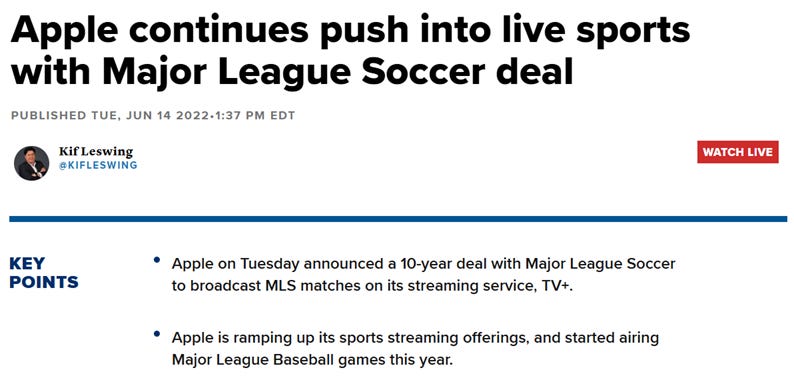
If you want to see how the same revealed-preference lesson runs in the opposite direction, look at America’s own league. MLS has NEVER been a ratings force or a moneymaker on U.S. television, despite the sport’s popularity — and in 2022, the league said the quiet part in contract form. MLS signed a ten-year, $2.5 billion deal with Apple: a guaranteed $250 million per year, nearly triple the roughly $90 million a year its previous ESPN/Fox/Univision deals produced combined, in exchange for disappearing into an exclusive walled garden behind a Season Pass paywall. It was controversial but I understood it completely. It was a tacit admission that MLS saw no realistic path to broadening its U.S. television audience — so they secured the bag, as the kids used to say.
Then the market rendered its verdict, in three acts. Season Pass subscriptions struggled to grow meaningfully even after Lionel Messi arrived. The 2024 MLS Cup Final drew all-time-low viewership despite streaming for free. And through it all, the most damning data point was the silence: when MLS vanished behind the paywall, nobody missed them. No outcry, no campaigns, no think pieces demanding their return. (Absence is a price signal too.)
By November 2025, both sides conceded — Apple folded Season Pass into its standard subscription, the deal was restructured to end three and a half years early, and MLS viewership promptly jumped 62% once the wall came down. Revealed preference, twice over: once when the audience didn’t follow, and again when the parties tore up their own contract.
Apple’s side of the trade was a revealed preference of its own. Apple TV, for all its brand ubiquity, has always been a niche, prestige service — more critical acclaim than viewers — and its pursuit of MLS was an admission that it viewed the league’s audience as upper-middle-class, educated, and small. (Formula 1 made a similar reach-for-cash trade to Apple starting this season — roughly $140 million a year — though from a position of strength rather than resignation, and with one delicious detail: Apple says it won’t release race-by-race viewership.)
To recap…the most-watched soccer league on American television is foreign, in Spanish, and free over-the-air. The domestic league sold its reach to the most exclusive walled garden in all of media. Same country, but the gap in prices told you everything.
6. A brief word in defense of American soccer
Since we’re reading markets honestly, one more — and I’ll keep it short, because it’s a coda, not a thesis. Within hours of the Belgium loss, the familiar diagnosis was all over the timeline (it even made THR’s reaction roundup): pay-to-play youth soccer is destroying American development, and that’s why we lose. I don’t fully buy that explanation.
American youth soccer is a pricing story too, just an inverted one: broadcast prices the demand to watch; but pay-to-play prices the ability to play. Premium club soccer runs $3,000 to $10,000-plus a year, and the mechanism is textbook scarcity — American parents demand paid coaches with at least college playing experience, only 7–10% of youth players ever play at that level, and inelastic demand against thin supply forces registration fees up. (Before soccer exceptionalists pile on: travel baseball and AAU basketball run the same model at similar prices. This is just American youth sports culture, not a soccer defect. And the European comparison is mostly a fallacy — Barcelona’s academy serves the scouted top 1–2%, it doesn’t subsidize the masses; volunteers do.)
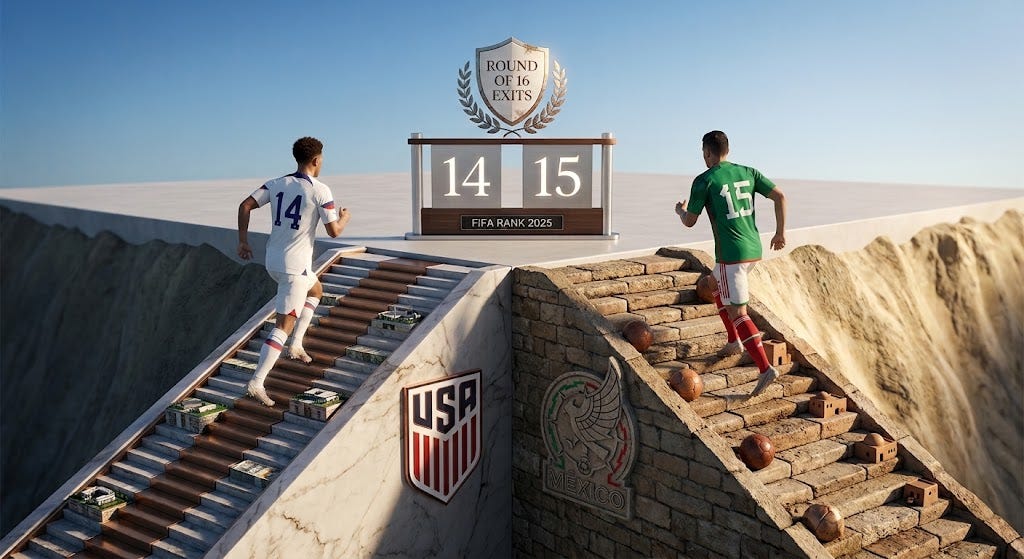
So I’ll push back on the popular narrative: it is not as simple as “talented poor American kids are priced out, and that’s why we lose.” The market comparison nobody makes is sitting right across the border. Mexico is a soccer nation where NOBODY is being priced out of the game — and for nearly two decades, the Mexican and American men’s national teams have been rated within shouting distance of each other. They ended 2025 ranked 14th and 15th in the world. They both just went out in the Round of 16, as usual. It’s an imperfect comparison, but if the pay-to-play tale explained everything, El Tri should be lapping us, and they are not. One thing pricing this sport taught me is to be a little less hard on U.S. Soccer than the general public is. The revealed outcomes don’t support the outrage.
Conclusion: 2030, and what the rate card says next
The tournament isn’t over, but the forward story is already in motion. The 2030 World Cup sits in Morocco, Spain, and Portugal, five to six time zones ahead of New York, which means afternoon U.S. windows and a structural ratings headwind — and the rights fight will be ferocious anyway, because 2026 just proved what this property does. NBCUniversal has already signaled interest in adding English-language rights to its Spanish-language package. Whether Telemundo can bid like a Comcast subsidiary after it spins is a topic for another day.
Here’s what I’ll leave you with. This week, a disappointed country looked at two losses and wondered, sincerely, what it meant for the rest of the tournament — whether the momentum, the audiences, the whole booming business of it could hold up without the home teams. The market answered, quietly, the way it always does — in guarantees written months ago, in reserves repricing upward, in 832 commercial units that didn’t exist a tournament ago, and in one network’s decision that its audience was worth more than the windfall. None of that was visible on the scoreboard. All of it was visible on the rate card.
The rate card knew. It usually does.
Relevant tickers: CMCSA 0.00%↑, TV 0.00%↑, FOX 0.00%↑, NFLX 0.00%↑, DIS 0.00%↑, PSKY 0.00%↑ , AAPL 0.00%↑
— Accrued Interest
Disclaimer: The information presented in this Substack is for educational purposes and should not be construed as investment advice. Investors should make their own decisions regarding the prospects of any company discussed here, as I am not a registered investment advisor.
You can always reach me at simeon@accruedint.com.