
AI Tracking Employee Keystrokes Validates Meta Bull Case
Why Deep Cuts Are the Real Supercycle

Accrued Interest TLDR: Reuters reporting reveals Meta is actively installing tracking software to capture U.S. employees’ keystrokes, mouse movements, and screen snapshots. While the mainstream press is framing this as a corporate surveillance or privacy story, they are missing the massive financial signal. This internal data collection is training Meta’s AI agents to automate white-collar workflows. It is the definitive proof that Meta intends to execute headcount reductions far deeper than the rumored 20% cut. Management is aggressively swapping human payroll for AI infrastructure, ensuring their massive CapEx spend translates directly into margin expansion. Let me explain why this is very bullish news for Meta.

Introduction: Ignoring the Privacy Noise to See the Margin Signal
If you want to understand where a trillion-dollar company is headed, you look at what the executives are doing to the business when they think Wall Street isn’t paying close attention.
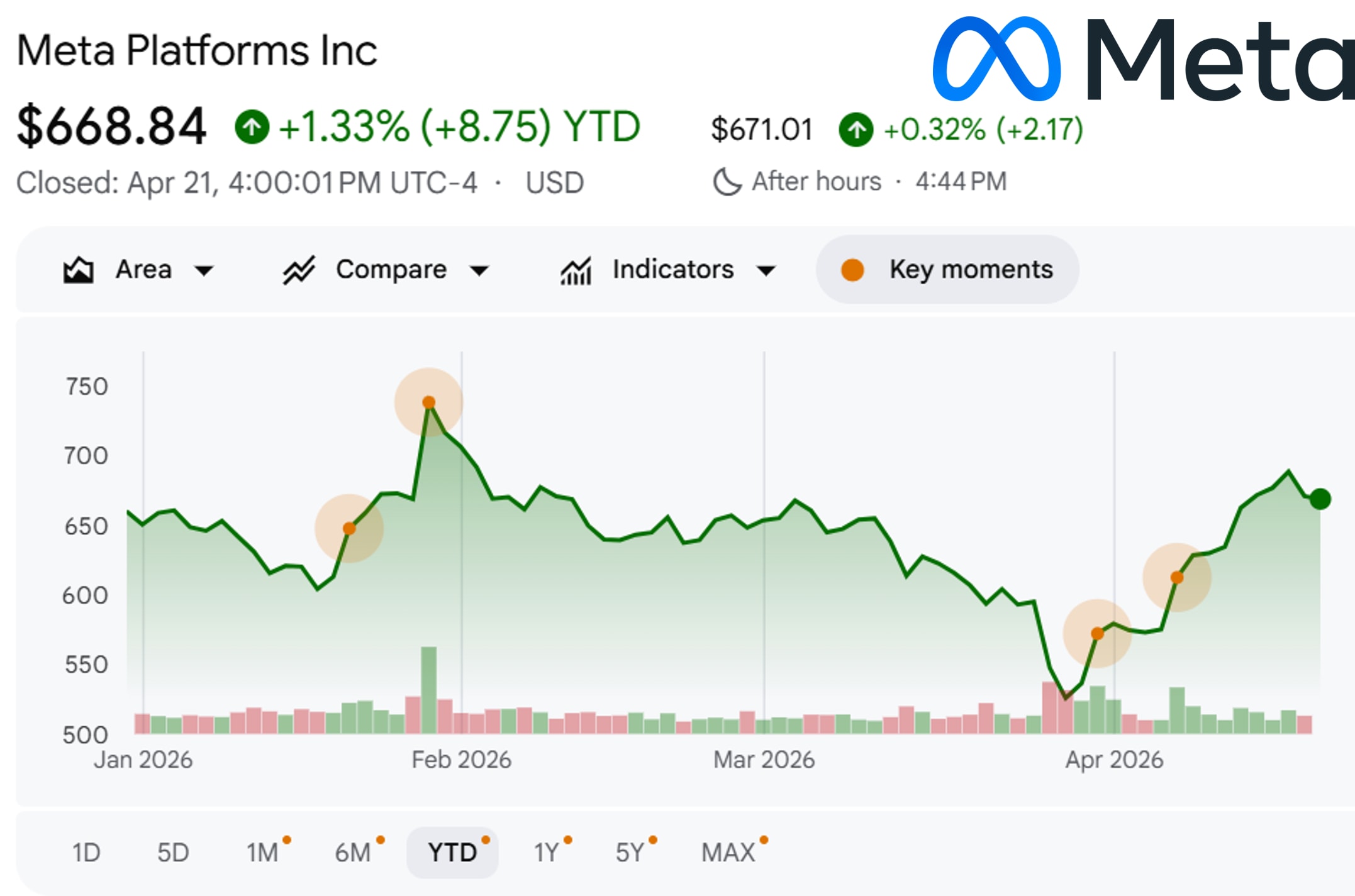
Currently, the market is fixated on the headline sticker shock of Meta’s artificial intelligence ambitions. Investors are looking for validation that CEO Mark Zuckerberg is not blindly incinerating free cash flow in his pursuit of “AI superintelligence”.
Earlier today, Reuters reported on a drastic new internal policy at Meta: the company is actively installing tracking software on the computers of its U.S.-based employees to capture their keystrokes and mouse movements for AI training data.
For the average tech blogger, this is a story about corporate surveillance with the white-collar recession on everyone’s mind and the dystopian reality of Big Tech. But for value investors and those of us tracking Meta’s financial trajectory, this is a clear signpost. This news is the most concrete indication to date that Meta intends to utilize its proprietary AI to drive a structural headcount reduction that will far exceed the currently rumored 20% cut.
The Agent Transformation Accelerator: Automating the White-Collar Workflow
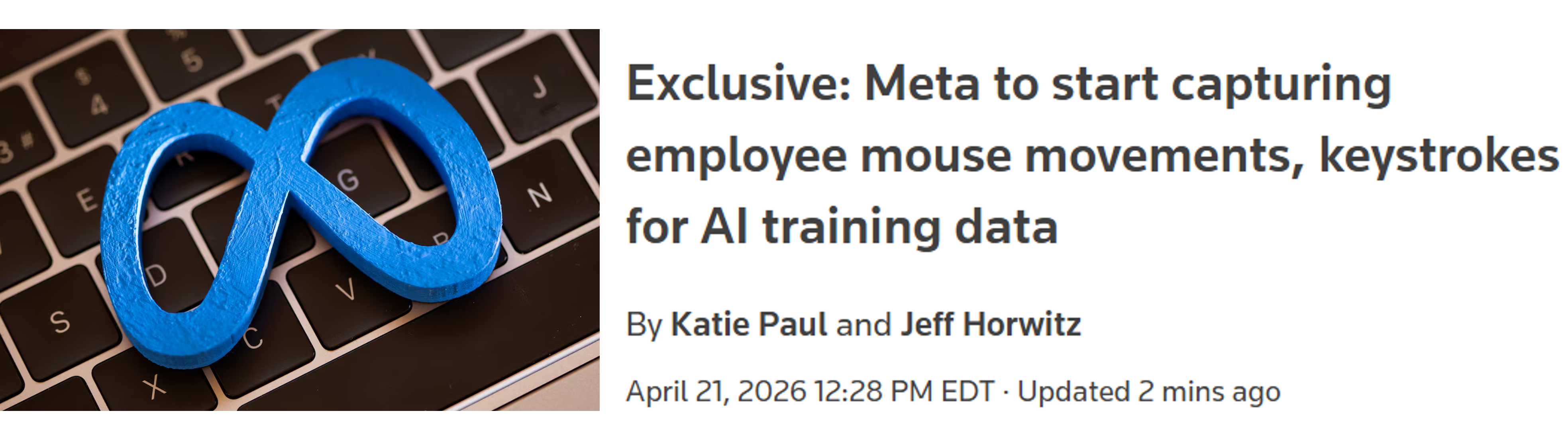
According to Reuters, Meta is rolling out a broad initiative to build AI agents capable of performing work tasks autonomously.
The internal tool, dubbed the Model Capability Initiative (MCI), will run in the background on work-related websites and applications. Reuters reports that MCI will track inputs like mouse movements, clicks, and keystrokes, and it will even take occasional snapshots of the content on employees’ screens to gather context.
The stated purpose of this exercise, revealed in internal memos, is to improve Meta’s AI models in areas where they currently struggle to replicate human-computer interaction, specifically tasks like “choosing from dropdown menus and using keyboard shortcuts“. The memo explicitly frames this as an employee contribution to the AI supercycle: “This is where all Meta employees can help our models get better simply by doing their daily work.”
This isn’t a rogue engineering project; it is an executive mandate coming straight from the top. Just a day prior, Meta CTO Andrew Bosworth informed the company that they would be accelerating internal data collection as part of an initiative recently rebranded as the Agent Transformation Accelerator (ATA). Bosworth connected these actions directly to the strategic shift toward AI-driven operational efficiency, noting that Meta would be “rigorous” about “building up data and evals for all the types of interactions we have as we go about our work.” Bosworth’s internal messaging perfectly mirrors the aggressive margin-expansion thesis we’ve been tracking here at Accrued Interest.
He stated: “The vision we are building towards is one where our agents primarily do the work and our role is to direct, review and help them improve.” He detailed the goal of creating “a closed loop” where these AI agents could “automatically see where we felt the need to intervene so they can be better next time.”
Meta spokesperson Andy Stone confirmed the MCI tool’s existence and purpose, acknowledging that the data will be fed directly into model training. Stone provided a highly revealing direct quote to Reuters regarding the necessity of this data capture:
“If we’re building agents to help people complete everyday tasks using computers, our models need real examples of how people actually use them — things like mouse movements, clicking buttons, and navigating dropdown menus. To help, we’re launching an internal tool that will capture these kinds of inputs on certain applications to help us train our models.”
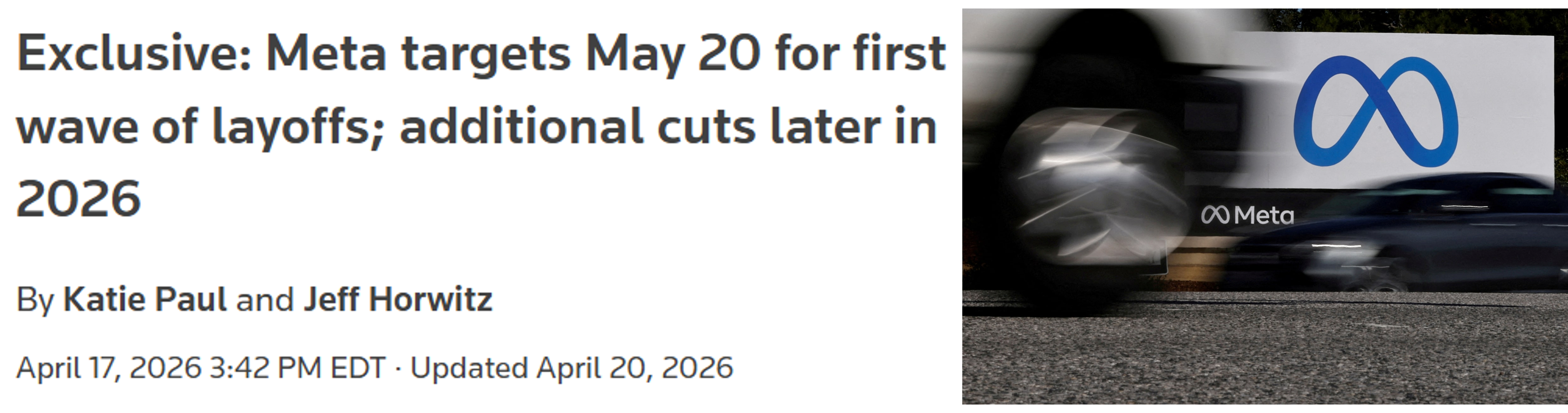
Reuters previously reported that META 0.00%↑ intends to conduct a first wave of layoffs on May 20 this year. That initial round is expected to slice roughly 10% of Meta’s global workforce, equating to nearly 8,000 employees. Crucially, sources indicate that the company is actively planning further layoffs in the second half of 2026, though the exact size and dates of those subsequent cuts remain fluid as executives monitor the success of these AI capabilities.
The timeline is not a coincidence. Meta is capturing the current workflows of its employees right now, feeding those keystrokes and screen snapshots into the ATA models, preparing the AI agents to take over these processes just as the human operators are transitioned out of the business later this year.
How Keystrokes Translate to a $1,116 Share Price
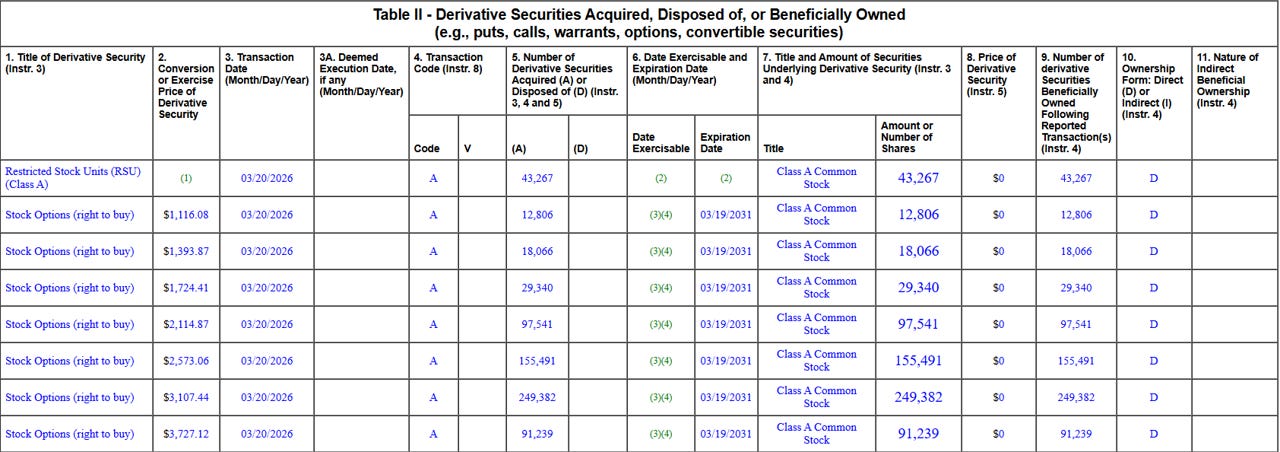
In my recent deep dives, "Back to the EBITDA: Decoding Meta’s $1,116 Executive Playbook" and "Zuckerberg’s Middle-Age Metabolism: Trimming Fat to Fund Superintelligence", I reverse-engineered the newly issued SEC Form 4 filings tied to CFO Susan Li and the executive team. This news shows how those executives intend to get paid.
The executives only get rewarded if they hit a specific absolute price floor of $1,116.08 by February 2028. And the tranches extend all the way up to a staggering ceiling target of $3,727.12 per share.
To fund the $115 billion to $135 billion in AI capital expenditures without crushing their 42% operating margins, Meta has to aggressively swap human payroll and speculative hardware research for hard AI infrastructure. A 20% reduction in force was identified as a necessary baseline just to absorb the impending spike in data center depreciation.
However, the MCI tool is the crucial indicator that validates the true scale of what is to come. Mathematically, achieving those massive stock price targets laid out in the Form 4 filings requires operational leverage and cost-cutting that vastly exceeds a simple 20% baseline reduction.
A great value investor looks for operational clues rather than waiting for official company announcements. By the time a corporation formally announces cost savings, the market has already priced it into the stock.
Layoffs are incredibly tricky to manage due to their devastating impact on employee morale, meaning Meta cannot simply announce a 40% or 50% multi-year headcount reduction without breaking its internal culture.
The MCI tool proves they do not intend to make a grand announcement. They are quietly building a system to become a structurally leaner, more nimble company while revenue scales.
CONCLUSION
When you synthesize the executive compensation filings, the capital requirements, and the Model Capability Initiative, the picture is clear: Meta is monitoring and training AI on its own employees to maximize efficiencies.
We will be tracking Meta’s progress when the company reports Q1 earnings next Wednesday, April 29th, after the market closes. The true supercycle is just beginning.
-Accrued Interest
Disclaimer: The information presented in this Substack is for educational purposes and should not be construed as investment advice. Investors should make their own decisions regarding the prospects of any company discussed here, as I am not a registered investment advisor.
You can always reach me at simeon@accruedint.com.