
The Pokémon Theory of Media Investing
Why some ad businesses are built to evolve, and why others are stuck.

Accrued Interest TLDR: Why do some ad platforms compound wealth while others become value traps? As a former media operator, I have learned that an ad model dictates a stock’s structural ceiling—just like a Pokémon’s type. Here is the unemotional math of what advertisers want, why platforms like Reddit and Pinterest face hard limits, and how to spot the true gold standards.

Introduction
The other night - Twitter was mad at me for questioning one of Fintwit’s most popular stocks – Reddit. I posted an offhand thought saying, “I’m genuinely surprised so many investors are bullish on $RDDT. 🤔 I get the enthusiasm from those high-margin AI licensing deals, but overall it’s still not a good business. Why is everyone so bullish? I don’t get it! 🤷♂️” (The stock was down -47% YTD).
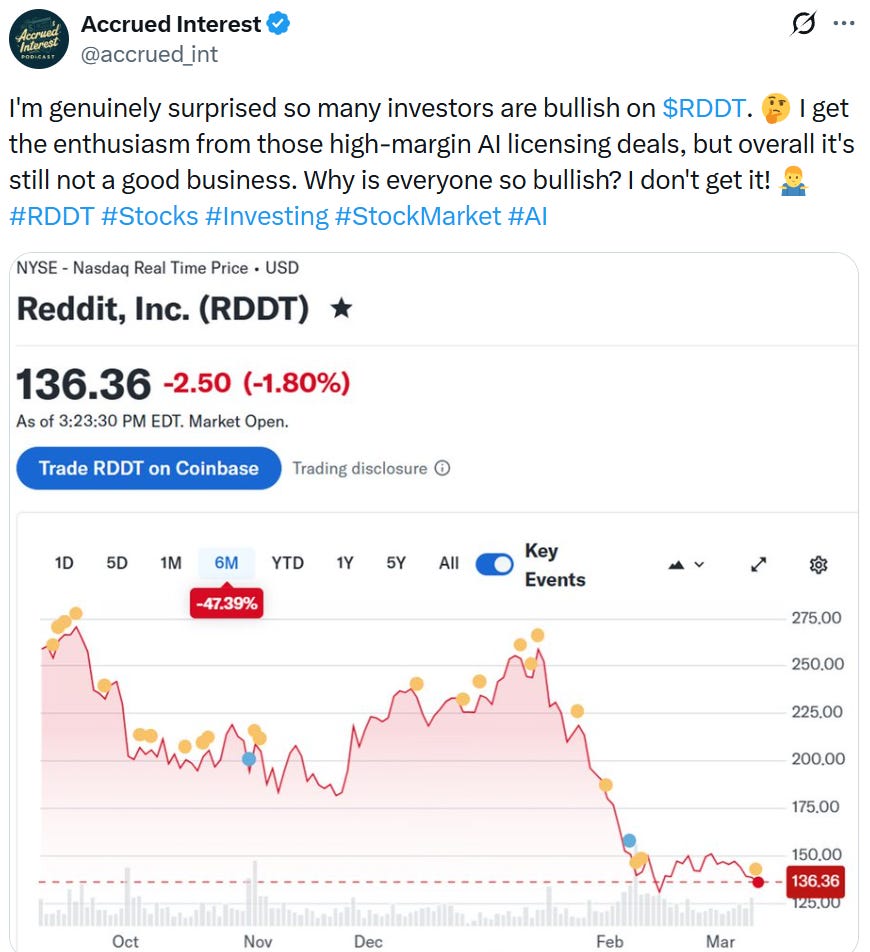
I got a ton of replies quoting me the revenue CAGRs and telling me to go “build a DCF”. But without opening Microsoft Excel, I could already see what aspects of the Reddit business model could put a ceiling on its growth ambitions.
Having spent over 15+ years doing strategic finance roles inside a variety of media companies - my investment edge stems from being an operator, not just an investor.
I figured now was a good time to share with you all some of my “mental models” on what makes an advertising business profitable, scalable and resilient. Judging business quality is a mix of art x science.
The Art of the Multiple: Quality vs. Performance
The concept of business quality is frequently misinterpreted. While quality often correlates with recent financial performance, it is fundamentally distinct.
While all businesses face inevitable periods of volatility, their underlying profit-generating potential is not equal.
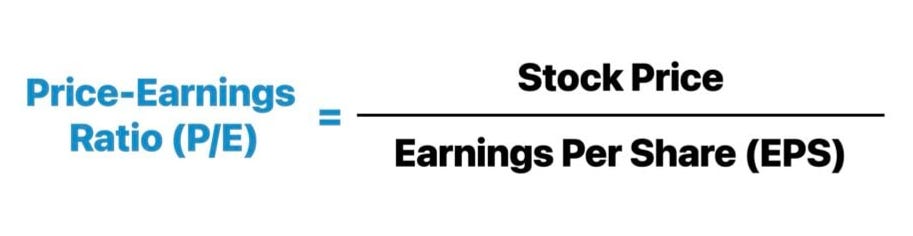
Every stock price is driven by EARNINGS X MULTIPLE:
The Science (Expected Earnings - The “E”): How much earnings a company is expected to make over the next quarter or next year.
The Art (The Premium - The “P/E” Multiple): How much the market is willing to pay TODAY for those future earnings is driven by qualitative factors often not revealed in a company’s financials. (This is where human judgement is needed.)
As a general rule of thumb, the market awards higher multiples to businesses it perceives as high-quality OR it expects to eventually become high-quality.
The Mental Model: What Kind of Pokémon Are You?
I want to share an exercise that I believe illustrates a less mystifying way to approach thinking about stocks, which will help you learn the process. Allow me to share some millennial lore.
2026 marks the 30th anniversary of the Pokémon franchise. And every Pokémon Master knows that part of the game strategy is assembling a roster where you pick amongst 18 different Pokémon types so that their strengths and weaknesses balance out. (Pokémon is really a game of rock-paper-scissors with extra steps - see the table below)
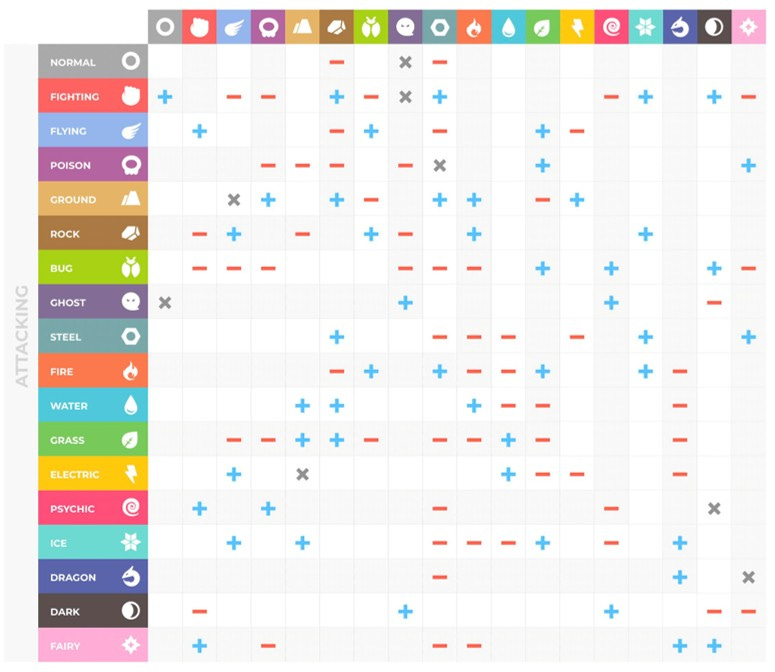
You would not pick six Fire-type Pokémon and take them to fight a lineup of six Water-type opponents and expect an easy victory.
Over the course of the game your characters level-up and evolve, becoming progressively stronger versions of themselves. However - their future powerset will always be derivative of their base form. (E.g., a ground-type Pokémon is not going to develop the power of flight.)
The same logic applies to evaluating companies (and their stocks) as their respective business models grow and evolve over the course of time.
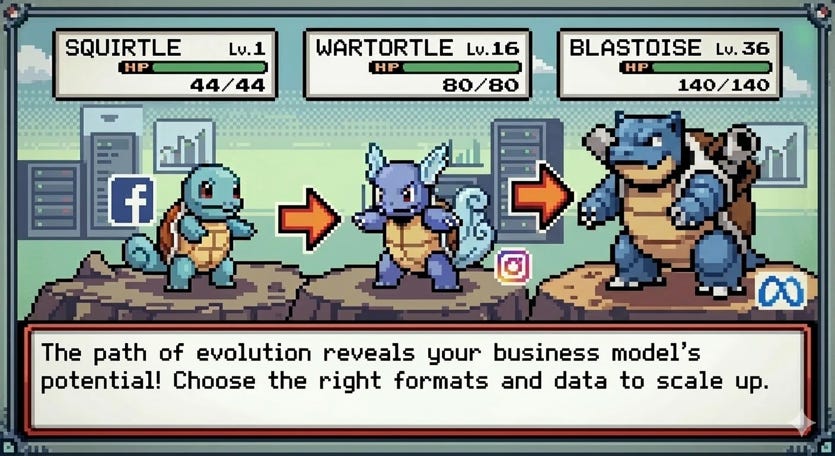
Any business can experience a growth spurt where sales are growing +50% YoY and anything seems possible. But no matter how successful a business appears - it can only change its model but so much in the future.
Understanding an advertising business’s core building blocks will give you a brutally realistic picture of what sort of outcomes WILL or WILL NOT be achievable.
Act Like a Trader, Think Like an Advertiser
The problem with a lot of stock pitches is that they are only being viewed through the lens of the product USER. They think just because people think something is cool and fun, that means advertising dollars are about to start pouring in.
But you must think about the needs of the AD BUYERS; the ones who are giving the company a share of their BUDGET.

At a high level, there are basically two broad types of ads: 1) Brand Advertising and 2) Performance Marketing / Direct Response.
Brand Advertising: These aim to capture attention and build awareness, making a product memorable for future purchases. (Think Tide detergent prioritizes long-term brand recall over immediate sales.)
Bigger Ad Buyers: Brand advertising is generally limited to the “Fortune 500” level of companies. Because only large companies have the surplus cash to spend on “awareness” or “sentiment” without requiring an immediate sale.
Discretionary: When a recession hits, the “awareness” budget is the first to be cut because it is hard to prove its utility in the short term.
Performance Marketing / Direct Response: These ads focus on measurable conversions, like units sold, calls received, or website clicks, rather than abstract sentiment. (1-800 commercials were a pioneering form of direct response performance marketing. Now promo codes are popular with digital services.)
Smaller Ad Buyers: Accessible to millions of SMBs (Small and Medium Businesses). A local plumber or a niche Shopify store does not care about “brand equity”—they care about leads.
Performance = Working Capital: Performance ads are seen as a cost of goods sold (COGS). If an advertiser spends $1 to make $3, they will continue to spend that dollar even in a downturn.
Advertisers decide where to spend their money based on what consumers are doing. This creates a clear ranking of the ad formats and features that matter most to them.
Video is King
People prefer video as a media format in almost every imaginable use case.
Businesses offering video ads often capture a larger share of a company’s total advertising budget.
Video ads almost always sell at a higher price, regardless of performance.
The Static Middle: I would put static pictures (digital display ads, billboards) next in the hierarchy of advertising formats.
These are images seen on phones, websites, or physical billboards.
They can reach a huge audience because they can appear everywhere digitally.
The Audio Bottom: Audio ads represent the lowest tier in ad quality.
Exceptionally difficult to determine:
Who is listening.
If they are paying attention.
Whether the ad directly led to a consumer purchase.
The podcasting industry exemplifies this struggle for significant profitability despite widespread presence.
Remember, most ad buyers use a portfolio strategy - spreading their budget across different advertising formats. While marketers are always readjusting their “media mix” favoring one format while reducing another, shifts are done over the course of years, not months.
For example - the linear television industry has been able to survive as long as it has, despite the emergence of streaming, because streaming services still do not have the capacity to take all the old-school linear ad dollars.
Advertisers also care deeply about the mechanics of the platforms they work with. Here are the key metrics that matter:
● Reach and Concurrency:
○ Effective advertising hinges on simultaneously reaching a large audience.
○ The Super Bowl exemplifies this: advertisers pay a premium to reach a massive, live audience at the exact same moment.
○ Advertisers will pay a premium if they are more certain someone saw their ad.
● Ad Load & Surface Area:
○ Every format has its limits on how many discrete ads can be served within a given period. For example, linear TV has a higher ad load (about 22 minutes/hour) compared to digital video (4-8 minutes/hour).
○ Lower ad loads in certain formats go a long way to explain why some digital companies often have lower margins than their competitors.
○ All companies face the challenge of balancing an increase in the volume of advertisements with the risk of negatively impacting the viewer or customer experience.
● Sales Force vs. Auction/Self-Serve Platform:
○ In-person sales channels have traditionally been used for older, higher-margin products. This approach typically results in slower price adjustments and a longer lead time for onboarding new advertisers.
○ Auction-based platforms are more resilient. They can adjust pricing in real-time during sales slowdowns. This adjustment attracts new ad buyers previously discouraged by higher costs.
● Brand Safety (Or Lack Thereof):
○ Advertisers pay a premium for brand safety, seeking to avoid controversial, salacious, or “not safe for work” content.
○ Many avoid news entirely, especially content involving polarizing topics such as the President and war, to prevent association with questionable material.

Twitter (X) has always struggled to convince ad buyers that their placements are truly insulated from controversy.
Grading the TMT Roster
Now let’s talk about some actual stocks so we can apply some of these concepts to the real world. Let me be clear - I am not making buy / sell recommendations today. I am merely using the above framework to discuss the quality of some business models.
The Gold Standard: Meta & Google
Meta and Google are considered the “crown jewels” or “gold standard” in the advertising world for several reasons, making them the clear top two global ad companies:

Meta (Facebook):
Largest User Base: Reaches billions of people, offering unparalleled audience reach.
Diverse App Ecosystem: Operates multiple high-traffic platforms including Instagram, Facebook, WhatsApp, and Threads.
Versatile Ad Formats: Can deliver various formats, such as video and display ads.
Google:
Superior Search Engine: Maintains the best search engine, providing deep insight into customer intent and thought processes.
Intent-Based Advertising: Highly effective at understanding what customers are thinking and looking for on the web.
Strong Tracking Capabilities: Excels at tracking clicks through to sales conversions.
The High-Quality Contender: AppLovin ($APP)
AppLovin is redefining the ad tech landscape by proving it is a structurally high-quality compounder. Rather than resting on simple display ads, their business is built on several key architectural advantages:

The AXON 2.0 AI Engine: AppLovin utilizes a proprietary predictive machine learning model that processes massive amounts of real-time market data to optimize ad placements. This creates highly efficient targeting that matches or beats incumbent platforms on cost-per-acquisition.
Full Attention Ad Formats: Their platform leverages non-skippable, full-screen video ads. In a mobile environment, a user is engaged in a single task, meaning these long-form ads command uninterrupted attention—a luxury few other digital formats can offer.
E-Commerce Expansion: While historically dominant in mobile gaming, AppLovin is aggressively bringing direct-to-consumer (DTC) and e-commerce advertisers onto its platform. These advertisers operate with superior unit economics and are highly responsive to AppLovin’s performance-driven videos.
MAX Mediation Auction: Their supply-side platform operates highly competitive real-time auctions that not only maximize publisher yield but constantly feed fresh conversion data back into their AI algorithms, creating a continuous loop of model optimization.
Good Businesses…With Limitations: Reddit & Pinterest
Sometimes a stock can fall hard (-30%) when a rich valuation multiple is temporarily attached to a mediocre business that is destined to revert to the mean. Again, this is an oversimplification, but this is why both Reddit and Pinterest have fallen so much YTD despite posting healthy revenue growth.

Reddit: At its core, this platform hosts digital message boards where people go to talk, look for facts and share opinions.
Strengths for Advertisers:
High Intent Data: Like Google Search, text-based message boards provide insight into user intent and buying interest.
Weaknesses & Limitations:
Video Platform Ceiling: Primarily text- and static-image based, limiting growth potential as the industry pivots to video.
Anonymity: High number of anonymous users.
Google Traffic Correlation: Traffic is heavily reliant on Google. This external dependence suggests a lower valuation multiple is warranted.
Pinterest: This is a site where users create, share, and discover digital vision boards that serve as “inspiration”.
Strengths for Advertisers:
High “Commercial Mindset”: Unlike “scrolling” platforms (Instagram/TikTok) where ads are often perceived as interruptions, Pinterest users are typically in a planning phase, explicitly signaling future purchase intent.
Weaknesses & Limitations:
Static Content Ceiling: Primarily static images limit growth; lack of video caps engagement potential.
Conversion Ambiguity: Difficult to measure inspiration-to-conversion rate accurately.
AI Flooding Risk: Vulnerable to system gaming by AI-generated image proliferation.
CONCLUSION
In every write-up I do, I talk more about the quality aspects of the business than its financials. You want to overwhelmingly invest in the strongest business models.
Life is short, and predicting the future is challenging.
While a lower-quality business can still be a viable investment, I would require a significantly lower earnings multiple before considering a purchase.
Stocks such as Reddit and Pinterest fall hard when the multiple is high and investors think they have a good business. Time goes on, earnings come out, and the business is not scaling in size or profitability like they thought it would, and then they must lower the earnings multiple. If you are wrong, then you are going to be punished more harshly with a weaker business, and the stock may never recover. Look at Snapchat.
But stronger companies like Meta and Google can make it through rough times and come out stronger in the end.
Share your thoughts in the comments below: Which companies do you believe possess the most resilient advertising models, and which ones are most vulnerable to competitive pressures?
-Accrued Interest
Relevant Tickers: RDDT 0.00%↑ , PINS 0.00%↑ , META 0.00%↑ , GOOGL 0.00%↑ GOOG 0.00%↑, SNAP 0.00%↑ APP 0.00%↑
Disclaimer: The information presented in this Substack is for educational purposes and should not be construed as investment advice. Investors should make their own decisions regarding the prospects of any company discussed here, as I am not a registered investment advisor.
You can always reach me at simeon@accruedint.com.
That's sharp framing. Too often I see financial analyses that ignore the product reality.
META for sure has very strong advertising model. Pinterest has theoretically promising one (discovery implies traffic closer to the bottom of the funnel), but seems they struggle to make it work properly.
I would add that strong model sometimes also causes too much optimism. I often hear bull cases for META based on "AI will improve ads efficiency!", but they again ignore the product reality: efficiency can't be milked indefinitely and META will inevitably face diminishing returns here.
Any thoughts on where Unity sits? Think we all know it aint the same level yet as an AppLovin (and I get theres some fundamental differences) but curious if any 2c take? Thanks for the write up Simeon! Largely agree on the ranking.