
Interview: Yet Another Value Podcast and the Shifting Media Landscape
Diving deep into the Versant ($VSNT) spin-off, the streaming wars, and why audience attention trumps financial engineering.

Accrued Interest TLDR:
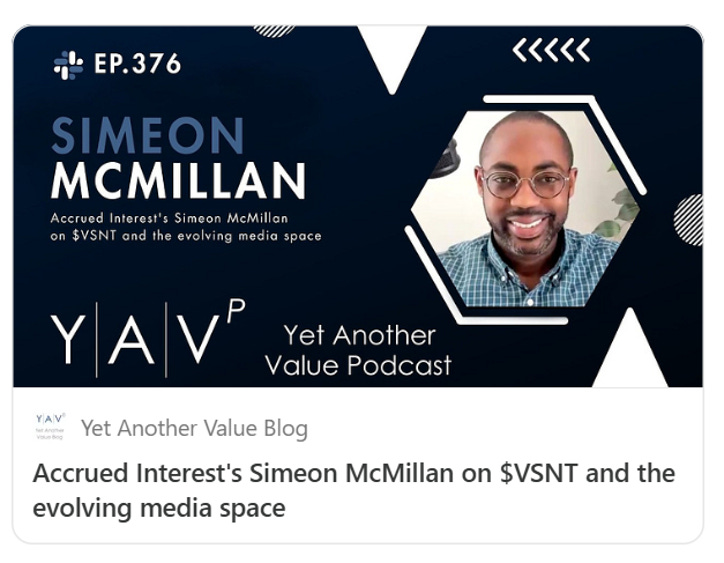
Check out this interview! I joined the Yet Another Value Podcast to discuss the evolving media landscape and do a deep dive into the recent Versant ($VSNT) spin-off from Comcast. We break down why the newly formed company might be a value trap, the hidden gem trapped inside its golf assets, and the upcoming bloodbath in linear television carriage negotiations. We also cover the future of NFL broadcasting rights and why financial engineering can’t save dying linear networks. Check out the article below for the full transcript, and be sure to watch the YouTube video or listen on all major podcast players such as Apple Podcasts and Spotify.
Introduction
I had an absolute blast joining Andrew Walker on the Yet Another Value Podcast to talk all things $VSNT and the wild evolution of the media landscape!
I’ve been a longtime subscriber and a huge fan of Andrew’s work, so getting the chance to sit down and jam on media strategy, the Versant spin-off, and the broader streaming wars with him was a real thrill. We went deep into the weeds—including why financial engineering isn’t a strategy and how the audience will ultimately dictate who wins the living room.
A huge thank you to Andrew for having me on. If you enjoyed the conversation, make sure to subscribe to the Yet Another Value Blog for more great interviews and posts.
Below is a detailed roadmap of the topics we covered so you can jump to the sections that interest you most. Keep scrolling all the way to the end for a full transcript of the talk!
Interview Roadmap
[00:00 - 02:13] Introduction & Disclaimers: Welcoming me to the podcast, establishing that the discussion is not investing advice, and outlining the focus on Versant and the broader media landscape.
[02:14 - 05:26] The Versant ($VSNT) Spin-Off Mechanics: An overview of Comcast’s decision to spin off its cable assets into Versant, drawing on my decade of experience supporting senior leadership inside major media companies like Univision and Hot 97.
[05:27 - 10:15] The 2028 Protective Halo Cliff: Why Versant is currently over-earning and the severe implications of NBC separating from the cable channels’ ad sales department in 2028.
[10:16 - 12:45] Valuation and Dividend Yields: Analyzing Versant’s recent stock bounce driven by its newly announced dividend, and why the stock might be overvalued at $35.
[12:46 - 16:45] The AMC Networks Comparison: Comparing Versant’s declining free cash flow and enterprise value multiples to the historical trajectory of AMC Networks.
[16:46 - 21:00] The Hidden Gem in Golf: Deep diving into GolfNow and GolfPass, the software and barter models powering this $600M+ revenue business.
[21:01 - 26:17] Synergies and The Golf Channel: Discussing the lack of real synergy between the Golf Channel and the booking software, and the broader recurring revenue strength of the golf industry.
[26:18 - 32:45] The Future of CNBC: Exploring CNBC as a potential trophy asset for tech companies or retail brokerages like Robinhood.
[32:46 - 38:24] Podcasting and Self-Disruption: How finance podcasts and YouTube are disrupting traditional financial news, and the challenge of on-air talent competing with their own networks.
[38:25 - 44:55] Carriage Negotiation Bloodbaths: Analyzing the precedent set by YouTube TV’s aggressive blackout tactics against Disney, and why Versant will get railroaded in future carriage negotiations without the leverage of NBC.
[44:56 - 54:50] NFL Rights and the Streaming Ecosystem: Breaking down why Netflix won’t bid on a full NFL season, the domestic limits of NFL leverage, and why legacy broadcast partners will pay up to keep their packages.
[54:51 - 60:02] The Nielsen Gauge and Wrap-Up: Wrapping up the hour-long discussion by highlighting the monthly Nielsen Gauge report series on Accrued Interest, which tracks the torrential ascendance of YouTube’s market share on big screens.
Full Interview Transcript
Andrew: Hello. Welcome to the Yet Another Value Podcast. I’m your host, Andrew Walker, and with me today, I’m excited to have from Accrued Interest, Simeon McMillan. Simeon, how’s it going?
Simeon: I’m doing great, Andrew. Thanks. Thanks for having me. I’m a first-time guest, longtime listener, and longtime subscriber as well.
Andrew: So I really appreciate it. I’m excited. I can already tell you and I are going to have a lot of fun—our energy is right on the same path. So I think we’re going to have a lot of fun here. Look, we’ll hop into it in one second. Remind everyone, nothing on this podcast is investing advice. Please see a full disclaimer at the end of this episode or there’s always a disclaimer link in the show notes. Simeon and I are going to be talking Versant in particular and media in general. So we’ll be popping around today. Simeon, the reason I reached out to you is I followed Accrued Interest for a while, but I mean, you have just been smashing the name on the Versant story, which is the spin-off from Comcast. I’ll let you give the full overview. So I want to talk about that in particular and then we can talk media in general. But I’ll just pause there and kind of turn over to you and, you know, what is Versant and why has your coverage of them attracted me to you so much?
Simeon: Sure. So again, thanks for having me on and I want to say hi to all the listeners on the podcast. We’ll follow up at the end with all of my handles and whatnot.
Andrew: I’ll include a link to Accrued Interest in the show notes if you want to see the articles I’m talking about, too. I’ll just throw that out there so people can follow you. I always want the guests to get all the likes, all the subscribes, and everything.
Simeon: Absolutely. No, this is a perfect intro. So as you opened up, I cover a lot of media, just for context for the audience, because I think it’s very relevant to how I describe the company. I have experience in investment banking, the buy side, hedge funds, and middle market private equity, but I spent about a decade working at basically an executive level or supporting senior leadership inside media companies. So I have a lot of experience in senior FP&A roles, ad sales, and investor relations. I worked inside the office of the CEO for Univision Communications where I got to see them work with a very similar set of assets as Versant. And that’s what brought me to this here. I wanted to have a different view on the company. There’s a lot of newsletters out there that cover spin-offs. And I think a lot of the alpha has come out of spin-offs recently. You can’t just mindlessly buy them. And I think for the most part, a lot of investors had a good read on Versant. This is one of the last spin-offs. We’ve been spinning off cable networks and TV networks for almost a decade. So they’re very late to the game. And so I wanted to see what was actually there. And then I wanted to see if there’s any strategic value, let’s say if something happened with Paramount, Skydance, and Warner Bros. I started looking at this before that whole merger saga. I came to his conclusion and it might still not be over.
Just to dive into the name Versant to clarify for the listeners. It’s a spin-off of the cable assets from Comcast Universal. So when Comcast Universal separated their TV assets, they put everything in Versant except for two, call it three, assets. They kept the NBC network, the broadcast network, and Peacock. They obviously kept Peacock, the streaming conduit for NBC, as well. And they also kept Bravo, which is a general entertainment network.
Andrew: I was just laughing because you said they put everything in except for it. It’s like they put everything except for the things that actually matter, like the real good stuff. Bravo is kind of funny that they didn’t put it inside here.
Simeon: Yeah, I did think that that was kind of funny because Bravo is what I would call general entertainment. But they decided that that was the one that they wanted to keep. So anyway, so the spin-off happens. Okay, just to skip ahead a little bit. So this is a little bit the opposite of what happens with Warner Bros. Discovery and their linear spin-off. This spin-off was not done under duress. First of all, so this has been a long time coming. Why now? It just so happened to be now. There’s a key date that I want your listeners to keep in mind for 2028 because in 2028, that is not only the time when the spin-off is no longer held back from doing M&A and other strategic deals that could threaten the tax-free nature. In 2028, NBC is separating themselves completely from the ad sales department of these cable channels.
It is very quickly for your listeners: I think a lot of investors, and this is where I try to add my edge, pay far too little attention to the mechanics of what it takes to actually sell advertisements. It’s actually a very difficult thing to do. And you can’t just pop up and sell ads to a hit show overnight. So this law puts in takes. What your listeners need to know is that right now, all of the financials inside Versant, I would argue, are over-earning. They’re over-earning because up until today, they’ve had the protective halo of the NBC family. And this gets especially relevant because Versant wants to really market itself going forward as having strength in news and sports for live events. Well, we can get to news in a second. The news is MSNBC, but I actually think that you can sort of ignore the news and the politics of it. Let’s just look at the sports. The sports rights that they have are really just a compilation of sports rights from the NBC portfolio that they didn’t have room to put on the NBC network. Like that is in a nutshell, what the assets are.
And then I also want to point out to people, and we talked about this more, when entertainment companies sell ads, the ads are sold through sales teams and they’re sold in a packaged way. Usually, you cannot just buy one show or one event. It’s always done as a portfolio, as a formula. They use the stronger content to help sell the weaker content. Well, the biggest thing your listeners need to know is that the Olympics with football slash the Super Bowl—the Super Bowl rotates networks every three to four years. As your viewers know, those two marquee sporting events were the ones that I think were forcing advertisers to buy all these other networks. So a big issue I have is that whatever forecast you want to make, it changes completely when the ad sales relationship separates. And the baby is no longer under the protective parent of NBC. So I’ll jump to the conclusion: I rate this underperform, not just because the fundamentals are deteriorating, but because they can’t do the strategic moves and need to get out of this. And I don’t know how you can put a multiple, I don’t know how you can put a dividend yield on the company until we get past the 2028 separation.
Andrew: There’s one other piece, and again, this is why when I was reading your piece, I was like, I could imagine a younger me seeing this spin-off. When I was following all the Paramount/Warner Bros. stuff, you know, they come on and you would hear the CNBC host be like, we’ve never seen a stock with this much selling pressure, right?. And these are generally well-reasoned guys who like, not that they’re investors, but they’ve seen a lot and they’ll be like, it’s just the selling pressure is relentless. I remember, I think it was David Faber, who’s like, this is a coiled spring, and David Faber is generally very measured when he’s talking about something. So you look at this and you say, Oh my God, they spun off and yes, I get it. These assets are terrible, but they’re kind of trading at four and a half times, five times, and you’re not the only one. They’re shitty, but they’re not AMCX shitty, you know, so you kind of see that. But then your piece is the one where I really started thinking like, Oh my God, the one thing you didn’t even mention, which you’ve pointed out. So it’s not that you didn’t see it, you just didn’t say it in the rent. I mean, we didn’t even talk about, Hey, the carriage was done under this umbrella of the NBC umbrella. Right. So there are carriers too. But then you start thinking exactly what you’re saying, like, Oh my God, when they go to do these advertising to like, Hey, does anybody want USA Network? Does anybody want USA Network in the sports portfolio? And I’m going to talk about all this, but I was looking at the sports portfolio and they love to come out and they say, Hey, 60% of our viewing is live news or sports. This is what you want. You’re like the sports portfolio. They are going to get, as soon as they’re out of NBC, they are going to get the worst of all worlds, right? Because right now NASCAR, they love to say we’ve got four NASCAR races. I think, as you said, they’ve got the four NASCAR races that they couldn’t put on NBC. Well, in 2028, when they’re out from NBC, either NBC is going to say, Oh, we’ll take those NASCAR races back, right? Or NBC is going to say these things suck. All right, Versant, go bid for them, but they’re there. They’re so small. Like all their sports rights are going to be gone. It is just they’re in a tough spot. So I rambled a lot. I just want to throw that all out. Perfect.
Simeon: No, no, it’s, and along the lines, what you’re saying, what I think is interesting is that as I mature as an investor and making content, well, making content for a living, excuse me, will make you a little more contemplative. I want to try to go behind. I’m going to steal that from yourself.
Andrew: I love that line making content for a living. I’m going to steal that from you. So that is fine now.
Simeon: Oh, please do with the crisis we got on right now. There’s a lot of content to be made, but we’ll get to there in time. But yeah, no, and I think it was also interesting too, is because you have this sort of holding pattern until the time runs out in one to two years, I think I want to put on people’s radar. I actually think under the right circumstances, there’s lots of bits and pieces that different middle market private equity players could probably want a part of. But let me tell you this, Andrew, I know this from experience working inside Univision and working with and looking at other similar companies. Everyone internally, I guarantee, knows exactly what the stakes are. And I think, and we can talk about this more, you begin to see little, I want to say tricks, but little cues and tells what they talk about, what they choose not to focus on, what they do want to focus on because they themselves, if you put themselves and see the management here, okay, we like to talk about incentives; management knows that their hands are tied. They literally couldn’t even sell the company if they wanted to. So something that made me laugh a little bit. I don’t give action alerts and I don’t pitch a portfolio with precise buy and sells. I think this is underperform, but the stock has rallied recently. And why was that? Well, it’s because on the quarterly earnings last week, which we can talk about, it wasn’t because of anything they said with the actual performance. It’s because they announced a relatively large dividend, a dividend, which comes out to about $1.35, $1.50 a share, I believe, which around $35, $36 a share comes out to about four, four and a half percent dividend yield. And so with the dividend announcement, it forced the stock to rerate. And I’m not sure when this is going to air, but the stock is currently trading around $35, $36. So it’s bounced off of the lows a little bit. In my analysis, I want to be conservative. I think that this is probably worth $27 a share. And I look forward to 2028 and I put a multiple on that. And to your point, you bring it full circle. I actually think this is very much like AMC. And in the article, I actually showed that if you adjusted their multiples, the stock price is the same where it was about three months ago. But I can say, so AMC networks at the time was trading at about seven and a half to eight times EV to free cash flow. Enterprise value to free cash flow is sort of my version of owner earnings that I tend to use a lot on Accrued Interest. So AMC was at about seven and a half times that in 2028. And then on my adjusted math, I said, Oh, yeah, Versant is trading about seven times the 2026. But that free cash flow is rapidly falling. Free cash flow is falling between 15 and 20% a year. It’s scary out there.
Andrew: You know, I think one other thing, and this is just technicals, but I do think people were shorting Versant against the Warner Bros. just on the, because Netflix won and there was the Warner Bros. spin. I think this was the, nobody wanted to sort of that Warner Bros. spin. So you had this and it’s not lost on me that the day Paramount won the bid, this was quite a bit. Let me go. So we’ve been pretty negative and I want to come back to all the reasons to be negative. But the other thing I found really interesting in your article is, you know, I read a lot of these spin-off presentations. If I read most of the Versant material—particularly about the tee time service that they have—just as a general observer, my first instinct was these guys are smoking something right there. There’s no value there. Like they’re just desperate. They’re trying to get something to hang their hat on so that people can get excited. And it’s not lost to me like golf, you know, who buy stocks? It’s generally old white men who like to golf or your key buyers and they run a lot of portfolios. Right. So it’s not lost to me. That’s something you talk up and like it excites your customers. But your article was the first time I saw like, Oh my God. And they, I knew they’ve mentioned like, Hey, it’s about 10% of the subs. But your article was the first time the math got laid out and I was like, Oh my God, they might like actually have a growth category killer like the type of thing that a private equity firm might really pay and get behind. So one of the things I liked about your article was it hammered the stock, but then you pointed out this and a few other ones we’ll talk about. But some hidden gems in here. And I’d love for you to just talk about a little bit the golf play in particular the tee time business if we can. So the listeners have a little bit of upside or, you know, if the stock crashes, something to hang their hat on.
Simeon: Sure. So, speaking of the golf assets. So everyone can know what we’re talking about. The way I’m going to tell you how they present the business and how I think about it. So they put the golf assets together. All right. And it’s about a 50/50 split in terms of revenue. So it’s about 600 million, let’s say, on each side. So you have the Golf Channel, which I’m going to say right now, I think has no synergies with this golf business. I don’t think it, no, no, it’s, if they want to advertise, they can advertise on it. They only don’t.
Andrew: It’s the type of thing. It sounds good. It’s one of those one plus one equals 1.5 mergers and people come out like, hey, we’re merging. I’m trying to think of a good recent one. But, you know, we’re merging. You’re like, you could solve that with a contract. You could solve that with a license. Like, you absolutely do not need to have these two businesses together. I’m trying to think of another good one, but I completely agree with you.
Simeon: Oh, I can give an example right here. And we’re seeing this with the NFL and the NBA. There really was not that much value in the NFL network. There really wasn’t, and same with NBA TV, you know, with Warner Bros..
Andrew: NFL network was a tax, right? You know, you’ve been doing this long enough, you know, 10 years ago, RSNs, and I fell for it. RSNs were the crown jewel in a portfolio, right? They were the best things you could buy. And the NFL network basically formed their own RSN and was like, hey, four NFL games a year. You’re going to have to carry this out in channel because everybody loves the NFL. And then, you know, there’s no need for them to have it now. So, I think that’s a pretty good one, though. I’m sure we can think of some better ones if we came up with it.
Simeon: So with RSNs and all the numbers I’m giving are highly estimated, I triangulated. Please do your own research at home. I just want to point out the company has never provided specific numbers, probably for a reason on the most recent call. If you read between their guidance, the GolfNow business is probably growing at mid-single digits. Maybe high-single digits if that. So I just want to say that. So we got the Golf Channel about 600 million in revenue and falling because it’s losing carriage or will be losing carriage because it’s not a must-see channel, because, as your viewers also know, the must-watch golf events aren’t even on the channel. But so back to the actual software business. So the business is GolfNow and GolfPass. I think it’s about 600 million in revenue. And what it basically is, is they have somewhat of an oligopoly. And I’m sorry, I don’t play myself, but for any listeners who do, there’s a recurring aspect to it. There’s software. In the article, I was saying how what’s interesting about it is that they’ve been able to get more traction, they’ll be able to cover more golf courses by selling the software through a barter model. So in television, where I’m used to barter, a lot of times companies will exchange advertising for airtime in another show. Okay. So barter, you trade my ad time for your time. In this situation, what the golf courses do is Versant or GolfNow says, Hey, look, instead of paying us for this booking software, you give us a percentage of your inventory of your booking fees effectively. And what’s interesting is that this aspect adds a little bit of an inflation hedge to the business because you have a natural revenue uplift.
Andrew: Can I drill in on that? I’m sorry. So are they saying, Hey, you know, golf course X, we want 10% of your inventory. If you’ve got an 8 a.m., a 9 a.m., a 10 a.m. slot, we’ll take the 8 a.m. slot? Or do they say, Hey, every time someone books through us, you know, we’re just percentage of sales. If somebody pays $50 for the tee time, we’re taking $5. Which one are they, which model are they following?
Simeon: I’m not sure exactly the mechanics of the sales agreements, but I think it’s probably much more percentage based. I would guess so.
Andrew: The former is interesting, but it would make sense. I mean, this is, if I remember correctly, this is largely what Mindbody does. This is what Doordash does. This is completely, completely standard. But I think it’s a very interesting model. Please continue and I’ll add stuff at the end.
Simeon: Sure. So they have this model. There’s a whole separate research vertical. If I was younger doing this, or this was a standalone business, I would say, Hey, I think golf is actually still growing. It had a big burst during the pandemic. I thought it was a fad. I did a little research. It turns out it’s not. It’s still growing. It’s a healthy sport. I think it’s a good business. But the key thing to know, and this is what I always have to remind myself, is what is material to the stock. This 600-ish, 700 million dollar revenue business is not growing fast enough with margins high enough to really make noise in the equity story. And that’s why if you go inside the filings, they break out almost nothing. You really have to work hard. I would argue that if you actually look at how little they tell you about the golf business, Versant basically talks about the golf business as, look, they say we have these other growth businesses that are creating enough revenue to offset the declines of our media businesses. Okay, so I gave a little overview of the mechanics. I think it’s an attractive business, but it’s clearly being trapped inside of the structure. And I can see this being one of the assets that at a later date, probably is going to find a new home.
Andrew: Look, it’s interesting because everything about this business reminds me of Mindbody, right now Mindbody. The nice thing is you tend to book gyms. I mean, Mindbody for those who don’t know is the software that if you do boutique fitness, they power most boutique fitness gyms and stuff and some other stuff. But, you know, that business, it was years ago, but it got acquired for like, I think it was seven or eight times revenue, right back in early 2019. Now, this is before the SaaS sell off, interest rates are zero, all that sort of stuff. But I could imagine having golf course inventory, you know, boutique fitness, there’s a hundred, two hundred, five hundred clubs and they’re churning a lot like golf. I could imagine once you get golf, if you get exclusive rights, like pretty damn sticky. It’s not like there’s 15 golf courses changing every month. You get one, you lock them in, people get used to it. I could imagine it’s a pretty damn good sticky business. As you said, inflation protected. I could imagine it being a pretty, pretty high multiple business. So that’s what I think so interesting because again, when you’re paying five times EV/EBITDA for the whole thing, and we’ve talked about how EBITDA is falling off a cliff. But if you’ve got a little, you know, let’s say it’s a four times revenue business that’s growing five percent per year. You said it’s 600m right. I mean, it starts adding up really quickly and you start to get to really interesting sum of the parts. So I don’t know anything else on the golf business you want to talk about?
Simeon: Well, no, that was the crux of it. I think that in the news, there have been some reports, again, more on the Golf Channel side, and there have been some reports speculating what moves Versant could do to get studio space for the Golf Channel, because one of the many questions of what they’ll do without NBC is, okay, where do we get studio space where we get equipment. I’m less worried about that. They’ll probably work it out. But yeah, the golf part is the most interesting aspect. All the other sports are really just trash.
Andrew: It’s so funny. It’s like, where are they going to get studio space? It’s like the Golf Channel is declining, like crazy. And by the way, have you seen the stock prices of some of these offices like the AI revolution is here? I’m sure they’re going to be able to find a warehouse to stuff a bunch of people in it if they really need to or something. I don’t know.
Simeon: I would say so. Let’s ask what you want to talk about next.
Andrew: I want to talk about one other interesting asset that I think has a lot of upside and this is probably their trophy asset. I would say you could correct me if I’m wrong, but CNBC. And I mean this in a few ways, you know, CNBC. I think it’s so interesting because look, it’s a bedrock of the financial community. Yes, people like to go on Bloomberg television, but as the CEO said, I was just at Davos and you should see all the business people want to talk on CNBC, right? If the administration wants to send somebody out to get an economic point, they send them to CNBC, right? So it’s got that brand name. It’s got a little bit of a dump. I think there’s a lot of interesting and you explored them in your article. There’s a lot of interesting possibilities and levers you could pull. But at the same time, I kind of look at them like, Hey, man, okay, yes, it’s nice, but it’s CNBC. You know, they’ve stubbed their toe a lot on launching financial networks. It was like, is it that great that in two years, you know, Bloomberg’s out there. There’s a lot of other competitions. It’s a legacy news network. I could imagine it’s getting undercut in a lot of ways. So I could see upside and downside and it’s probably the crown jewel. So let’s just spend a minute talking about CNBC and kind of what you see for that.
Simeon: Sure. So I think that you’re very astute in your recognizing the disruption risk in CNBC. That’s actually something that I had to write the article again. I’m going to explain to you why I think that CNBC actually has similar disruption risk to MS Now, a very liberal network. I just want to say, I actually have extensive experience in radio. My last corporate role. I spent about three years in what actually was a carve out of radio stations, Hot 97, WBLS with some billboards, a random combination.
Andrew: And so all the radio stations have billboards. I mean, the old CBS outdoor billboard, they always got mashed together. And I guess it was because it’s a local sales business, I guess is why, but they are, or maybe it’s because 50 years ago, they were the best business, you know, but for some reason, radio and billboards matched made in heaven.
Simeon: All the above. Yeah, radio, billboards and television. And I got to talking with a head of programming over the years and learned a lot. And he explained to me that liberal talk radio and conservative talk radio are really different products. And I think that as that’s true in radio, that’s also true in television. Okay. But what I think is similar between CNBC and MS Now is I think both financial news reporting and political talk, I think it’s clearly being disrupted by podcasts. You know, you have cross-pollination. You have CEOs, finance people who will go on lifestyle podcasts, like Rogan or Theo Von or other stuff and break news like that. You have financial people who will go on podcasts like the All-In podcast. It feels like a lot of investors have their own podcasts to break news. You have companies with it.
Andrew: They come on this one, whatever they want to, my friend.
Simeon: Exactly. Did you see the one? I don’t butcher her name, but it was the CFO of Meta. And she had a hat that said Free Cash Flow. And she was on someone’s podcast wearing a hat that said Free Cash Flow right before they hiked their CapEx forecast and killed their free cash flow. But I digress. The whole point is that I actually agree with you. I actually think, in time, I could see CNBC getting slowly disrupted by just the proliferation of podcasts. Yes, I think that another tricky part about CNBC is that CNBC is very much a channel that’s tied to the linear bundle. I think it’s one of the last channels that will be left standing as the bundle keeps shrinking. And it keeps whittling everything away. I tell people Fox News will be the last channel in the cable bundle. If it was a battle royale, I think close to the top five, you have CNBC that would make the cut. But yeah, I think they have some obsolescence risk. I also know that CNBC is looking to try to sell D2C to try to sell some more high value subscription financial news products, join the club. I think that everyone’s got a Substack as we both know. So that’s a little, that makes sense on paper. But I’m not sure how much incremental revenue there is. I’m going to get to the point. I think CNBC would be a great trophy asset. But you need a trophy buyer who is willing to pay a trophy price. And I think it’d be a great trophy asset for a large tech company that sells stuff. Because they have one of the highest average income audiences out there anywhere. So an Amazon, just anyone. In my piece I threw out there, and this is really a pie in the sky, a Robinhood.
Andrew: If they want to have a news, you must have seen in my mind because I could see it, right? Like Robinhood. You know, you think about all the E-Trade use, integrate with Yahoo TV, I think, but you could see how a Robinhood integration could make sense. You could see how integrating this to a data provider, right? Like S&P or something. Because it does have a brand name. And as you said, you could see a lot of different ways. And I am really interested in the D2C side. CNBC still does break a lot of news. You could imagine like, Hey, a professional tier where the news is getting hit on the professionals tier 10 minutes before it’s hitting. I’m not 100% sure, but it does seem like there are a lot of options. I will tell you that I think CNBC is mismanaged. CNBC’s YouTube presence sucks. How can CNBC’s YouTube presence suck because it feels like that’s a place where a lot of these stories are pretty topical. It feels like they should be doing more. They’ve got several different channels. But the one I looked at, it just had like months old stories, very little views. They do have one that kind of runs little clips, but it just feels like an untapped asset that has a lot of different levers. And it feels like, maybe my imagination is too wild for like a legacy brand, but it feels like they weren’t really pulling the right levers or really looking to maximize its value here.
Simeon: So here’s my thoughts on that. I think that, and this is where I’m not predisposed to defending management. I’m not rooting for any side in this. I think investors are right to push management and to be skeptical and make sure that the thing is forthcoming as they are. However, I would say what I like to talk about on Accrued Interest is what it’s like to be inside the boardrooms of a lot of these media companies. And I can tell you if there is an overarching theme of year one of Accrued Interest, I’m coming up on my one-year anniversary of launching a Substack in a couple of weeks, about 1100 subscribers in the first year, which is more than I ever would have imagined. A piece of the overarching theme that comes up is that YouTube competes with everything and YouTube is the force. It’s the force in the ether that we don’t talk about, but it matters. I can tell you from having built revenue models, YouTube—putting your content on YouTube, if you’re a legacy television video provider, it’s a devil’s bargain. You have to do it, but the economics are horrible. So you try to do as little as possible.
Andrew: Yeah.
Simeon: So if you ever see someone whose YouTube presence isn’t as big as you might think it should be, or it needs to be, it probably is for a reason. But to your question of, well, is it mismanaged or what they could do? I think that another tricky part about media is the unbundling of all aspects of media. Let’s focus on video. Okay. A big reason why Versant is in the position they are is because the whole streaming ecosystem, I think, made the whole concept of a network irrelevant, because as you search for something, a show is a tile on the screen. And I can tell you most people really don’t know what show comes from what network or what studio has made it. Now another problem where I actually have some sympathy for CNBC, MSNBC, ESPN, really anyone who wants to try to do news, is that all these companies were forward-thinking. They let their talent do podcasts; they let their talent go out there. But what ends up happening is that your talent ends up competing with you. So I don’t have it in front of me. I’m not sure of a list of all the talent on CNBC. I’m more of a Bloomberg watcher. It’s a little calmer. It’s like easy viewing. It’s like lazy viewing for me in the background. But I know from the Bloomberg anchors, almost half of them have a podcast. Okay. You know, and they go on other people’s shows. And so what happens is that just by nature of existing in the digital ecosystem, you have no choice but to disrupt yourself. And that is an observation you made in that piece that you wrote. I want to say this last week, where you’re prepping for your webinar that you’re going to be hosting on Netflix. When you point out, Andrew says, Hey, Netflix outperformed every other media stock over the last 10 years. And sometimes it literally is just that simple. Like, I really do think that sometimes a lot of these media companies are structurally handcuffed and they can’t make the changes. But yeah, to your points. I think CNBC probably could have done more, but short of bringing in some of the podcast guys. You know, if you look at ESPN, ESPN, I think is a good example here of what CNBC is probably going to have to do, but it’s not ideal. So are you familiar with the Pat McAfee show? So Pat McAfee, for any listeners not familiar, he was a sports podcaster. He was a former kicker.
Andrew: Right. Yeah.
Simeon: He wasn’t like a superstar. He wasn’t dating a pop star, but he built a great show, a big following. And now ESPN licenses his show and they paid him to take his show off of YouTube. And now he’s on air on ESPN. He’s tussling with them. I could see a business model where maybe CNBC goes to the All-In guys or another finance podcast and says, Hey, you know, maybe we don’t need Jim Cramer on for two hours yelling at people.
Andrew: It’s funny to say that. Cause I think Jim Cramer is there. Stephen A. Smith, and it hits me now Cramer is older, but when you look at their desks, every CNBC has him, but I think you’re onto something. Right. Like you think about, I have not watched CNBC in so long, but you think it was like, they’ve got Cramer. They’ve got the Fast Money traders, like you could imagine where it kind of, as you’re saying, it kind of hybrids like ESPN has SportsCenter, which is the news, and then they’ve got, you know, Pat McAfee fills a big block. They’ve got a lot more personality-driven shows. You could imagine a CNBC where they break it into, Hey, we’re going to have the news for part of the day. And then we’re going to start licensing. And you know, maybe if people love Andrew and Simeon, maybe it’s we license the Andrew and Simeon show to talk about media or, you know, but you could imagine that’s where it’s going.
Let me go back to Versant 2028. We talked about, they’re boned in a lot of ways. Right. First, they’re going to lose a lot of these sports rights that they share with NBC, whether it’s the Premier League, NASCAR, a lot of others are going to kind of come out of that. And I think they’re going to get the negative end of every single one of those situations. And that’s just a scale thing. Right. USA is going to reach 70 million people and be getting 10 cents a head. And NBC is going to be reaching 100 million people and be getting a dollar a head. They can just pay a lot more and distribute it to more people. So I think they’re screwed in ads. The other interesting thing I think is, look, they gave 2026 guidance and I can’t remember if they gave 2027 guidance. I can’t remember, but no, they didn’t. Yeah, they haven’t, but 2028 is where the big cliff of where the majority of their subs are going to end. And they even said, look, we’ve negotiated this under the NBC umbrella. How bad, when they go to Cox, or I guess it’s going to be Charter, when they go to Charter, when they go to the old mothership, when they go to Comcast, when they go to Verizon, and they say, Hey, we’re here to renegotiate. And we’re negotiating, you know, just for USA, CNBC, MS Now and whatever rump of other channels they have. We don’t have NBC. How bad are these renegotiations going to go?
Simeon: I think they’re going to be completely railroaded. I think that a lot of these channels are going to absolutely drop carriage, that they’re going to lose their spot on a lot of different providers. So here’s something I want to contextualize for your listeners. A lot of my pieces on Accrued Interest are trying to point out the media stories that aren’t necessarily financial, but I think are really important. I think the most important television strategy negotiation was last fall, when YouTube TV gave Disney a black eye. YouTube TV, I think it was for maybe several weeks, had what was the most contentious cable carriage dispute with Disney channels.
Andrew: And they did something even more contentious than the Charter one prior. Yes.
Simeon: For this reason, Andrew, because for the first time, I call it shooting the hostage. YouTube said, we’re not going to fold and they let their subscribers miss, I think, two weeks of NFL games. They missed NFL games and they missed some college football games. And for your listeners who aren’t familiar. So I’m an elder millennial. Okay, I’m an 86 baby. So I remember TV in the old regime. And for those who aren’t familiar, when there used to be a negotiation between a local cable company and your local channel, if they had an NFL game, it was a wrap. The cable company was going to have to fold because they could not deal with everyone being mad.
Andrew: The executives were worried that their subscribers were going to come with pitchforks. If they missed an NFL game, the subscribers come with pitchforks and just force them to take the settlement.
Simeon: 100%. So to get to the point and answer the question, I think that, while people weren’t realizing it, we entered a new, more contentious set of carriage negotiations and we’re in a period now where channels are just getting dropped and staying dropped. So Disney on their latest call had a huge charge—like hundreds of millions of dollars—for being kept off. And this is where it gets really fun. YouTube not only bloodied them, but YouTube set a precedent where they basically said to Disney. And this is really where Versant is going to get killed. YouTube set the precedent: okay, you know, we’ll carry your channels, but you’re going to have to give YouTube TV subscribers for free all the goodies that you were giving to your subscribers, ESPN+, you’re going to have to give them away so they can ingest that content, all those WWE pay-per-view events, all those UFC pay-per-view events. Yeah, we’re getting that for free.
Andrew: Let me pause you there, because one of the most interesting things, and I still don’t quite understand it, is Charter’s Q4, right? This is much talked about, and I still, probably because I’m not as deep in the weeds. Charter’s Q4, for those who don’t know Charter, they own Spectrum, a big cable company, about to merge with Cox. They’ll, I think they’ll be the largest cable company, even bigger than Comcast after. They reported a surprise increase in video customers. And now there’s a lot of things going over. One quarter does not make this a trend. But I think one of the things they’re saying is, look, we’ve succeeded in our negotiations because they had a contentious negotiation with Disney, and they’re doing a lot of things that you’re saying. They’re saying, hey, if our subscribers are going to pay you $10 a month for ESPN, then Gosh darn right, they’re going to get access to your DTC service. You’re going to have to let them connect. And I think that’s what’s driving it, but I’d love, what did you think of the Charter Q4 video number?
Simeon: Sure. So full disclosure, I don’t cover Charter extensively, so I was not familiar with that. I can tell you, it did not register to me, partly because in my tracking notes, for the last one to two years, almost 100% of the net customer adds in the pay TV bundle have come from YouTube TV. I forgot what analyst it was. I’m not sure if it was MoffettNathanson, but I track the numbers myself. If you just add up all the pay TV losses from all the distributors, and then the industry gains, it pretty much all came from YouTube. I’m not sure as much what that short term was for Charter, but cord-cutting is still happening at an egregious pace.
Andrew: Here’s an interesting question. So I think the next big shoe to drop, and you can correct me if I’m wrong, right? But I think the next big shoe to drop is the NFL wants to get all their, you know, despite the fact they just signed a new agreement. I think the current agreement runs till 29. I can’t remember for sure. They’re signing a new agreement this summer, right? They basically go to the show and say, they’re signing a new agreement. And I think there’s two interesting things about that. I don’t think people realize like the Fox network, and I’m just going to be a broken record. I’ll say this on 15 different podcasts at this point. But Fox, there’s no point for them to exist without NFL. And that is one of the big four broadcasters. If they lost the NFL, I think that network goes away, basically. So getting the NFL is existential for them. ESPN. Now ESPN is probably in a good negotiation position because NFL owns 10% of ESPN at this point. But ESPN, I don’t think it’s quite existential because they do still have NBA and other stuff, but come on. If they lost the NFL, I mean, that whole network, especially because not just NFL itself, but all the tail programming stuff, like they got to have the NFL, I think. So borderline existential for them. Paramount, kind of existential for them. They do have other stuff, but I don’t think people realize when you’ve got three bidders that are existential there, how crazy the bidding is going to get here. I mean, I think NBC wants it. You’ve got all these players. I think Netflix keeps saying we’re not going to do a whole season, but Netflix seemed very happy with how the Christmas games performed. Amazon’s been very happy with how they perform. So the two things I’m driving to here is A, how crazy do you think the NFL bidding is going to get? But then B, YouTube, which you mentioned is the biggest growth. And I think YouTube can be so interesting because it’s the biggest growth. And as you’re saying, the channels are breaking. YouTube TV has, I believe they have the new Sunday ticket, right?
Simeon: Yes.
Andrew: Why wouldn’t YouTube TV just take a package, right? Say, hey, we want that Paramount Sunday NFL games. We want that package, right? And now maybe the NFL doesn’t want it. Maybe they still want distribution parity and maybe they want a broadcast. But if you’re a YouTube TV and you take that package and you cut out the middleman there, I mean, your numbers go through the roof. You are the TV channel at that point. So I threw a lot there, but the two questions: How crazy does the bidding get and why wouldn’t YouTube, or I think YouTube TV is the best positioned for this? Why wouldn’t YouTube TV or Netflix just take one of these packages?
Simeon: Sure. Here’s how I would frame it for your listeners. And here’s how I sort of think about it. I think that things change in television faster than you realize, but maybe not as fast as sometimes the headlines might seem. A key thing to keep in mind with the NFL is the NFL is overwhelmingly a domestic sport. Okay, so they don’t have, they’re trying to get more international reach. Your somebody listening is probably tired from getting up early when they find out one of their teams is playing in Paris and then they didn’t check the schedule. The NFL is still very much tied to the US, which means for better or worse, no one would disagree that the NFL is worth more money. And I think that a little belatedly the press figured that out. Yes, the NFL has leverage to get more money. I think the press and I think some investors might be a little bit ahead of themselves. Let me talk about some of the limits to how much the NFL could actually squeeze. And this is where you think about the pull and take of both sides. So the NFL is domestic. And the most important thing for them is that their games are seen by the most viewers possible. That is different from an F1 or an MLS who we’ve seen, they’ve sometimes taken a bigger package to go with Apple TV. The NFL cannot do that. So the NFL actually can’t play but so much hardball with the broadcast stations because at the end of the day, the NFL can only move as fast as the audience. And if there’s anything that your listeners take away from this: I think you can make yourself a better media investor if you think more from the audience and the ad buyer. The audience is moving away from linear. They are. But they’re not going to go all streaming in two years or three years.
Andrew: So the NFL... Can I push back on you a little bit there? Go ahead. I do agree. And especially the last time that they had their media up, which was only like two or three years, but it’s crazy how fast time flies and how we’re already in another one. There was the argument. You know, a lot of people were saying what I’m saying. YouTube TV should take up the slate with Amazon. People said, no, they went on the broadcast. And I think another thing to remember is the NFL, a lot of the owners are much older. And I do think that influences where they want, you know, if you go to the owners and you say, Hey, Apple TV is going to give us six billion. That’s more than the Paramount five billion. A lot of the owners would be like, how do I get Apple TV on my TV? I’m being a little facetious, but six versus five is a lot. But I hear you, but let me push back. They did the Netflix two games on Christmas. They did an all-streaming wildcard game. So I certainly hear you. That’s not the whole playoff slate, but they did an all-streaming wildcard game. I think people are getting comfortable with this. And I think the road has been paved, right? They’ve got the, you’ve seen NBA on Amazon, right? That’s all streaming. And I think that’s doing quite well. How much do you trust the numbers? I don’t know. But you know, that seems to be doing well. So the road’s been paved a little bit. And I do wonder, you know, whether the NFL is probably going to split the difference and go to CBS and say, Hey, the CBS package is all these AFC games, except for three that we’re tossing onto YouTube and take it or leave it. But I do wonder how much that... I think the audience is there, I guess is what I’m driving to.
Simeon: Okay. So here’s another. I think that I want your listeners to think about. The reason why I don’t think the more extreme scenarios you laid out—or rather the reason why I don’t think you’re going to see Netflix bid for a whole season or a larger package or even YouTube bid for a larger package—is because at the end of the day, the video product is the lowest margin. I’m sorry. The sports video product is the lowest margin part of the business. It just is. It’s far more profitable for Netflix on a per-hour viewing, you know, for like a cheap drama. You do the big expensive content because you have to because it expands the tent. There’s lots of reasons. But on a per hour basis, if you did like the optimization math, you know, and what Netflix is doing. And I actually, so I will push back a little bit. I actually think it’s funny that people have this skepticism for Netflix. I actually think Netflix has been the most consistent. And I actually think that they’re telling the God’s honest truth. Netflix realizes that in the whole season, there’s a lot of games you don’t want. Okay. And I think I also push back on you on the NBA a little bit. I think the NBA gets a bit of a bad rap. I think the NBA is funny. The NBA people poo-poo it because it’s not the NFL, but they completely overlook the fact that it’s light years ahead financially of NHL and MLB. I think the last package for the NBA was aggressive, but yeah. But no, back to why you’re not going to see Netflix do this. Netflix has shown you, and there’s a lot of games that you don’t want. And everyone likes to talk about how the NBA season is too long. There’s a lot of NFL games that Netflix doesn’t want. Is there, is there NFL games that you don’t want?
Andrew: I’m sorry. Are there NFL games you don’t want? Because I mean, the Pro Bowl, which I don’t watch. Everybody always says is a joke. The Pro Bowl gets more viewers than the NBA Finals does. I don’t know if there’s actually... The game, the, you know, the Germany game where you sent the two and nine Jets to play the four and seven Dolphins that starts at 9 am. That gets huge numbers. I don’t know if there’s any NFL games that you actually don’t want.
Simeon: I’m gonna push back. They actually redid the Pro Bowl for the NFL. Yeah. And it’s actually a shadow of itself.
Andrew: It still gets huge ratings though.
Simeon: No, it actually doesn’t. No. They changed the NFL Pro Bowl to a flag football game and it has worse ratings in the last 30 years, but here’s the thing.
Andrew: Down 60% year over year this year. So I would have been right until this year. Okay.
Simeon: Let me tell you something. It’s what I love about media, is that a lot of times the narratives don’t always match the ratings. And the NFL is such a religious brand that I actually think that people are far too hesitant to criticize them. But I digress. What Netflix is good at is... you’re absolutely right, an NFL game is the most valuable unit of television. Let me rephrase it. Netflix is the king at finding the piece of content that has the most juice. All right. And taking that out. So Netflix is one of the areas, the Home Run Derby. That’s a perfect example. You know, they’re not even wasting time with the games. But Netflix got the World Baseball Classic rights for Japan. With the NFL, if the owners would let them surgically carve out the package, they would. The problem is they can’t. The other reason why I do think the NFL is going to keep all the same broadcast partners: you keep all the same broadcast partners because they need that coverage in the United States. And there are still some places that only broadcast TV can reach. And they’re not going to get Netflix and YouTube and the other guys to bid for a whole season. Not in the future. Yeah, they could. But I think the NFL negotiations might not be as big of a game-changer as some people think. So we’ll see.
Andrew: I agree with you. I think they’re going to keep all the same partners. I just think like all the same partners are basically going to bid their enterprise value to get it. It is existential. And I do think it’s existential. I think they’re going to bid huge numbers and they’re going to get worse packages in the same way that ESPN for the NBA rights, they bid a big number and they got a worse package. And that was the NBA, which I love. And I think it’s got a lot of content and people forget like if you can get somebody tuning in every Tuesday night, every Thursday, like that’s got a lot of value.
Simeon: But 82 nights, that calendar, people, everyone forgets that. You know, not to cut you off, but let me just lob a hot take here. HBO as a network. It’s so overrated, so overrated. And a big reason why it’s overrated is because HBO only has maybe two or three hit shows at any given time with eight episodes and you can’t build a network or a service around that. But no, I’m back to you. Having lots of units is a big advantage.
Andrew: No, you’re right. I mean, it is though at the same time, it is one of those things where when you’ve got shows that good and that break, it does have a little bit of random break-through and it forces people to sign up. So the issue is, you know, the whole vision for Warner merging with Discovery was you’ve got HBO, which is this great, like they get the draws, right? They are the thing that signs up and then you merge them with Discovery, the Dr. Pimple Poppers, right? The things that you watch in the background, that’s the thing that stops the customer churn, that’s the innings eater. And then you have the HBO, like the big Game of Thrones to lure people in and it’s a perfect marriage and the execution probably left a lot to be desired there. I mean, this has been awesome. We’re kind of coming right up to the hour mark. We hit a lot. I actually wanted to hit some more, but I’ve had a ton of fun. Again, I’ll include a link to Accrued Interest in the show notes and everything if you want to see it. But any last thoughts we should have hit that you want to wrap up with before we call break?
Simeon: Sure. Well, one thing, thank you again, Andrew, for having me on.
Andrew: It was a ton of fun.
Simeon: I’d love to be back and we can, you know, talk more about Versant or other stocks. I just wanted to tell all the listeners that when you go to my site, accruedint.com, I think the piece of content that I’m most proud of that I want people to look at is I do a monthly series where I break down a TV viewing report called the Nielsen Gauge report where it measures the market share of big screen, non-mobile TV viewing. And it’s in this monthly series I’ve been tracking just the torrential ascendance of YouTube and you see the little market share stuck at 1.5% for Warner Bros. every single month. And you see the market share for Paramount stuck at less than 2% every single month. And I just want everyone to know that media is great and we can read the financials. But if you don’t have the audience, you’re not going to have the value. And financial engineering is not a strategy. Eventually, the audience is going to dictate who wins.
Andrew: I’m not going to spoil the witness here, but obviously the big news over the past 10 days is Warner Bros. abandoned the Netflix deal and agreed to merge with Paramount. What are the odds you would give Paramount/Warner Bros. of being a success?
Simeon: Negative 10. I think the question is when is the breakup coming?
Andrew: Completely agree. History suggests it’s going to be a disaster. I couldn’t be more negative. I mean, I generally like to ask and think they could be masking it, but I just couldn’t be more negative on how it’s playing on the evidence. So, I mean, this has been great. Look, there’s always stuff going on in the media. We’ll just have to make this like a quarterly occurrence or something. But I really appreciate you coming on. This has been fun to get through everything for about an hour and we will do it quarterly. It will be a lot of fun. Thank you, Simeon. Have a good one.
A quick disclaimer. Nothing on this podcast should be considered investment advice. Guests or the hosts may have positions in any of the stocks mentioned during this podcast. Please do your own work and consult a financial advisor. Thanks.
Relevant Tickers: VSNT 0.00%↑ , CMCSA 0.00%↑ , WBD 0.00%↑ , PSKY 0.00%↑ , AMCX 0.00%↑ , NFLX 0.00%↑ , AMZN 0.00%↑ , GOOGL 0.00%↑ / GOOG 0.00%↑ , DIS 0.00%↑
Disclaimer: The information presented in this Substack is for educational purposes and should not be construed as investment advice. Investors should make their own decisions regarding the prospects of any company discussed here, as I am not a registered investment advisor.
You can always reach me at simeon@accruedint.com.