Everywhere at Once: WWE's Multi-Surface Distribution Game and Streaming's Rebundling Wave (Accrued Interest Update 6-1-26)
$TKO, $NFLX, $ROKU

Accrued Interest TLDR: Today I am initiating coverage on a name I have wanted to add to the Accrued Interest universe for a while — TKO Group Holdings ($TKO) — and using it to make a broader point I keep coming back to: the winners in modern media are the ones who refuse to play the distribution game just one way. WWE is about to give away one of its most anticipated matches of the year for free on YouTube, and that is not a mistake — it is strategy. Also, I look at the latest New York Times reporting on the streaming “rebundling” wave and explain why it reinforces my long-term thesis that aggregators are the new distributors and Netflix is the one service that does not need them.
Please subscribe to read the rest of the Accrued Interest Daily Update for June 1.
A) WWE Is Giving Away Its Biggest Match for Free — On Purpose
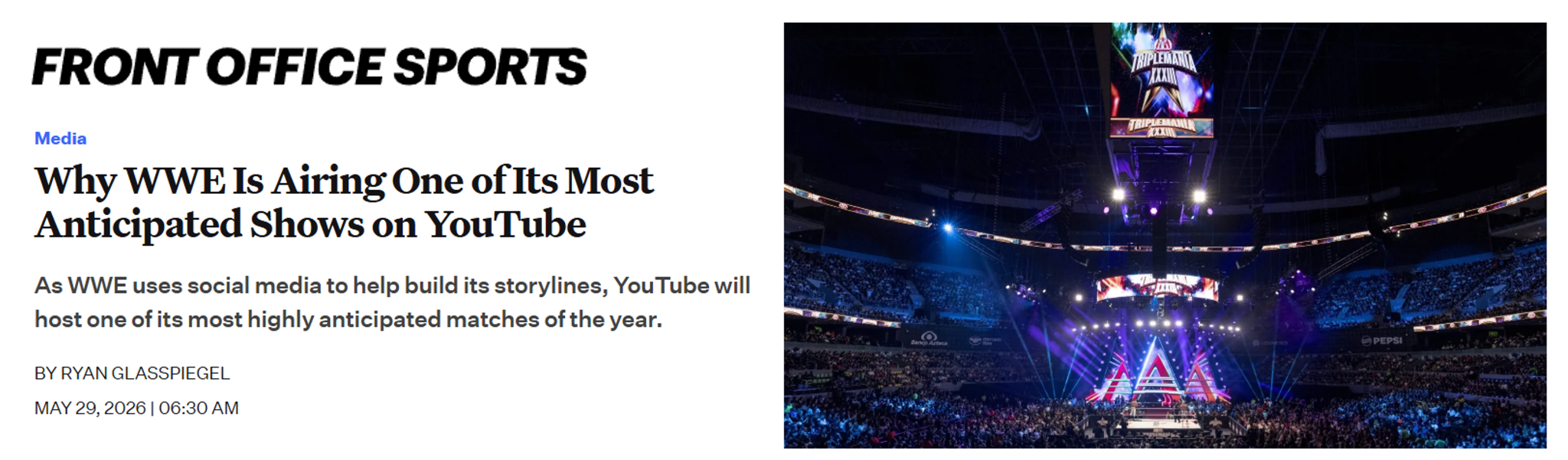
Ryan Glasspiegel’s May 29th piece for Front Office Sports, “Why WWE Is Airing One of Its Most Anticipated Shows on YouTube,” offers an insightful look at WWE’s digital media innovation. He highlights how the company is utilizing Lucha Libre AAA Worldwide content, specifically the highly anticipated Noche de Los Grandes match in Monterrey. While traditional industry wisdom would suggest placing such a high-profile event on WrestleMania or an ESPN+ Premium Live Event, WWE has opted to stream it for free on YouTube.
To a lot of people, giving away a year’s worth of built-up anticipation sounds insane. To me, it is the single clearest signal yet of how sophisticated WWE — and its parent, TKO — has become about distribution.
The YouTube Push Is a Deliberate Pattern, Not a One-Off
A few numbers from Front Office Sports‘ reporting that frame how serious WWE has gotten about the platform:
Massive Scale: The main WWE YouTube channel boasts roughly 113 million subscribers. But the real structural growth is in the network build-out: WWE Vault, WCW, NXT, and individual talent channels.
Volume: Across these channels, WWE pulled in more than 12 billion views over the past year.
Engagement Growth: The WWE Vault page alone logged roughly 133.6 million hours viewed over the prior year—up 131% year-over-year—and is closing in on four million subscribers.
The AAA Playbook: Since WWE acquired the Mexican promotion AAA in April 2025, it has strategically placed the bulk of its Lucha Libre AAA Worldwide content—including the PLEs—on YouTube. Why? Because that content lacks a traditional U.S. linear rights deal. The weekly AAA show averages north of 200,000 viewers, and the recent “go-home” show topped 541,000.
The Accrued Interest Take: TKO Is Playing the Distribution Game in Every Direction at Once
WWE/TKO is one of the most genuinely innovative brands in all of sports entertainment when it comes to monetizing its content across surfaces, and the YouTube strategy is the proof.
What I find impressive is that this is a two-pronged distribution strategy executed deliberately, not by accident. On one side, TKO has navigated the collapse of the linear cable bundle into highly lucrative linear and streaming rights deals — Peacock historically, the move of NXT PLEs to The CW, the flagship product now living on ESPN’s streaming service. On the other side, they use YouTube as the home for rights that do not yet have a U.S. linear component — chiefly AAA. They are not choosing between “old media checks” and “new media reach.” They are taking both.
That is the whole game. The free YouTube match is not WWE leaving money on the table; it is WWE using the largest video distribution platform on earth — and, as their head of digital pointed out, the broader Google ecosystem behind it — as a marketing engine to build storylines, grow new stars, and drive interest back into the paid PLEs that do carry a rights fee.
It is the same “build the habit, then meter it” logic I keep coming back to with Meta and Roku. TKO is, in my view, the cleanest current example of a sports-rights owner using YouTube to simultaneously grow the brand and extract maximum value from multiple networks — linear and streaming — at the same time.
This is also why I am bringing TKO into the coverage universe. As I expand Accrued Interest toward the full set of companies you actually need to understand to make sense of today’s media landscape, you cannot leave out the one live-event franchise that has figured out how to be everywhere at once.
Valuation & Rating: TKO Group Holdings ($TKO)
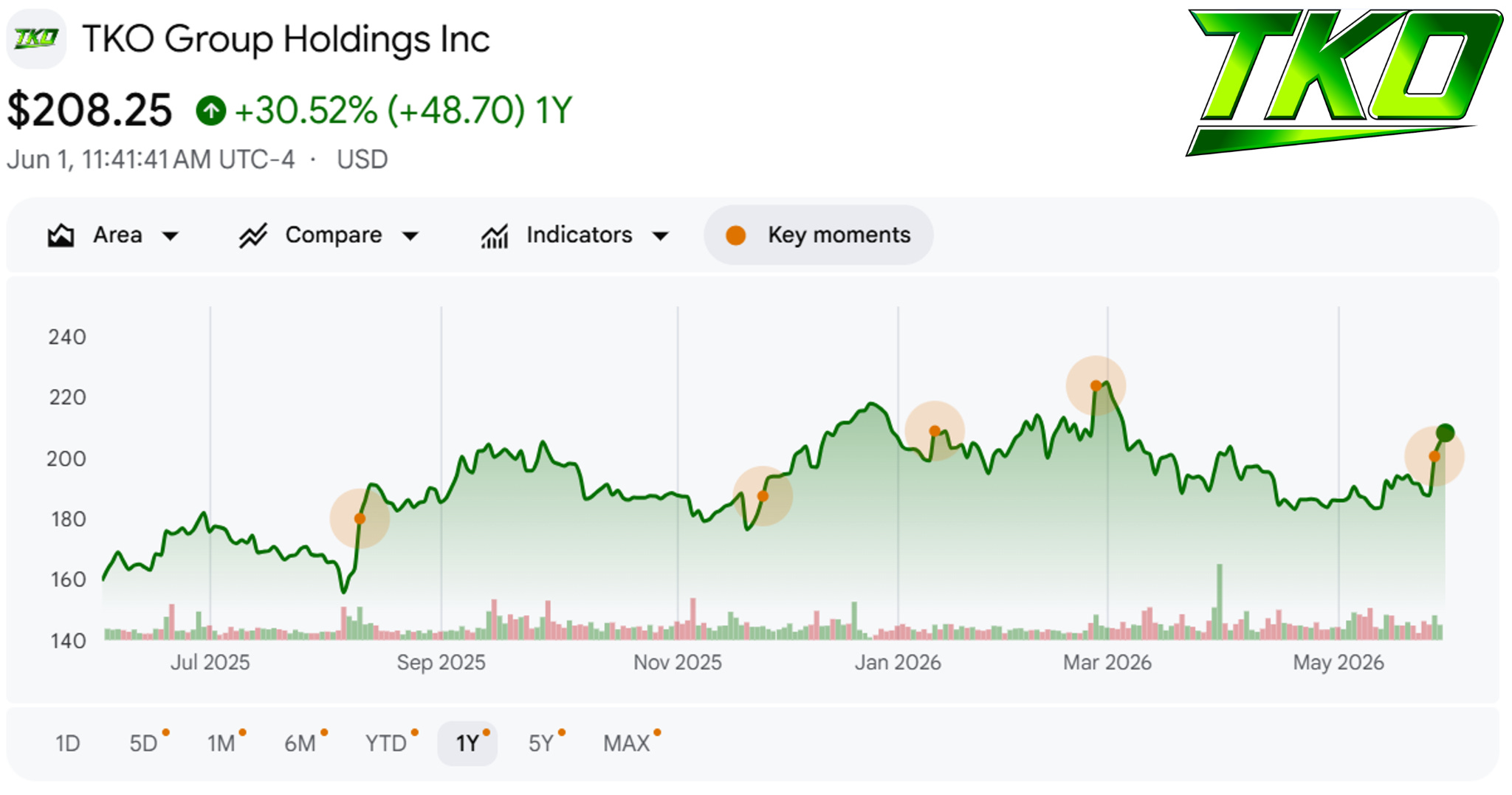
So while I love TKO’s business and its strategy…I want to point out that it is a very fairly valued stock at today’s price.
TKO trades around $205 per share. On consensus GAAP EPS, that is roughly 43x 2027 (about $4.75) and roughly 34x 2028 (about $6.00) — estimates via TIKR.com. The stock is up almost 30% over the last year, which slightly beats the S&P 500.
This is not a cheap stock. I think the strategy is excellent and the assets — WWE, UFC, and the rest of the live-event portfolio — are close to irreplaceable. But “great company” and “great price” are not the same sentence, and at 43x forward earnings the market is already paying up for a lot of execution.
Accrued Interest Rating: Market Perform, $TKO. I will be covering this name more going forward as I broaden the watchlist toward the winners and the structurally important players in media. The TKO playbook rhymes directly with themes I have written about across the coverage universe. They are pursuing the opposite lesson from Nexstar, where a roll-up of pure-linear assets with no real digital parachute keeps running into a wall. TKO is what it looks like when a rights owner gets distribution right.
TKO 0.00%↑ , GOOG 0.00%↑, GOOGL 0.00%↑
B) The Rebundling Wave Just Got Another Data Point
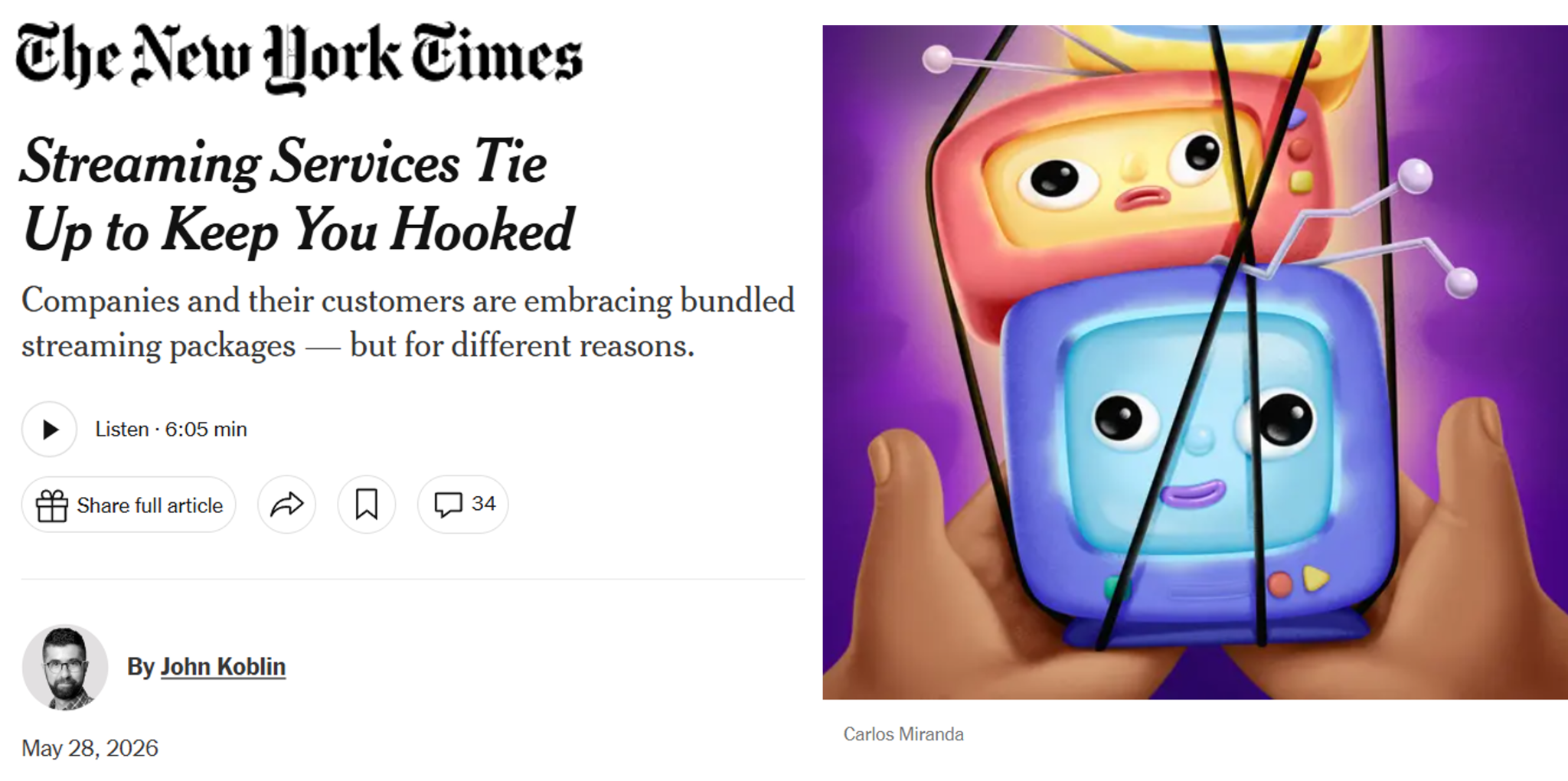
A recent New York Times piece by John Koblin, Streaming Services Tie Up to Keep You Hooked, lays out how far the streaming “rebundling” trend has come, and the numbers are striking.
Bundles Have Gone From Fringe Experiment to Industry Core
Market Share: Two years ago, bundled offerings made up ~10% of new major-streaming subscriptions. Today, they account for roughly one-third of all new subs and 28% of total subscriptions.
Product Velocity: Since early 2025, approximately 30 new bundled packages have hit the market (e.g., Apple TV & Peacock, AMC+ & Hallmark+).
The New Toll Booths: Large aggregators like Amazon and Roku are successfully pushing subscribers to manage multiple services through a single, unified interface. Traditional players are attempting to keep pace (e.g., YouTube TV’s skinny bundles, Charter pairing Paramount+ and Hulu).
The Holdout: Netflix, the most dominant paid streaming service globally, has stubbornly—and smartly—refused to team up.
The Accrued Interest Take: This Is Consolidation Wearing a New Costume
This is yet another example of the rebundling trend I have been tracking, and I read it the same way I always do — as consolidation. The dominant distribution platforms are quietly reassembling the cable bundle, just with a streaming front-end. The more powerful providers act as the new distributors stitching the individual services back together.
And the “who” matters. Streaming services are increasingly leaning on aggregators like Amazon and Roku to be the new rebundlers. This connects directly to my decision last week to initiate coverage on Roku — the toll booth at the front door of the living room is exactly the kind of business that benefits when everyone decides the answer to churn is to bundle through a third party.
Because that is the real point here: bundling’s job is to lower churn, and lowering churn is arguably the single biggest driver of streaming growth — more important than any individual piece of content. When David Zaslav describes the HBO Max / Hulu / Disney+ bundle as “as close to a solve as you’re going to have” on churn, that is the whole thesis in one quote. Content gets you the sign-up; the bundle keeps you from leaving.
Netflix Doesn’t Need a Bundle — And That’s the Tell
The most important detail in the NYT piece is the one thing that didn’t happen: Netflix, the clear number-one service, has not partnered with anyone. It does not need to. That is exactly what you would expect from the de facto anchor service — the one everyone else has to bundle around. This reinforces my long-standing view that Netflix is the continued winner of the streaming wars (with YouTube as the other giant) and the service least exposed to the churn problem that is forcing everyone else to link arms.
Valuation & Rating: Netflix ($NFLX)
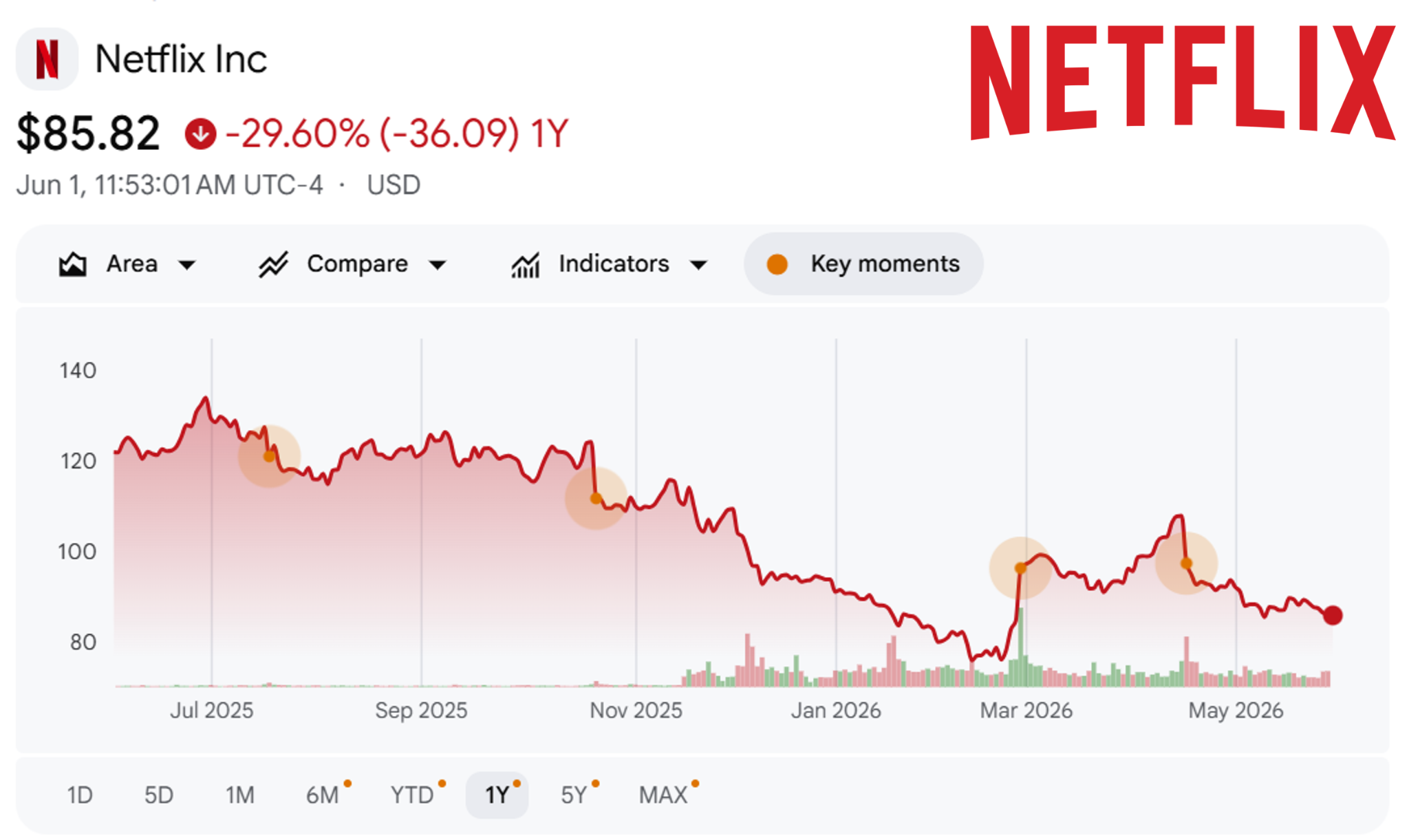
Netflix currently trades around $85 per share. On consensus GAAP EPS, that is about 22x 2027 ($3.86) and about 18x 2028 ($4.56). For the dominant, most durable, lowest-churn platform in the category — the one that gets to stay a stand-alone storefront while competitors merge their checkout lines — that is too cheap.
Accrued Interest Rating: I am reiterating my Market Outperform on Netflix (following the Market Perform I assigned to Roku last week).
CONCLUSION
Two stories, one lesson: in modern media, distribution strategy is the strategy. TKO refuses to pick a lane, successfully monetizing marquee linear/streaming rights while weaponizing YouTube to feed the top of the funnel. Conversely, the rebundling wave exposes a streaming industry racing to solve churn by linking arms through aggregators like Roku—leaving Netflix sitting untouched at the center of the ecosystem.
Follow the distribution, follow the churn, follow the cash flow.
- Accrued Interest
TKO 0.00%↑, NFLX 0.00%↑, ROKU 0.00%↑
Disclaimer: The information presented in this Substack is for educational purposes and should not be construed as investment advice. Investors should make their own decisions regarding the prospects of any company discussed here, as I am not a registered investment advisor.
You can always reach me at simeon@accruedint.com.