
Duolingo Q2-26: Growing Users, Not Money
Most of my bear case played out. Here is why I am upgrading anyway.

Accrued Interest TLDR: Following Duolingo’s second quarter earnings last week, most of my issues with this company continue to be proven correct, and I stand by the underperform call I made throughout the first half of the year. DUOL is down 24% year to date against a rising market. But I am upgrading my rating from underperform to market perform, because while two of the main points of my bear case played out, the other two are weaker based on recent evidence. This article walks through the quarter: 1) users are growing north of 20% while every incremental user is worth less than the last one, 2) management spent the earnings call describing price cuts dressed up as generosity, and 3) growth is getting more expensive, with R&D and marketing now eating 44 cents of every revenue dollar. 4) At roughly 48x 2026 GAAP earnings, the stock is too expensive for me to recommend as a buy. 5) But with a patient bull base and roughly 15% of the shares still sold short, I am no longer being paid enough to argue. Subscribe for the full breakdown.
Introduction
Duolingo reported Q2-26 last week, and the core of the underperform I gave last December has aged like fine wine. Bookings decelerated to 8% growth. Paying subscribers lagged users. Management spent a good chunk of the call describing ways to charge people less.
So why I am changing my rating to market perform from underperform? Well, 2 of the 4 points in my bear case have played out. The other 2 look weaker based on recent earnings, and the rest of this article will explain why.
I think DUOL is a company that can grow revenues 9% - 13% YoY once reported revenue converges to bookings growth, which the Q3-26 guide of 11% already shows happening. Margins can expand a little, though they have a ceiling. The earnings multiple is too expensive for me to call this an outright buy.
Duolingo bulls are proving to be very patient. After the company reset expectations back in February with its Q4 2025 report, and trimmed the bookings outlook again in May, they have been willing to give management time to focus on user growth and worry about monetization later.
My Bear Thesis Rested on Four Points, and Two of Them Broke

To briefly recap for new subscribers who did not read my Pitch-Mas piece back in December, when I called the stock an underperform: my bear thesis was built on four points. (1) The mobile-game monetization trap. (2) AI disintermediation risk. (3) The monetization pivot as a red flag. (4) Structural limits, including a profit margin plateau.
Points 1 and 3 proved correct. Once we get into the quarter, it becomes clear that Duolingo is very much a mobile video game, as evidenced by all the additional content they keep adding that has absolutely nothing to do with learning a language: chess, math courses, music lessons. DUOL said on the Q2 call that they are leaning into performance marketing and influencer networks to grow. There is nothing wrong with good marketing, but it tells you this product does not have network effects.
The 2nd vindication for me was the monetization pivot itself. When management said it would focus on user growth over monetization, that was waving the white flag…an admission of a ceiling. Active user growth is diverging from paying users, meaning DUOL is getting less money out of each incremental account.
OK - so the other 2 points have not come true, or have outright reversed, and this is why I am moving to market perform to stay honest.
Point 2 was that AI language tools would disintermediate Duolingo. Half a year of steadily smarter models has now come to market, and user growth has not slowed a bit. That is a real win for the company, and part of why the stock rallied off its spring lows. I find it somewhat ironic that perhaps being a game turned out to be Duolingo’s moat against AI!
Point 4 of my bear thesis, the margin plateau, deserves partial credit to DUOL. There has been some margin expansion, albeit not a lot. The irony is that part of the reason margins expanded is a switch to cheaper open-weight AI models. Management said the cost of an AI Video Call has gone from about 30 cents to under a penny. I did not see that coming!

The margin ceiling argument still stands. Being a mobile app, they pay the App Store tax on the bulk of their revenue. They spend heavily on R&D because, per the company’s own admission, they are updating the service all the time. And they now spend meaningfully on sales and marketing.
So before we get into the evidence, let me say it plainly. The stock is still expensive, the monetization ceiling is real, and I would much rather own the S&P 500 than this company. But when the biggest parts of a thesis have already played out, it is time to say so. And with roughly 15% of shares outstanding still sold short, nearly 19% of the float, this stock could go higher on short covering alone.
These are the takeaways I think the bulls should not ignore from Q2…
1. Every New User Is Worth Less Than the Last One
Duolingo added users faster than ever this quarter. Daily active users grew 23%, an acceleration from 21% in Q1. But paying subscribers only grew 16.5%. A year ago, those metrics moved together. Look at the table below…
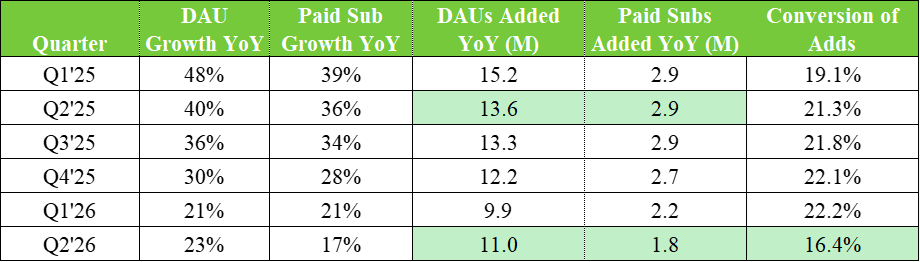
See the last column “Conversion of Adds”. For five straight quarters, roughly 19% to 22% of incremental daily users added over the prior year became a paying sub. In Q2 that dropped to 16.4%. DUOL added 11M daily users YoY and only 1.8M subs. A year earlier it added 13.6M users and 2.9M subs. So they added more total users, but 1 million fewer subscribers!
Here is another view. Divide total bookings by daily users. See the table below I made. A year ago, each daily user generated $5.62 of bookings per quarter. Q2 was $4.93, down 12%. And before you blame it on seasonality, just look at Q2 over the years in the table below:

Part of the explanation is the Streak Revival campaign in June, which brought back 15.4 million lapsed streaks. Bringing them back was a reasonable thing to try. But it is yet another example of how the company, by its own admission, is optimizing for growth over monetization.
(One caveat to the bulls: Duolingo also extended most free trials from 7 days to roughly 30 this quarter, and users on trial do not count as paid subscribers. Some of the Q2 subscriber shortfall is timing. If subscriber growth snaps back in Q3 once those trials convert, the bulls win this argument. If conversion prints in the 16s again, the problem is structural.)
2. When Duolingo Pushes on Price, It Pushes Down
Bulls have long argued Duolingo has untapped pricing power, pointing to Max, the premium AI tier priced above the standard Super plan. Now listen to what management actually said this quarter. They are handing Video Call, Max’s marquee feature, down to regular Super subscribers. Mgmt is testing a new plan called Super Lite at roughly half the price of Super, supported by advertising. And on the future of the highest-priced tier, CEO Luis von Ahn told analysts:
“Another possibility truthfully is that we may actually sunset Max.”
When I put my operator hat on, this is a business effectively lowering its price by trying to give you more. Von Ahn even named the trap himself, acknowledging that Video Call is “one of the main things that gets people to buy,” which means giving it away forces them to find a NEW reason to charge you.
All this growth will be dilutive to ARPU, and management sees the monetization ceiling too.
3. Growth Is Getting More Expensive, Not Less
The bull case on any software business is operating leverage, but that is the opposite of what is happening with DUOL.
R&D rose to 30.9% of revenue this quarter from 29.2% last year. Sales and marketing jumped 35% YoY, reaching 13.4% of revenue from 11.7%. Together, 44 cents of every revenue dollar now goes to those two lines, up from 41 cents last year. The result: revenue grew 18% yet GAAP operating income only grew 2%.
Duolingo’s growth was famously powered by word of mouth and a viral owl. This quarter, mgmt admitted that “there was a while where I was massively allergic to performance marketing,” and that they view it as a useful tool, alongside influencer networks that now generate roughly two-thirds of the company’s total social media impressions, with particular traction in Asia (China, Indonesia, and India).
There is nothing wrong with good marketing, but the growth you buy is worth less than the growth you earn, and it does not scale the same way. So yes, AI is lowering the cost of serving features, but other costs are rising right behind it.
The Stock Is Still Expensive on Real Earnings
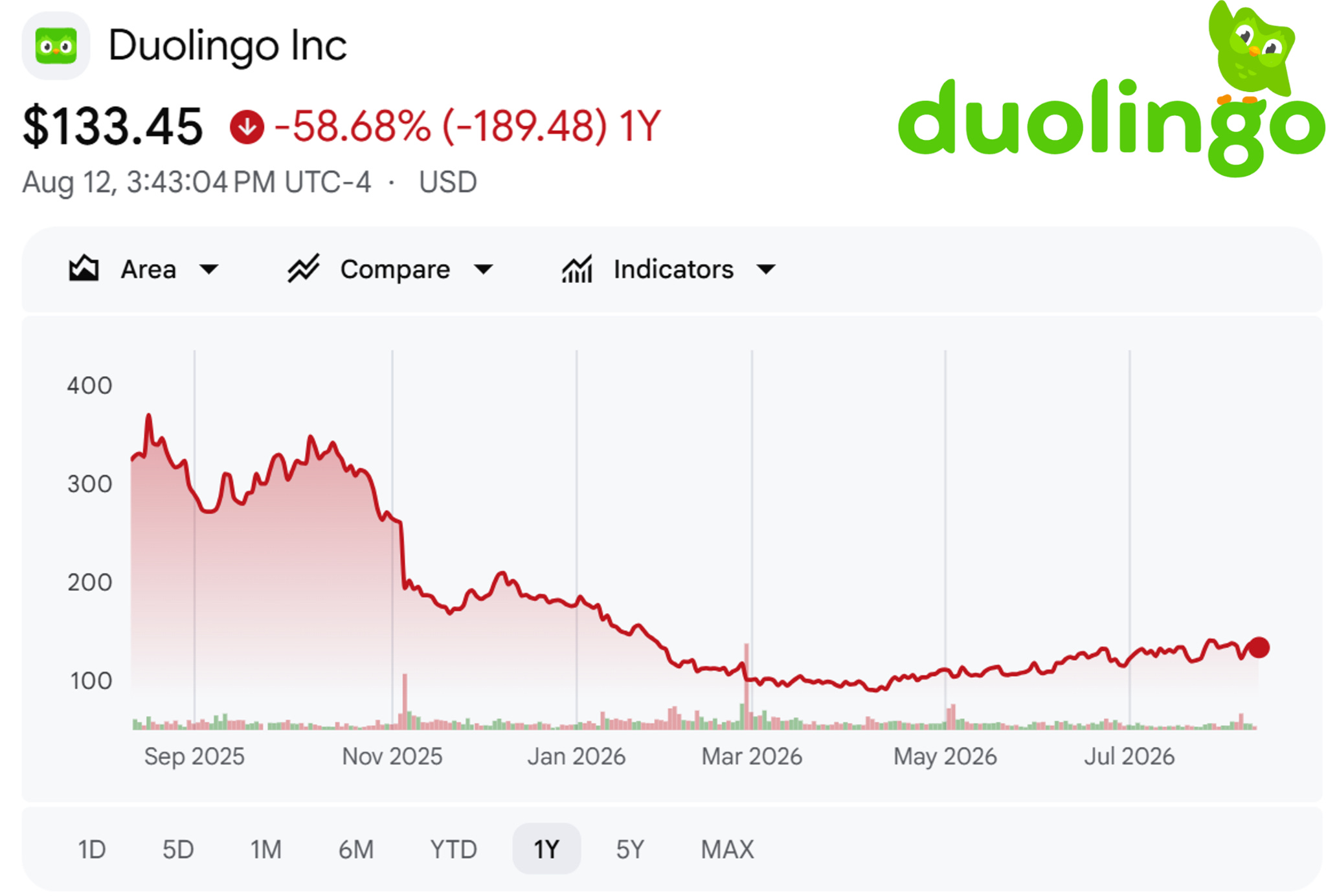
Here is how I think about Duolingo’s valuation with the stock at about $133.50. Start with the growth rate, because everything else follows from it.
Why 9% to 13% Revenue Growth Is the Right Range
Duolingo sells subscriptions, mostly annual, and collects the cash up front. Bookings measure what people bought in the quarter. Revenue measures what accounting lets the company recognize, spread over the following twelve months. It is a lagging indicator of bookings, and for the last several years that has helped.
When bookings were compounding at 35% and 40%, reported revenue had a big tailwind behind it from all the cash collected in prior quarters. Now that tailwind is gone. Bookings grew 7.8% this quarter while reported revenue grew 18.3%, a gap of more than ten points.
The Q3 outlook calls for 11.1% revenue growth against 8.9% bookings. Back the fourth quarter out of the full-year guide and you get roughly 11.1% revenue growth again. So Duolingo exits 2026 growing revenue at about 11%.
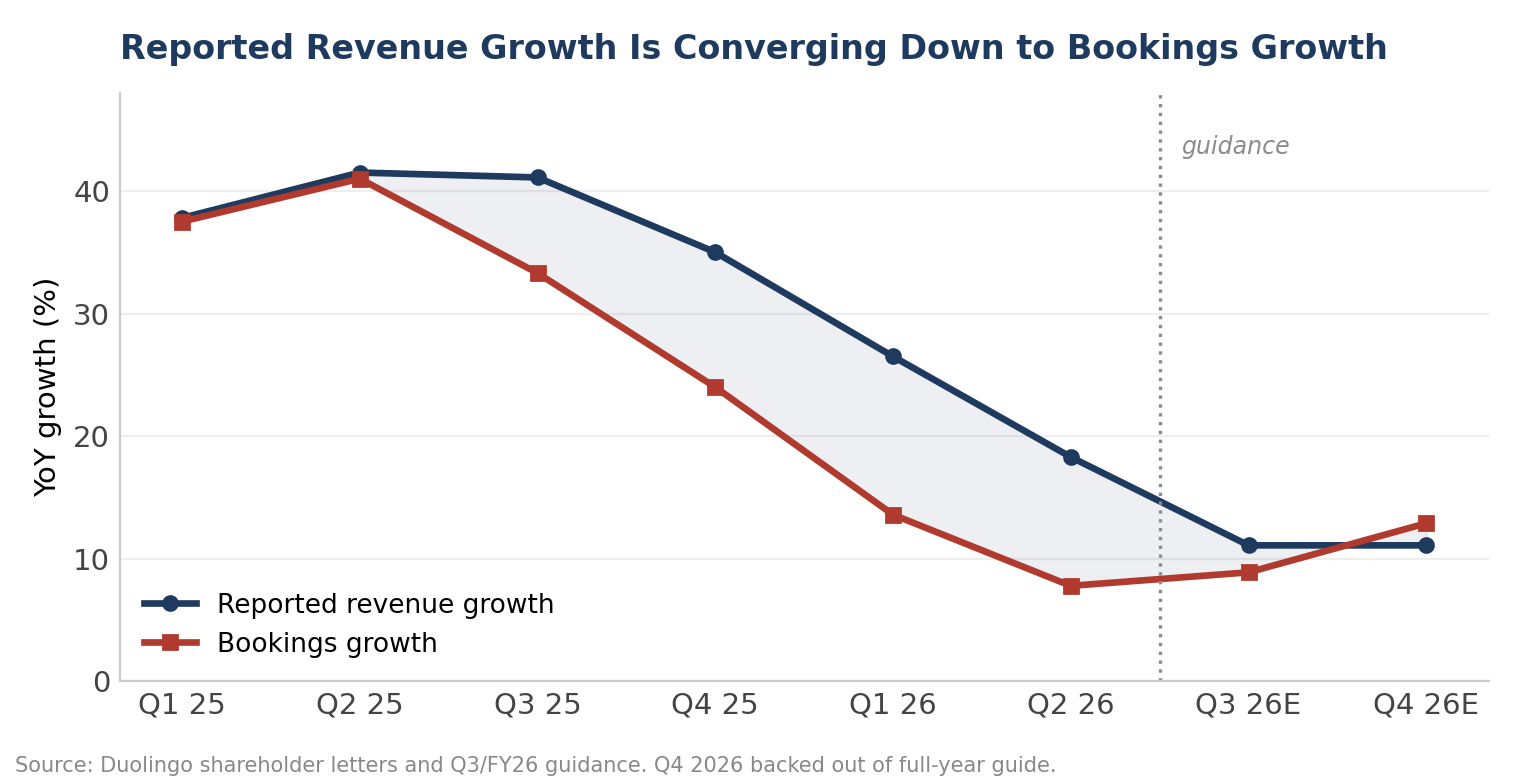
Now let’s go forward. Revenue in 2027 is largely a function of bookings collected in 2026, and management is guiding that to 10.9% YoY. Add a point if the longer free trials convert better than expected OR remove a few points if bookings decelerate again. That is where my range of 9% to 13% comes from.
The rest of my valuation work sits below here, where I walk through paid conversion, the gross margin call I got wrong, and what all of it means for the P/E multiple. For paying subscribers, let’s dive in!
