Disney’s Reality Check and Uber’s Lucid Deal (Accrued Interest Update 4-15-2026)
$DIS, $UBER

Accrued Interest TLDR: We have a fascinating split screen today: legacy media is still trimming its workforce, while Big Tech is ruthlessly accelerating into the future of transportation. I am starting with the newly announced layoffs at Disney, reading between the lines to unpack what this means for their new CEO’s corporate diet. From there, I am pivoting to the electric vehicle sector to break down Uber’s massive new robotaxi commitment with Lucid—and why this deal perfectly illustrates why I am stubbornly sticking with the ride-hailing giant as a value play.
Please subscribe to read the rest of the Accrued Interest Daily Update - for April 15, 2026.
A) Disney’s Marketing Layoffs Signal a Necessary Corporate Diet
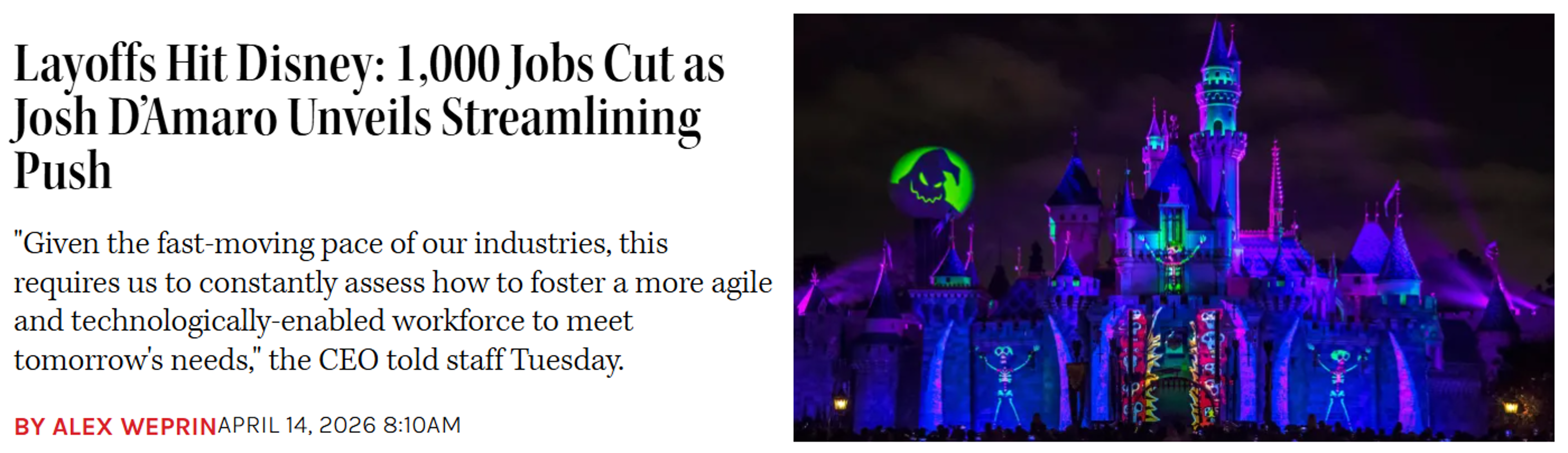
The honeymoon phase is officially over for Josh D’Amaro. Just a month into his tenure as Disney’s new CEO, D’Amaro has confirmed that the company is eliminating roughly 1,000 jobs. The cuts are primarily targeting the company’s newly streamlined marketing and brand organization, but they are also hitting several entire divisions of publicity, Marvel, and home entertainment. Back in January, Disney made a massive show of elevating veteran executive Asad Ayaz to Chief Marketing and Brand Officer, ostensibly to unify their sprawling marketing apparatus. In hindsight, it looks incredibly obvious to me that Disney was not actually expanding its marketing efforts, but rather executing a massive reorganization for what was ultimately going to be a prime area for cuts.
If you want proof, just look at the specifics of who is being shown the door. Disney is completely wiping out its entire home entertainment team, which was led by Chris Bess, as well as its EPK team, including director of creative content Natalie Clunis. The digital marketing side is experiencing an absolute bloodbath across every level. They let go of Dustin Sandoval, a 16-year veteran of the company who was one of Ayaz’s key lieutenants and oversaw massive digital campaigns for hits like “Avengers: Endgame”. They also dismissed Steve Nuchols, who handled print campaigns for almost every Disney movie over the past 25 years, and Theresa Helmer, who ran YouTube and brand campaigns. Marvel is feeling the squeeze as well, with layoffs hitting employees in Burbank and New York across film and television production, comics, franchise, finance, and legal. While Disney disputed rumors that 8% of Marvel was cut, claiming the number is “much smaller,” sources clearly point to this being the result of a necessary reduction in Marvel’s artificially inflated production slate from the peak of the Disney+ era.
My angle here is simple. Yes, these 1,000 jobs are a relatively small proportion of a global workforce that stood at over 230,000 employees at the end of their last fiscal year. However, this move sends a key, undeniable message: Disney Corporate is aggressively looking for cost efficiencies to start out the new CEO’s tenure. I know from my own experience that new CEOs often want to make immediate changes to leave their mark. These cuts are widely understood to be necessary for a business that is fundamentally stronger than its harshest critics want to admit, but it is also decidedly not in a growth phase where investors are willing to simply look past corporate bloat. Everyone in the market knows the linear television business is in a secular decline. But I do not think people fully realize that when your core business is in a secular decline, the company will always be in the ongoing process of making cuts.
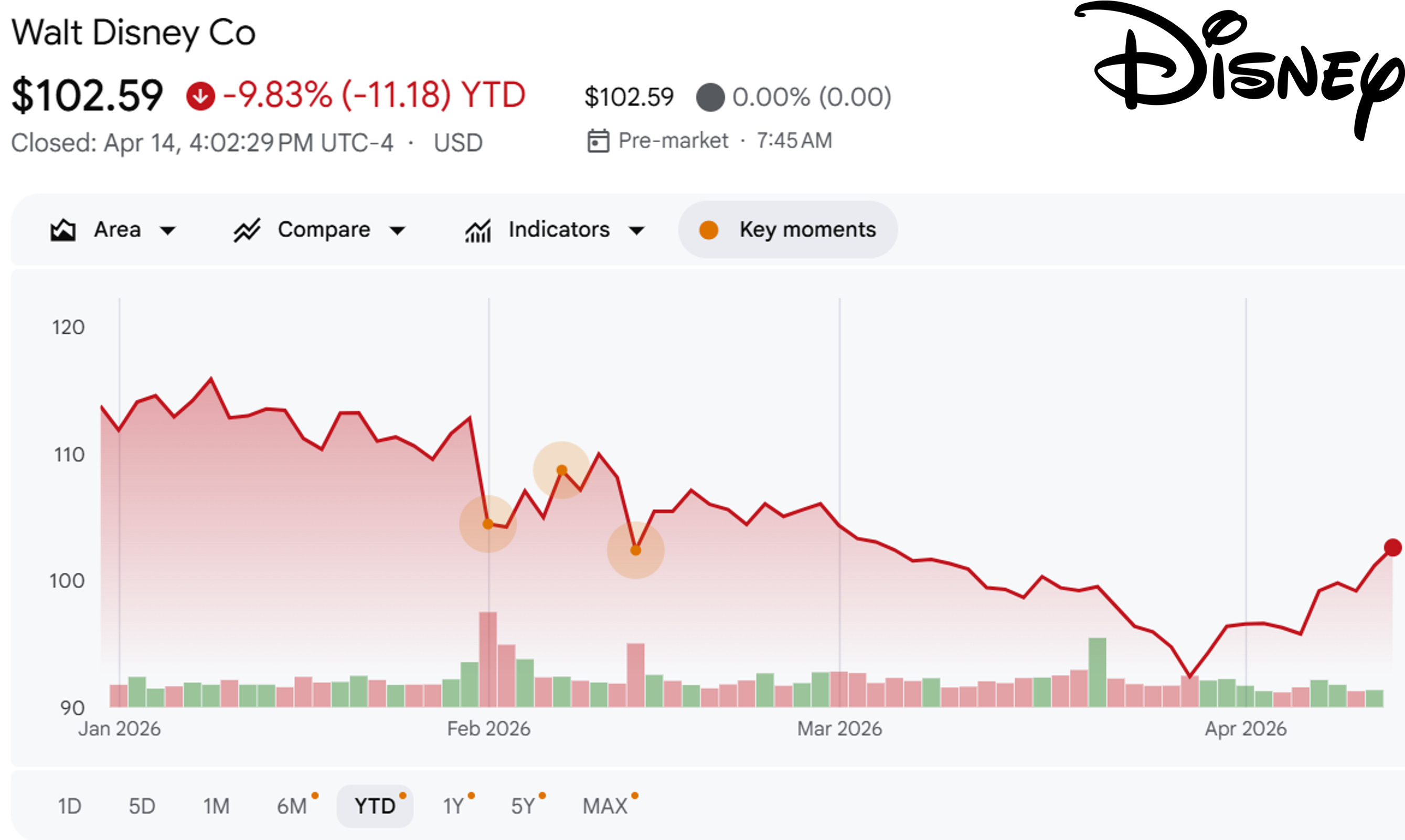
I have been structurally bearish on Disney in my past Accrued Interest writings. Back in December, during my 12 Days of Pitch-Mas series, I explicitly stated that Disney would underperform the broader market until they finally made the tough choice to cleave off and separate their linear TV assets and ESPN from the rest of the enterprise. Through April 15th, with the stock trading at $102 per share, Disney is down -10% year-to-date and is heavily trailing the S&P 500. The stock currently trades at approximately 17.5x 2026 GAAP EPS and about 16x 2027 earnings. I fully expect this underperformance to continue until management makes much larger strategic moves.
B) Uber’s Robotaxi Bets Widen an Indispensable Moat
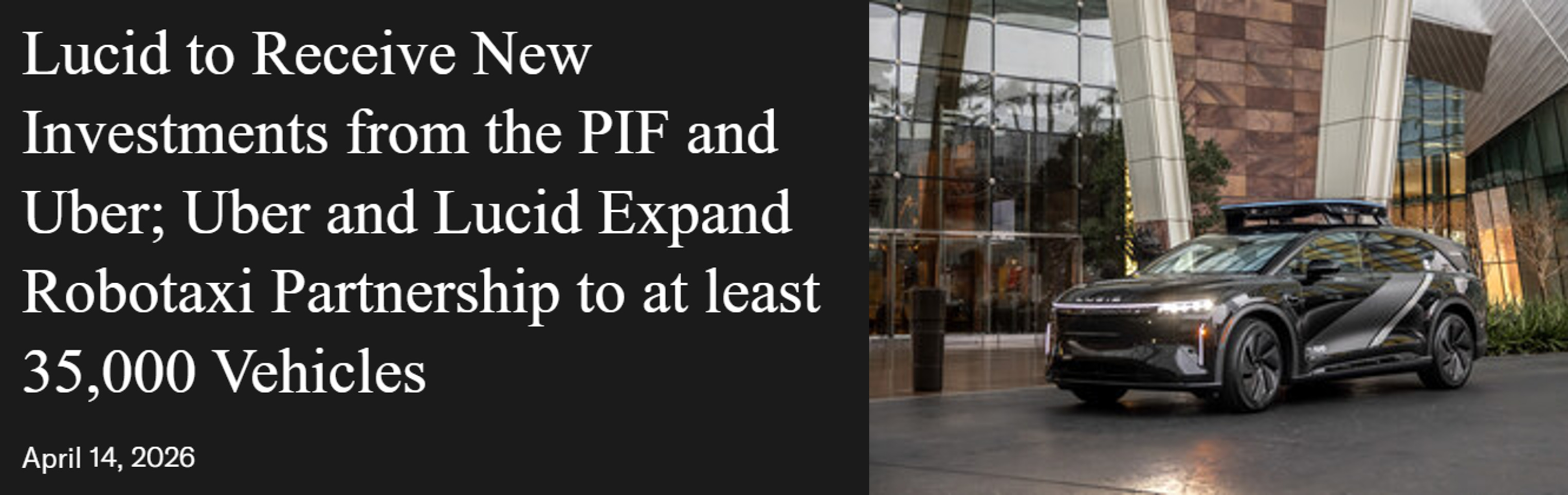
Over in the electric vehicle sector, Lucid is trying to manufacture a turnaround, and Uber is footing a massive part of the bill. Lucid just announced a slate of major updates, including naming Silvio Napoli, the former head of Switzerland’s Schindler Group, as its new CEO. Alongside the leadership change, Lucid has secured a fresh $750 million in capital. Saudi Arabia’s Public Investment Fund is injecting $550 million, while Uber is doubling down with another $200 million, bringing their total investment in the EV maker to $500 million.
Under this funding deal, Uber and Lucid are aggressively expanding their robotaxi partnership. The companies originally agreed last summer to deploy at least 20,000 Lucid Gravity SUVs equipped with Nuro’s self-driving technology. That commitment has now exploded to at least 35,000 total vehicles, which will also include Lucid’s upcoming mass-market midsize platform.
What is really catching my eye, however, is that Lucid, Uber, and Nuro are quietly moving out of the purely theoretical testing phase and into real-world deployment. For now, only Uber employees can request these autonomous rides, but the rubber is officially meeting the road. Uber has also begun early test rides of these Gravity SUV robotaxis in the San Francisco Bay Area this month utilizing safety drivers.
I want to remind readers that I remain incredibly bullish on Uber, as I laid out in my Accrued Interest Update back on April 9th where we discussed their deal-making strategy. This Lucid agreement is exactly why. Uber is making absolutely certain that they are deeply partnered with basically everyone developing self-driving cars, with the glaring exception of Tesla. This strategy will guarantee that Uber becomes an indispensable, foundational part of global transportation infrastructure going forward. While skeptical investors often look at these massive partnerships as cash simply going out the door, I view them as critical, highly strategic investments that are permanently widening the company’s moat.
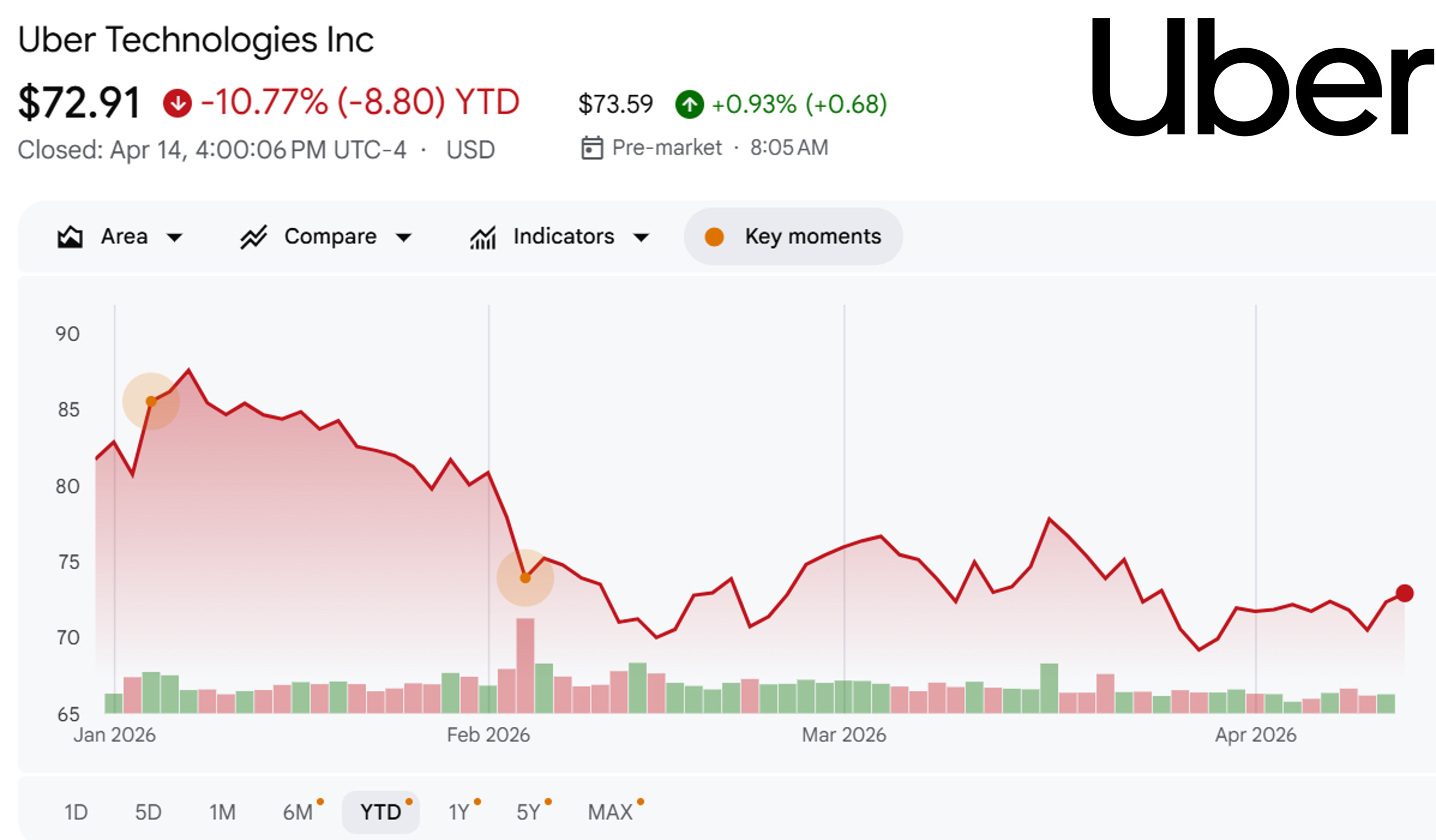
Looking at the tape, Uber stock is currently sitting at $73 per share. I rate Uber as an Outperform, but the stock is currently down -11% year-to-date. I do not think Uber stock is going to truly take off until management can show strong, undeniable revenue growth to investors, so I expect the stock’s performance to be somewhat muted until earnings. Uber is trading at 21x 2026 GAAP EPS, but a much more reasonable 16.7x 2027 earnings. This is a value stock, and I am stubbornly sticking with it.
-Accrued Interest
Disclaimer: The information presented in this Substack is for educational purposes and should not be construed as investment advice. Investors should make their own decisions regarding the prospects of any company discussed here, as I am not a registered investment advisor.
You can always reach me at simeon@accruedint.com.