
AppLovin Q2-26: I Got This One Wrong
5 reasons the market stopped paying up, and why I do not expect a re-rate before 2027.

Accrued Interest TLDR: I recommended AppLovin as an outperform on the last day of 2025, and it has been my worst pick of the year. This article is my honest accounting of why. The remarkable thing about the decline is what did NOT cause it: earnings. Consensus 2027 GAAP EPS is UP 8.5% year-to-date while the stock is down 48.5%. Every dollar of the decline is multiple compression, from 35.3x forward earnings in December to 16.7x today. Q2 explains why the market stopped paying up: the first guidance miss in company history, management admitting AI model gains cannot be scheduled, an e-commerce ramp on a slower clock than advertised, Unity applying real competitive pressure for the first time, and a free cash flow conversion reset that quietly took ~$800 million out of 2027. I am moving my rating from outperform to market perform. The company remains excellent, but the stock is now a show-me story, and I do not expect the re-rate before 2027. Subscribe to read the full AppLovin Q2 report.

0. Introduction
Readers of Accrued Interest know my history with this name. I was early, I was loud, and I defended the company against short-seller allegations that turned out to be bogus. For most of last year that looked brilliant, as the stock ran from obscurity into the S&P 500. On the last day of 2025, I closed my 12 Days of Pitch-Mas by naming AppLovin an outperform for 2026.
That call was a mistake, and the stock has underperformed the market more than any other pick I made. The market discounts the future and does not care about my track record or anyone else’s.
Here is the part that makes AppLovin’s 2026 genuinely unusual. The earnings are not what caused the decline. Over the course of this year, the full-year estimates went UP.
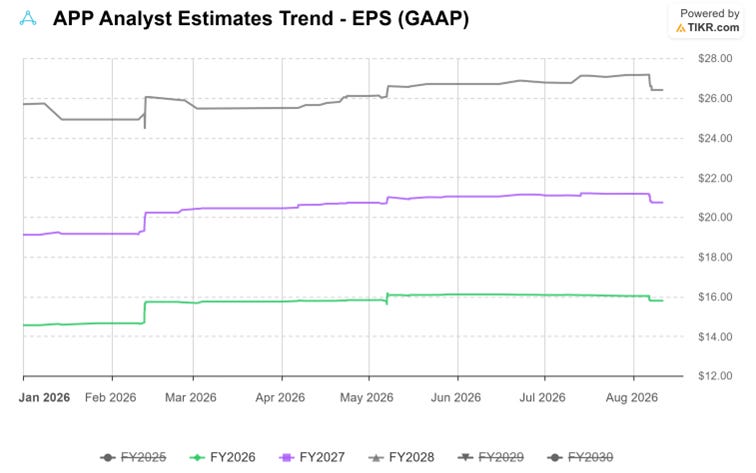
On December 31, consensus 2027 GAAP EPS was $19.10 and the stock closed at $673.82, which meant the 2027 P/E multiple was 35.3x. As of this weekend, the 2027 consensus was $20.73, 8.5% higher than December, and yet the stock is $346.80, or 16.7x. So over the course of the year, the stock fell over 48% because the earnings multiple was cut by ~53%. (If AppLovin still traded at December’s multiple on today’s higher estimates, the stock would be $731, UP 8% on the year.) Clearly we are not seeing $700 anytime soon. More than 100% of the stock decline has been multiple compression.
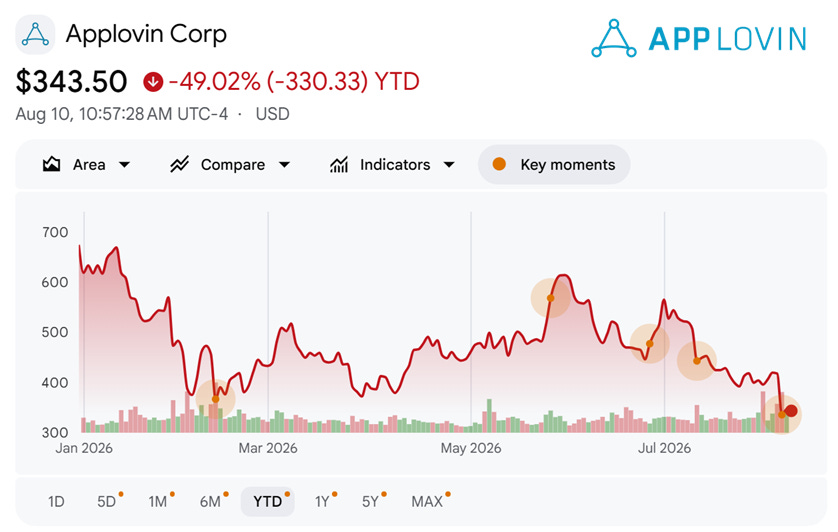
So the question is not “what happened to the business?” but “why did the market stop paying a premium?”
First, credit where it is due. I think Eric Seufert of Mobile Dev Memo and FUNDA AI on Substack have been the two BEST voices on the technical side of this name. So I will cite both below. Where I will try to add value is by layering in my thoughts on valuation and how to think about risk-reward from here.
1. AppLovin missed its own guidance for the first time
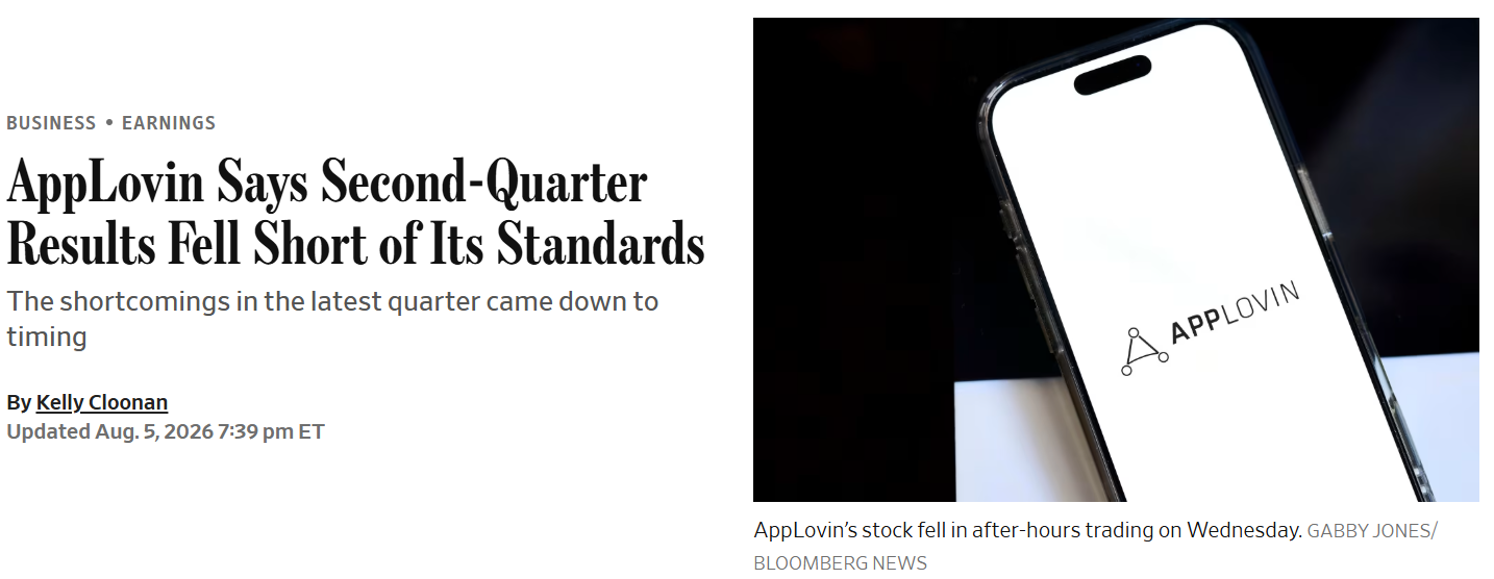
A large part of the premium investors paid for this stock was a management team that beat estimates every single quarter.
In Q2-26, revenue of $1.924 billion landed in the bottom third of the company’s own $1.92 to $1.95 billion guide and below the roughly $1.94 billion consensus. Adjusted EBITDA of $1.614 billion came in below the LOW end of the $1.62 to $1.65 billion guidance range.
Yes, I know the size of the miss seems very small, but the disappointment was real.
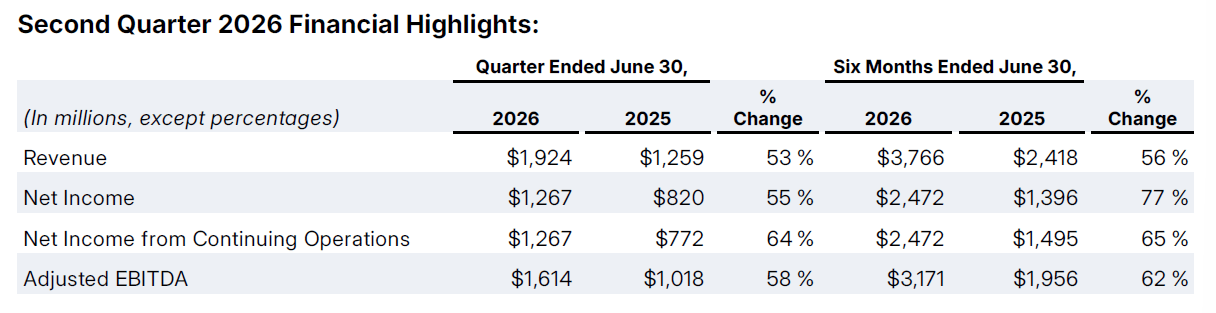
Growth of 53% YoY is still impressive, but the quarterly dollar-adds tell the real story: AppLovin added $81 million of sequential revenue in Q2, which was less than half of Q1’s $185 million. The YoY revenue trend now reads 68% for Q3-25, 66% for Q4-25, 59% for Q1-26, 53% for Q2-26, and a guided 47% for Q3-26.
None of this is catastrophic, but it is not enough to send the stock higher.
2. AppLovin’s AI model gains are no longer taken as a given
I thought management’s explanation for the quarter’s disappointment was refreshingly candid. However, the market does not care!
Most of AppLovin’s growth comes from its AXON models improving. This quarter, the improvements were smaller than usual, and the material uplift landed in early July, after Q2 was in the books. CEO Adam Foroughi said plainly that this is the nature of R&D: a large set of A/B tests looking for gains, with no guarantee of finding them in any given three-month window. I do not doubt any of that. But it forces investors to reprice the stock.
Mobile industry expert Eric Seufert made the sharpest version of this point in his review of the company. See his Aug 6th note (please subscribe to read his full article):
Now, the AppLovin bull case is still very much real and achievable. Management guided Q3 to 7.6% sequential growth, ABOVE their typical mid-single-digit baseline, which implies the early-July uplift they mentioned is actually showing up in the numbers. I think if APP clears that bar in Q3 earnings, the multiple can begin to expand again. However, nobody will be giving AppLovin the benefit of the doubt anymore.
3. E-commerce revenue is ramping slower than investors expected
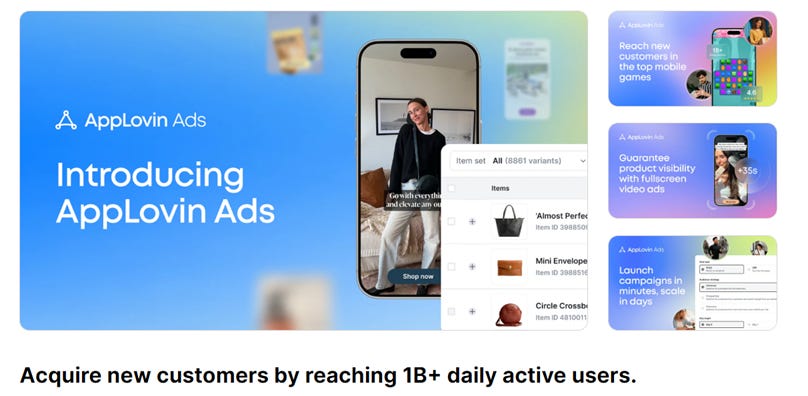
I still remain bullish on the e-commerce opportunity. The consumer vertical grew 28% in Q2 versus Q4 2025, which I think is impressive given Q2 is typically APP’s seasonally weakest quarter.
But I have to be honest that AppLovin e-commerce has not lived up to the hype. Back in December, management touted roughly 600 pilot advertisers scaled to a $1 billion run-rate of spend in a matter of months, alongside claims of ROAS parity with Meta. The self-service platform, originally slated for 2025, reached general availability at the end of June. Six weeks in, management is describing the launch as deliberately quiet. Management is right that e-commerce dollars are second-half weighted. But that means we won’t have numbers until Q4-26, in February 2027. And when the proof moves out, the multiple comes down.
4. Unity is now a real competitive threat to AppLovin
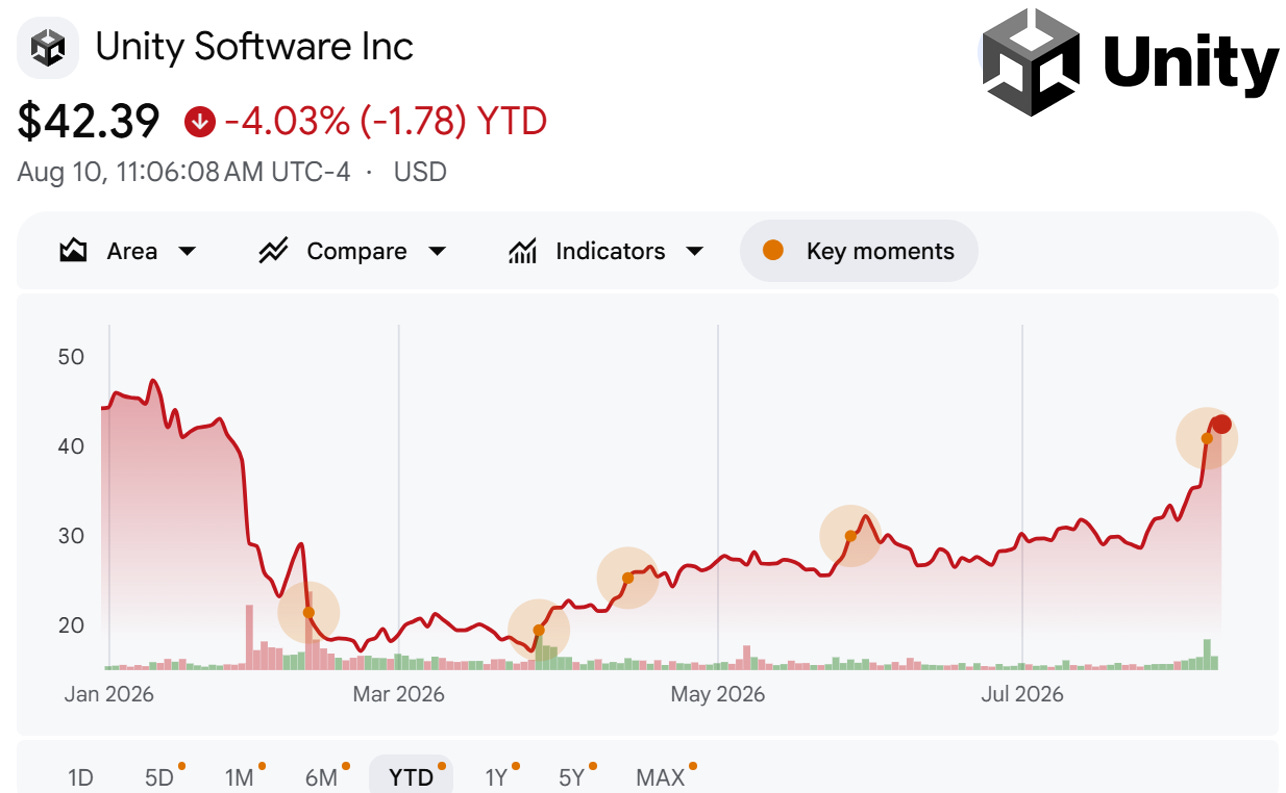
This quarter, Unity’s ad business accelerated sharply, driven by its new Day-28 ROAS bidding product reaching the ad-monetized game developers who are AppLovin’s core customer base.
FUNDA AI, who flagged this dynamic before the print, put the two results side by side: “We estimate that, excluding the contribution from commerce, AppLovin gaming revenue grew only 2% QoQ.” Their conclusion was that the pattern points to a meaningful share shift between the two companies, and that Unity “has become a competitor that cannot be ignored.” (Give them a sub!)
FUNDA themselves said investors should take AppLovin’s timing explanation at face value, having independently seen AppLovin gaming budgets improve from early July. But again, that new and permanent complication is going to make it difficult for APP stock to rally in the near-term.
5. AppLovin’s free cash flow conversion got worse, and it changes how you should value the stock
This is a point I did not see other analysts make, and I think it is probably worse than the small revenue miss. Because a lower free cash flow conversion rate means lower FCF in every future year, not just 2026.
For context, AppLovin converted roughly 88% of adjusted EBITDA into free cash flow in 2025. In Q2, that fell to 53%. Here is how CFO Matt Stumpf explained it:
“Conversion was below our normal cadence in the second quarter due to the timing of international cash tax and interest payments. This is a timing dynamic, not a change in the earnings power of our business. We expect free cash flow conversion to improve in the third quarter and to normalize to roughly 75% of adjusted EBITDA for the full year.”
If Q2 were purely the timing issue he describes, the full year would land back near 88%. Guiding the year to 75% concedes that the shortfall does not come back.
The driver is cash taxes: $639.8 million paid in the first half versus $100.6 million a year ago. For years, AppLovin’s cash tax bill was suppressed by the tax deduction on employee stock vesting, which is measured at the share price on the vest date. When the stock ran from $40 to $733, that windfall was enormous. With the stock down more than 50% from the December high, the windfall is deflating, and cash taxes are now running ABOVE book taxes.
Consensus has marked 2026 conversion down to about 77%, but still models 84% for 2027 and 86% for 2028. If 75% is closer to the new reality, then 2027 free cash flow could be $800 million too high, about 11%. (To be fair, only 9 analysts model FCF for 2027 versus the 25 who model GAAP EPS, so that number is noisier.) The trend is not good.
Valuation and Outlook
Here is how I think about AppLovin’s valuation with the stock at about $346.80…
