A Melting Ice Cube on Trial: Breaking Down the Nexstar-TEGNA Injunction
How a 52-page federal court order just blew up the industry's favorite growth strategy and trapped a highly-leveraged giant.

Introduction
Welcome back to Accrued Interest. If you have been following my coverage of the broadcast television sector, you know my ongoing bearish stance on Nexstar (NXST) and the broader broadcast M&A playbook. I have consistently warned that rolling up declining linear television assets with massive leverage is a flawed long-term strategy. Now, that strategy has hit a massive roadblock.

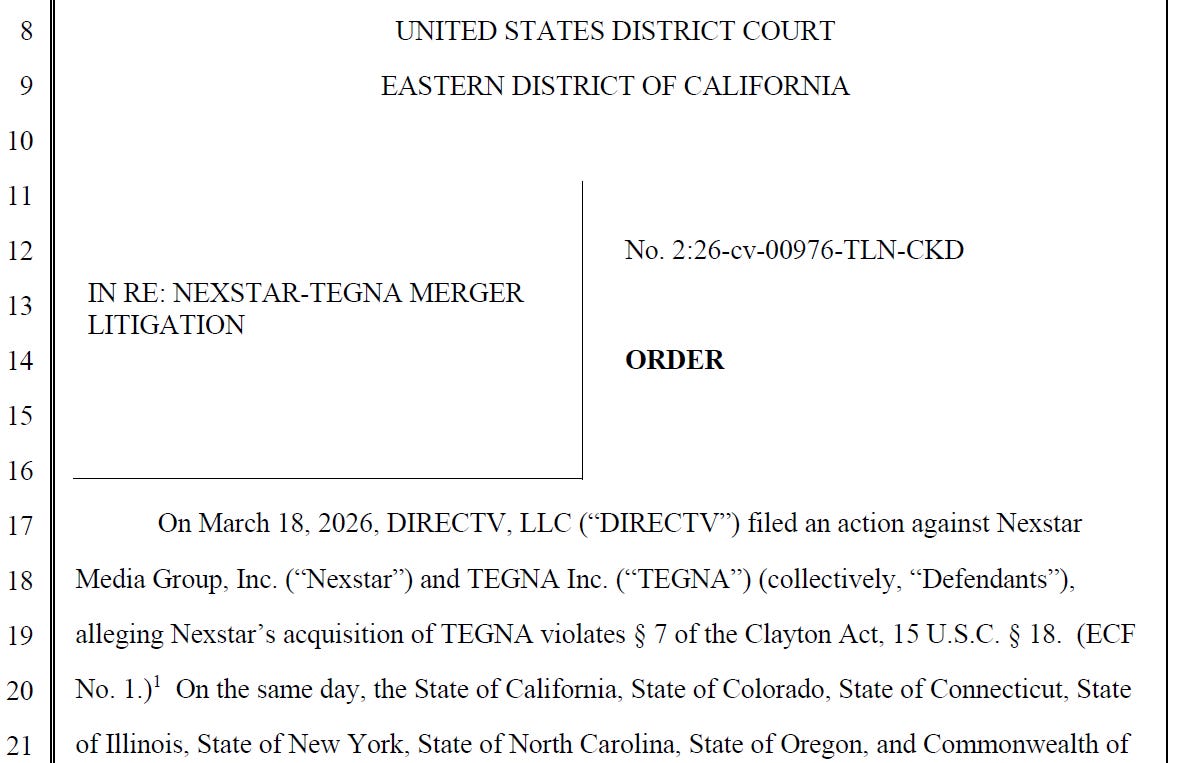
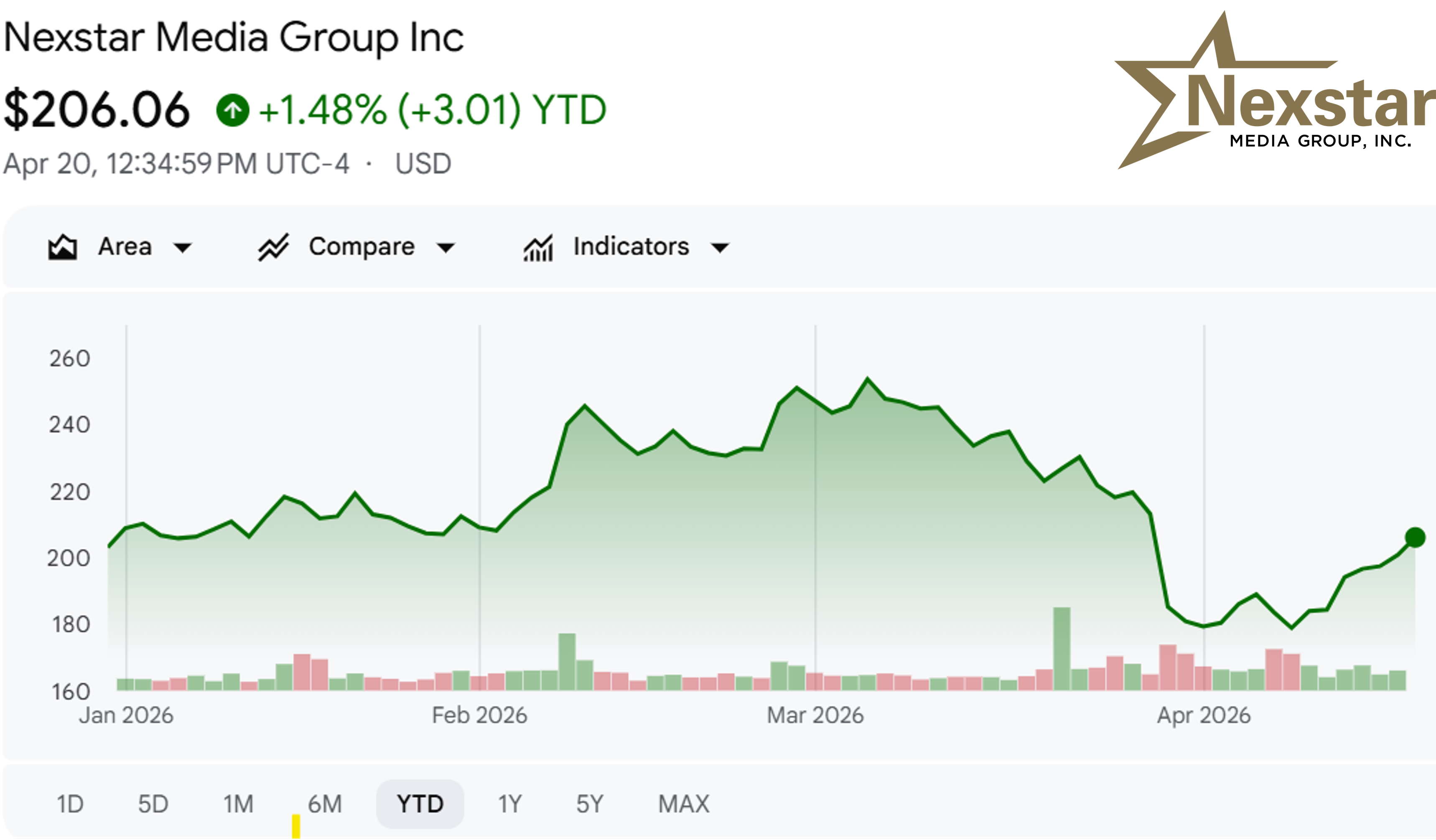
On Friday, April 17, 2026, the U.S. District Court for the Eastern District of California just slammed the brakes on the $6.2 billion Nexstar-TEGNA megadeal by granting a preliminary injunction. I wanted to give readers a fresh update first thing this Monday to help get you up to speed. In granting this injunction, the judge’s reasoning systematically exposes the structural flaws in the broadcast roll-up strategy. This ruling isn’t just a legal setback; it is a validation of the bear thesis that this industry is running out of runway. Nexstar stock is up today over +2% to about $206 per share. I think the fundamentals have not changed for the better.
Here are 5 key reasons why the antitrust risk in Nexstar is understated based on my read of the 52-page preliminary injunction…
Key Point 1: The court firmly rejected the broadcaster narrative that streaming services are a viable substitute for Big Four networks.
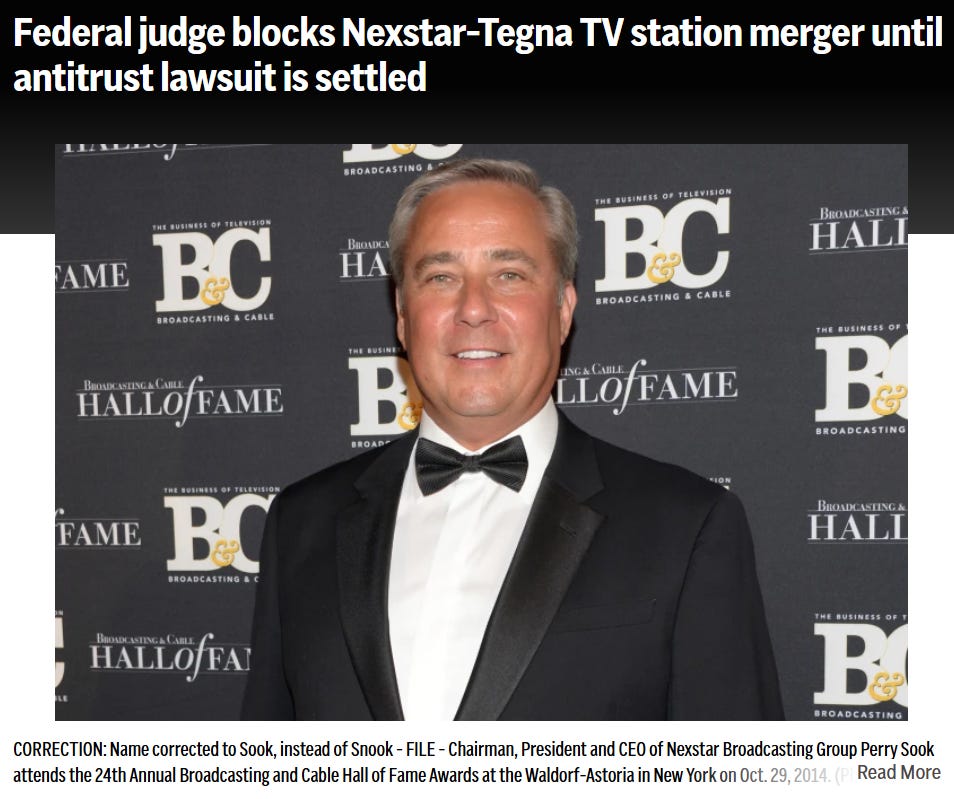
Broadcasters love to tell Wall Street their consolidation is justified because they are fiercely competing against digital streaming giants. However, the court saw right through this argument, defining the relevant product market strictly as Big Four broadcast retransmission licenses.
The court found that customers do not consider streaming services to be reasonable substitutes for Big Four broadcast stations.
Consumers must still get Big Four content primarily from multichannel video programming distributors (MVPDs) as part of their cable packages, explicitly noting that “customers cannot get Big Four station content from any streaming services”.
Even when an MVPD like DIRECTV has an arrangement with a streaming service like Peacock, they act “only as a sales agent of Peacock, which is not a reasonable substitute” and cannot integrate the content into their own service.
Live television content available from virtual MVPDs (like YouTube TV or Hulu+ Live TV) is “more limited, less consistent, and less localized than the content that is available through an MVPD subscriber’s unlimited access to all Big [Four] stations”.
This destroys the narrative that legacy broadcasters have a natural pivot to digital. By recognizing that streaming is not a true substitute for local broadcast, the court highlighted that Nexstar’s core linear business is isolated. They are managing a melting ice cube that lacks a digital parachute, leaving them completely dependent on a shrinking pool of traditional pay-TV subscribers.
Key Point 2: Creating new local duopolies drastically shifts blackout leverage to Nexstar, harming distributors and consumers.
Nexstar’s financial engineering relies heavily on using market concentration to force MVPDs into paying exorbitant retransmission fees. The court explicitly outlined how dangerous this leverage becomes when a single company controls multiple major networks in one city.
The acquisition would give Nexstar control of additional Big Four stations in 31 local markets where it already owns at least one Big Four affiliate, “including 27 new duopolies and 3 new triopolies”.
The court noted that owning multiple Big Four affiliates in a single local market makes Nexstar’s blackout threats significantly more coercive.
If Nexstar initiates a blackout in these overlapping markets, “any MVPD that refuses Nexstar’s demands will risk leaving its subscribers in that area without multiple sources of live sports and local news,” making them more likely to drop their current provider.
By making blackouts more painful for distributors like DIRECTV, the merger effectively makes it harder for them to resist Nexstar’s demands for higher retransmission prices.
Economically, the merger drastically increases market concentration. In the 31 overlap markets, the post-merger Herfindahl-Hirschman Index (HHI) would range from 3,361 to 7,422, far exceeding the threshold for a highly concentrated market which is anything above 2,500.
Nexstar’s entire M&A model is built on forcing retransmission hikes to cover massive debt loads. If antitrust regulators and federal courts prevent them from creating these artificial leverage points (duopolies and triopolies), their ability to drive top-line revenue stalls out. Without the threat of localized blackouts, Nexstar loses its pricing power.
Key Point 3: “Synergies” is just corporate speak for gutting local newsrooms and degrading product quality.
When broadcast executives promise investors hundreds of millions in “synergies,” they are really talking about slashing payroll and centralizing operations. The court found this directly harmed the quality of the product being sold to the public.
The court reviewed studies showing that achieving “economies of scale” in broadcast consolidation directly leads to “text reuse,” which is the duplication of the exact same news material across different broadcasts.
As fewer station groups control the local television ecosystem, this content duplication becomes easier, and “opportunities for local journalism decrease”.
Testimony from the NewsGuild-CWA president confirmed that consolidation does not create a better local news ecosystem, but rather “results in downsizing and fewer journalists doing the work of reporting the news”.
The court found “no reason to believe Nexstar will deviate from its historical pattern of newsroom consolidation” from two into one, thereby reducing the quality of local news programming.
Gutting the core product to service debt is a short-term financial trick, not a sustainable business strategy. Degraded, homogenized local news will inevitably push even more viewers toward digital alternatives. You cannot shrink your way to long-term growth.
Key Point 4: Regulatory clearance from the FCC does not grant broadcasters immunity from federal antitrust law.
A major pillar of Nexstar’s bull case has been their ability to lobby the FCC for favorable regulatory waivers. However, the federal court made it clear that administrative goodwill does not bypass the Clayton Act.
Defendants attempted to argue that the injunction would conflict with the FCC Order that cleared the transaction.
The court explicitly rejected this defense, stating that “the FCC was ‘not given the power to decide antitrust issues’”.
The judge noted that FCC action “’was not intended to prevent enforcement of the antitrust laws in federal courts’”.
The court concluded that “A court order to enforce antitrust laws, therefore, would not undermine congressional intent in regulation of the broadcast industry”.
This is a blow to the broadcast rollup playbook. It proves that political cover and FCC administrative maneuvering cannot shield a fundamentally anticompetitive rollup strategy from standard antitrust scrutiny. This severely caps Nexstar’s future M&A runway, regardless of who sits in the FCC Chairman’s seat.
Key Point 5: Allowing Nexstar and TEGNA to integrate before a full trial would cause immediate and irreversible damage.

Finally, the court recognized the structural mechanics of how broadcast integration works, ruling that the companies must remain totally separate while litigation plays out.
The court found that allowing further integration of Nexstar and TEGNA constitutes “immediate, irreparable harm”.
Defendants argued that “divestiture would still be a viable remedy after a trial” if the companies were allowed to integrate now.
The court disagreed, finding that “integration efforts are exactly those that would make it more difficult to divest TEGNA as a competitive entity and will result in newsroom layoffs and shutdowns”.
Because “the merger, or particular aspects of the merger, [cannot] be undone” once executed, the injury to the market is immediate, justifying the halt.
This traps Nexstar in operational purgatory. They face the financial burden, legal expenses, and massive distraction of a stalled multi-billion dollar transaction without being able to extract a single dollar of the “synergies” needed to justify it. When your underlying business is a melting ice cube, time is your absolute worst enemy.
CONCLUSION
Even if we assume the Nexstar and TEGNA deal ultimately closes, the broader reality of this industry remains unchanged: Nexstar’s core business is in secular decline. Rolling up declining TV stations is a highly leveraged game of musical chairs, and cord-cutting is quickly pulling chairs off the floor.
Because of these structural headwinds, I maintain my Underperform rating on Nexstar stock (NXST). If you are looking for guaranteed media bets that will actually generate organic growth over the next five years, you have to look outside the traditional cable bundle. Netflix and YouTube (through Google) are the only guaranteed media bets for growth as they continue to capture the viewership that legacy linear television is shedding.
NXST 0.00%↑, NFLX 0.00%↑, SBGI 0.00%↑, GOOGL 0.00%↑ GOOG 0.00%↑
-Accrued Interest
Disclaimer: The information presented in this Substack is for educational purposes and should not be construed as investment advice. Investors should make their own decisions regarding the prospects of any company discussed here, as I am not a registered investment advisor.
You can always reach me at simeon@accruedint.com.